Tag: stocks

  • Philippine Food & Beverage Giants Show Resilience Amid Market Headwinds

    Philippine Food & Beverage Giants Show Resilience Amid Market Headwinds

    Three of the country’s leading food and beverage companies — San Miguel Food and Beverage Inc. (SMFB)Universal Robina Corporation (URC), and RFM Corporation — posted stronger results for the first nine months of 2025, signaling resilience despite cost pressures and shifting consumer dynamics.


    SMFB Leads with Broad-Based Growth

    SMFB delivered a 4.1% increase in consolidated revenues to ₱302.9 billion, while net income surged 10.8% to ₱33.7 billion. Growth was supported by all major segments: Food, Beer & Non-Alcoholic Beverages, and Spirits. The company also strengthened its balance sheet, reducing total liabilities to ₱187.2 billion and maintaining a hefty cash position of ₱62.4 billion. Dividend payouts totaling ₱2.00 per share year-to-date underscore confidence in sustained performance.


    URC Maintains Stability Amid Margin Pressure

    URC posted ₱124.6 billion in revenues, up 4.8% year-on-year, and net income of ₱9.03 billion, a 4.6% improvement. While gross margins eased to 26.5% due to higher coffee input costs, URC’s diversified portfolio — spanning branded consumer foods, commodities, and agro-industrial products — cushioned the impact. Strong financial metrics, including a gearing ratio of 0.19x and interest coverage of 14.4x, highlight its capacity to weather volatility.


    RFM Delivers Quiet Strength

    RFM reported ₱15.23 billion in revenues, up 1.8%, and net income of ₱1.25 billion, marking a 12.3% jump from last year. Cost discipline and lower general and administrative expenses supported profitability. Liquidity improved with a current ratio of 1.36x, while total liabilities fell to ₱8.67 billion, reinforcing financial stability.


    Defensive Qualities in a Volatile Market

    Analysts view SMFB, URC, and RFM as defensive plays in the Philippine equity market. Their core businesses — food staples, beverages, and packaged goods — cater to essential consumer demand, which tends to remain stable even during economic slowdowns.

    • SMFB benefits from a diversified portfolio across food and alcoholic beverages, ensuring steady cash flows and dividend payouts.
    • URC’s strong presence in branded snacks and beverages, coupled with commodity operations, provides a natural hedge against input cost swings.
    • RFM, with its focus on pasta, milk, and ice cream, serves everyday consumption needs, making it less vulnerable to discretionary spending cuts.

    These companies combine consistent earningsrobust balance sheets, and high liquidity, positioning them as attractive options for investors seeking stability amid inflationary pressures and global uncertainty.
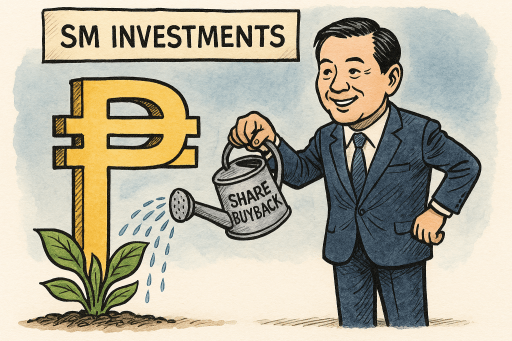
  • SM Investments Posts ₱88.8B Profit; Buyback Program Signals Confidence Amid Liquidity Pressures

    SM Investments Posts ₱88.8B Profit; Buyback Program Signals Confidence Amid Liquidity Pressures

    SM Investments Corporation (SMIC) reported consolidated revenues of ₱482.3 Billion for the nine months ended September 30, 2025, up 4.3% from last year, while net income after tax rose 5.6% to ₱88.8 Billion, according to its latest SEC filing. Net income attributable to the parent reached ₱64.4 Billion, driven by strong contributions from banking and property segments.

    Retail, which accounts for 66% of revenues, posted ₱318.1 Billion in sales and ₱12.2 Billion in net income. However, management flagged margin pressure from frequent flooding in Q3 and promotional activity in sports and athleisure categories. Merchandise inventories climbed to ₱47.9 Billion, raising concerns over potential markdowns if consumer demand softens.

    Property arm SM Prime delivered ₱103.4 Billion in revenues and ₱37.2 Billion in net income, supported by mall rental growth of nearly 7%. Still, residential sales slipped 2% amid slower revenue recognition, while capital expenditures surged to ₱59 Billion year-to-date, part of a ₱100 Billion full-year budget. Construction-in-progress now stands at ₱160.8 Billion, with ₱40.7 Billion in outstanding contractor commitments.

    Banking associates BDO and China Bank remain SMIC’s profit engine, contributing ₱39.1 Billion in equity earnings—around half of consolidated net income. Portfolio investments added ₱4.5 Billion, though Philippine Geothermal Production Company saw a 16% revenue drop due to lower steam prices pegged to WESM.

    Buyback Program: Boost for Valuation, Strain on Liquidity?

    In February, SMIC launched a ₱60 Billion share buyback program, repurchasing 3.7 Million shares at an average price of ₱764.08, totaling ₱2.8 Billion as of September. The move signals confidence and could support share price by reducing supply and lifting earnings per share, which rose to ₱52.73 year-to-date.

    Analysts note, however, that the buyback coincides with declining cash reserves—₱85.8 Billion, down 24% from year-end—and hefty near-term debt maturities of ₱126 Billion. “The program is positive for valuation, but balancing shareholder returns with liquidity and refinancing needs will be critical,” one market strategist said.

    Debt and Liquidity

    SMIC’s interest-bearing debt climbed to ₱511.4 Billion, while the current portion of long-term debt rose to ₱126 Billion. Despite this, leverage ratios remain stable, with a current ratio of 1.1x and interest cover at 8.6x.

    Outlook

    Management expects continued expansion in retail and property, with SM Prime targeting ₱100 Billion in capex for malls, residential projects, and integrated developments. However, risks loom from residential sales timing, banking sector dependency, and liquidity pressures amid aggressive capital allocation.