Tag: stock-market

  • Metro Retail Stores Group Posts Modest Gains Amid Margin Pressure and Cash Strain

    Metro Retail Stores Group Posts Modest Gains Amid Margin Pressure and Cash Strain


    Cebu City, Philippines — Metro Retail Stores Group Inc. (MRSGI) reported a slight improvement in profitability for the nine months ended September 30, 2025, as revenue growth was tempered by rising operating costs and a sharp drop in cash reserves.


    Sales and Revenue Performance

    Net sales climbed 4.1% year-on-year to ₱28.70 billion, driven by a 4.6% increase in food retail and 2.8% growth in general merchandise. Rental income surged 10.8% to ₱307.2 million, boosting total revenue to ₱29.0 billion, despite a 0.9% decline in same-store sales

    Margins and Expenses

    Gross margin held steady at 21.7%, but operating margin slipped to 1.63% from 1.81% last year as operating expenses jumped 8.7% to ₱6.06 billion. Higher utilities, personnel costs, and depreciation from new store openings weighed on profitability. Net income edged up 4.2% to ₱213.3 million, while finance costs rose slightly to ₱381.0 million.


    Liquidity and Cash Flow

    Cash reserves fell 69% to ₱711.5 million, reflecting heavy capital spending of ₱1.21 billion, dividend payouts, and debt servicing. Although operating cash flow improved to ₱962.6 million, free cash flow remained negative. The current ratio stood at 1.47x, with the quick ratio at 0.35x, signaling tight liquidity. 


    Operational Metrics

    Inventory levels increased by ₱713.8 million, pushing days-in-inventory to 81 days, while payables averaged 66 days. The cash conversion cycle was approximately 25 days, underscoring working capital pressure ahead of the holiday season. 


    Debt and Lease Obligations

    Outstanding loans totaled ₱2.31 billion, down from ₱2.66 billion at year-end, while lease liabilities remained significant at ₱5.25 billion, despite recent space reductions that generated a ₱119.9 million gain.


    Valuation and Dividend Yield

    Metro Retail Stores Group trades at ₱1.14 per share on the Philippine Stock Exchange, giving it a market capitalization of about ₱3.7 billion. The stock’s price-to-earnings ratio (P/E) stands at 5.7x, well below sector averages, suggesting the market is pricing in modest growth and operational risks. The price-to-book ratio is approximately 0.39x, reinforcing its undervalued status relative to its assets. 

    For income investors, MRSGI offers an annual cash dividend of ₱0.06 per share, translating to a dividend yield of roughly 5.2% at current prices. The payout ratio is about 31%, leaving room for reinvestment while maintaining shareholder returns. The last ex-dividend date was April 23, 2025, with payment made in May. 


    Outlook

    Management faces the dual challenge of sustaining growth while curbing cost inflation and preserving liquidity. Analysts point to the need for tighter inventory control, cost optimization, and selective expansion to protect margins and cash flow. 

    Subscribe to Support Independent Research

  • Ayala Land’s Share Price Finds Support From Recurring Income—But Financing Strain, Macro Risks Keep Valuation in Check

    Ayala Land’s Share Price Finds Support From Recurring Income—But Financing Strain, Macro Risks Keep Valuation in Check


    Makati City, Philippines (Nov. 23, 2025) — Ayala Land, Inc. (ALI) is navigating a delicate balance between strengthening recurring income and mounting financing pressures as investors reassess the stock’s valuation and dividend appeal heading into year‑end.

    Trading snapshot (latest PSE prints)

    ALI has traded in a tight band around ₱19–₱21 over the past week. Recent closes include ₱19.36 on Nov. 19₱20.05 on Nov. 20, and ₱21.00 on Nov. 21, reflecting choppy sentiment and heavier volumes around the company’s buyback executions. The 52‑week range now sits near ₱18.64–₱30.55, underscoring the stock’s de‑rating from 1H peaks as macro and sector headwinds intensified.

    On Nov. 20, ALI disclosed multiple buyback trades between ₱19.30 and ₱20.15 (3.0 million shares), a signal that management is willing to provide price support while executing its capital program. 

    Earnings and operating mix

    In its 9M 2025 filing, ALI posted ₱21.38B net income (+1% YoY) on ₱121.83B consolidated revenues (−3% YoY). A sturdier leasing & hospitality base (malls +4%, offices +6%, hotels +4%) and industrial real estate +39% helped offset softer services (construction −30%; property management & others −50%) and uneven property development.

     
    The company also acquired the 578‑room New World Makati Hotel on July 1, 2025, strengthening its hospitality footprint; and advanced property‑for‑share swaps with AREIT, including a ₱20.99B SEC‑approved infusion effective July 1 and a ₱19.5B mall infusion (Ayala Center Cebu, Ayala Malls Feliz) approved by the board on Oct. 29 pending final clearances—both intended to deepen recurring income and recycle capital. 

    Valuation: multiples tied to debt metrics

    While prime assets and estate strategy historically supported ALI’s premium, recent prints show the market applying mid‑single‑digit to low‑double‑digit P/E territory as financing costs rose and short‑term leverage increased. External trackers pegged ALI’s trailing valuation around ~9.4x–10.0x P/E in mid‑November, with P/B near ~0.9–1.0x, consistent with a cautious stance toward property names amid macro uncertainty. 

    The risk side of the ledger is visible in the interim numbers: interest & financing charges +11% YoY to ₱12.71B“other charges” +75% (larger discounts on receivable sales), short‑term debt +152% to ₱52.10B, and a lower interest coverage of 4.92× alongside a current ratio of 1.51×. Investors typically reflect these in higher discount rates for DCFs and in multiple compression, unless recurring income growth and asset recycling demonstrably outpace the financing drag.

    Dividend yield: supportive, but tied to cash discipline

    ALI declared ₱0.2888/share (1H) and ₱0.2928/share (2H) for 2025. At recent prices, the indicated annual payout of ~₱0.58/share translates to yields of roughly 2.7%–3.1% depending on the day’s close (e.g., ₱21.00 vs. ₱19.36), positioning ALI as a defensive yield play if share price softness persists. However, the market remains focused on free‑cash‑flow coverage amid higher interest expense and the timing of AREIT transactions; several trackers show the dividend yield near ~3%–4.5% in mid‑November, reflecting differing price points and methodologies. 

    Macro overlay: BSP easing vs. growth and FX risks

    The Bangko Sentral ng Pilipinas cut the policy rate to 4.75% on Oct. 9, and another 25‑bp “baby step” cut is possible at the Dec. 11 meeting—constructive for funding costs across property developers. Still, Q3 GDP slowed to ~4%, and caution remains around peso volatility if easing outpaces U.S. policy, an overhang for imported inputs, and investor confidence.

    What moves the stock from here

    • Upside case: Accelerated industrial/logistics roll‑outs, continued mall reinvention with high lease‑out rates (malls ~91%; offices ~90%), and AREIT monetizations that lift recurring income and lower net leverage—helping defend multiples and add support to the dividend. 
    • Watch‑items: Execution risk in reinvention works; receivable sale discounting impacting “other charges”; Core residential softness and foreign buyer pullback (Chinese sales down −81%) that can prolong the de‑rating unless premium NCR verticals maintain momentum; and the short‑term debt bulge that keeps the spotlight on interest coverage.

    Investor takeaway

    With the stock hovering around ₱19–₱21 and the 52‑week floor near ₱18.64, ALI’s valuation and yield are increasingly tied to tangible progress in scaling recurring income and managing the financing load. The buyback activity around ₱19–₱20 indicates management’s conviction, but consensus sentiment will likely hinge on debt metrics trending bettercash from AREIT asset rotations landing on time, and leasing metrics staying ahead of sector averages.

    Subscribe to Support Independent Research

  • Jollibee Foods Corporation: A Mature Giant Wearing a Growth Mask

    Jollibee Foods Corporation: A Mature Giant Wearing a Growth Mask

    From the Trading Desk. Shares the trading desk is selling, avoiding, and waiting to see if it corrects.

    Jollibee Foods Corporation (JFC) is the undisputed leader in Philippine quick-service dining. With over 3,400 stores locally and decades of dominance, JFC is a mature company by every textbook measure:

    • High market penetration in its home market
    • Stable cash flows from a loyal customer base
    • Ability to pay consistent dividends—a hallmark of maturity

    In fact, one defining trait of mature firms is a high dividend yield, reflecting limited reinvestment opportunities and a shift toward rewarding shareholders. Yet JFC’s current strategy tells a different story.


    The Growth Narrative

    Instead of leaning into its maturity, JFC is chasing a growth-company image through aggressive acquisitions and international expansion. Tim Ho Wan (premium dim sum), Compose Coffee (South Korea), CBTL, Highlands Coffee, Smashburger—the list is long and expensive. These deals inflate goodwill (₱78.7B as of Q3 2025) and create headlines, but they don’t guarantee earnings accretion.

    Tim Ho Wan, acquired for ₱10.7B in January 2025, posted a ₱86.9M net loss in its first nine months under JFC. Older acquisitions like CBTL and Smashburger were loss-making for years. Even with Compose Coffee’s success (₱1.59B net income in 9M 2025), the overall picture is clear: acquisition losses and financing costs are eating into the profits of JFC’s core Philippine business.


    The Cost of Pretending

    Despite a 14% revenue surge in 9M 2025, net income grew only 1.6%. Why? Debt-funded acquisitions and integration costs. JFC issued senior notes and ramped up short-term borrowings to finance these deals, adding interest expense that drags on earnings.

    This raises a critical question: Should JFC embrace its maturity instead of masking it? A pivot toward higher dividends—even a REIT-like yield—could unlock value for investors seeking income stability rather than speculative growth.


    A Dividend-Focused Strategy

    If JFC accepted its mature status, here’s what it could do:

    1. Reframe capital allocation
      • Pause high-risk acquisitions and focus on optimizing existing brands.
      • Use free cash flow to pay down debt and reduce interest drag.
    2. Target a REIT-like dividend yield
      • Aim for 4–6% annual yield, with a 60–70% payout ratio of normalized net income.
      • Commit to quarterly dividends for predictability.
      • At a hypothetical ₱200 share price, a ₱8–₱12 annual dividend would rival REITs.
    3. Build an income investor narrative
      • Position JFC as a stable cash generator, not a speculative growth stock.
      • Highlight recurring cash flows from franchising and royalties.
    4. Enhance shareholder returns
      • Consider special dividends from divesting underperforming brands.
      • Deploy share buybacks when valuation dips below intrinsic value.

    The Verdict

    JFC is not “pretending” in a deceptive sense—it genuinely wants global scale. But the reality is stark: its domestic engine is mature, and its growth bets are risky and uneven. Until acquisitions deliver consistent profits, JFC looks less like a growth stock and more like a cash-rich incumbent stretching for relevance.

    If the market recalibrates expectations, JFC’s share price could correct to reflect a high-yield, income-oriented profile, rewarding investors who value stability over uncertain expansion.

    Support Independent Research

  • STI Holdings Posts Strong Earnings Despite Enrollment Dip; Stock Seen as Undervalued

    STI Holdings Posts Strong Earnings Despite Enrollment Dip; Stock Seen as Undervalued

    STI Education Systems Holdings, Inc. (PSE: STI) delivered a robust financial performance for the quarter ended September 30, 2025, defying a slight decline in student headcount with a higher revenue mix and improved operating leverage.

    The listed education group reported ₱1.44 billion in revenues, up 39% year-on-year, driven by strong tuition collections and a shift toward higher-yield tertiary programs. Net income surged 135% to ₱619 million, while earnings per share doubled to ₱0.06 from ₱0.03 in the same period last year.

    Operating income soared to ₱657.5 million, driven by tight cost control and a 75% gross margin. EBITDA climbed to ₱878 million, translating to an EBITDA margin of 61%, underscoring the group’s efficiency gains.

    The upbeat results came despite a 4% drop in total enrollment to 132,941 students for School Year 2025–2026. Management attributed the decline to an earlier start of classes in public schools, which affected Senior High School intake. However, CHED-regulated programs grew to 77% of total enrollment, up from 73% last year. These programs generate significantly higher revenue per student compared to DepEd-regulated levels, helping offset the impact of fewer Senior High School enrollees.

    Liquidity remained strong with ₱3.2 billion in cash, while interest-bearing debt fell to ₱1.44 billion, improving the debt-to-equity ratio to 0.30x. STI also booked ₱955 million in operating cash flow, reinforcing its ability to fund ongoing campus expansion projects, including new academic centers in Meycauayan, Tanauan, and Alabang.

    Stock Price and Valuation

    STI shares closed at ₱1.42 on November 17, 2025, giving the company a market capitalization of about ₱14.06 billion. The stock has traded between ₱1.17 and ₱1.81 over the past 52 weeks and is up roughly 18–22% year-on-year, outperforming the broader PSE index. [edge.pse.com.ph][dragonfi.ph][bing.com]

    Valuation metrics suggest STI remains undervalued relative to peers:

    • Price-to-Earnings (P/E): ~6.1x vs peer average of ~9x (FEU: 9.4x, CEU: 9.7x, iPeople: 5.8x). [simplywall.st]
    • Price-to-Book (P/B): ~1.1x, below sector norms. [stockanalysis.com]
    • Fair Value Estimate: Independent models peg STI’s intrinsic value at ₱3.48, implying a ~59% upside from current levels. [simplywall.st]

    The company also offers a 3.1% dividend yield, supported by a policy to distribute at least 25% of prior year core income.

    Investor Takeaway

    With strong quarterly earnings, a favorable enrollment mix, and a healthy balance sheet, STI Holdings appears positioned for sustained profitability. At current levels, the stock trades at a discount to both its estimated fair value and sector multiples, making it an attractive option for investors seeking exposure to the Philippine education sector.

  • First Gen’s ₱50-Billion Gas Asset Sale Could Boost Dividends While Reshaping Balance Sheet and Debt Profile

    First Gen’s ₱50-Billion Gas Asset Sale Could Boost Dividends While Reshaping Balance Sheet and Debt Profile

    First Gen Corporation has completed the sale of a 60% stake in its natural gas business to Prime Infrastructure Capital Inc. for ₱50 billion, a landmark transaction that significantly strengthens the company’s financial position.

    Under the deal, Prime Infra acquired controlling interests in the Santa Rita, San Lorenzo, San Gabriel, and Avion power plants, the proposed Santa Maria project, and the Batangas LNG Terminal. First Gen retains a 40% stake, ensuring continued participation in the gas platform while unlocking substantial liquidity.

    Impact on Balance Sheet
    The ₱50-billion inflow will boost First Gen’s cash reserves, making the parent company effectively debt-free after having prepaid its ₱20-billion loans earlier this year. The transaction also positions First Gen with a strong net cash position, enhancing flexibility for future investments in renewable energy projects.

    Potential for Higher Shareholder Returns

    With a debt-free parent and substantial cash inflows, First Gen is in a position to return more capital to shareholders. This could come in the form of higher dividends or even special payouts, subject to board approval and regulatory requirements. The transaction provides financial headroom for the company to balance reinvestment in renewables with rewarding its investors.

    Debt Profile Transformation
    Before the sale, First Gen’s consolidated long-term debt stood at $2.106 billion, largely concentrated in subsidiaries such as EDC and the gas plants. With the deconsolidation of 60% of gas-related loans (about $159 million) and LNG lease liabilities, consolidated leverage will drop significantly.

    • Debt-to-equity ratio, previously at 0.86x, is expected to improve markedly.
    • Interest-bearing debt obligations will decline, reducing financing costs and strengthening solvency metrics.

    Strategic Outlook
    First Gen will continue to report earnings from the gas business under the equity method, while redeploying capital toward geothermal, hydro, wind, and solar projects. “This partnership strengthens energy security and accelerates our transition to clean energy,” said First Gen Chairman and CEO Federico R. Lopez.

    The deal underscores a strategic pivot: from heavy capital exposure in gas infrastructure to a more balanced portfolio focused on renewables, backed by a robust cash position and lower debt burden.

  • Philippine Food & Beverage Giants Show Resilience Amid Market Headwinds

    Philippine Food & Beverage Giants Show Resilience Amid Market Headwinds

    Three of the country’s leading food and beverage companies — San Miguel Food and Beverage Inc. (SMFB)Universal Robina Corporation (URC), and RFM Corporation — posted stronger results for the first nine months of 2025, signaling resilience despite cost pressures and shifting consumer dynamics.


    SMFB Leads with Broad-Based Growth

    SMFB delivered a 4.1% increase in consolidated revenues to ₱302.9 billion, while net income surged 10.8% to ₱33.7 billion. Growth was supported by all major segments: Food, Beer & Non-Alcoholic Beverages, and Spirits. The company also strengthened its balance sheet, reducing total liabilities to ₱187.2 billion and maintaining a hefty cash position of ₱62.4 billion. Dividend payouts totaling ₱2.00 per share year-to-date underscore confidence in sustained performance.


    URC Maintains Stability Amid Margin Pressure

    URC posted ₱124.6 billion in revenues, up 4.8% year-on-year, and net income of ₱9.03 billion, a 4.6% improvement. While gross margins eased to 26.5% due to higher coffee input costs, URC’s diversified portfolio — spanning branded consumer foods, commodities, and agro-industrial products — cushioned the impact. Strong financial metrics, including a gearing ratio of 0.19x and interest coverage of 14.4x, highlight its capacity to weather volatility.


    RFM Delivers Quiet Strength

    RFM reported ₱15.23 billion in revenues, up 1.8%, and net income of ₱1.25 billion, marking a 12.3% jump from last year. Cost discipline and lower general and administrative expenses supported profitability. Liquidity improved with a current ratio of 1.36x, while total liabilities fell to ₱8.67 billion, reinforcing financial stability.


    Defensive Qualities in a Volatile Market

    Analysts view SMFB, URC, and RFM as defensive plays in the Philippine equity market. Their core businesses — food staples, beverages, and packaged goods — cater to essential consumer demand, which tends to remain stable even during economic slowdowns.

    • SMFB benefits from a diversified portfolio across food and alcoholic beverages, ensuring steady cash flows and dividend payouts.
    • URC’s strong presence in branded snacks and beverages, coupled with commodity operations, provides a natural hedge against input cost swings.
    • RFM, with its focus on pasta, milk, and ice cream, serves everyday consumption needs, making it less vulnerable to discretionary spending cuts.

    These companies combine consistent earningsrobust balance sheets, and high liquidity, positioning them as attractive options for investors seeking stability amid inflationary pressures and global uncertainty.

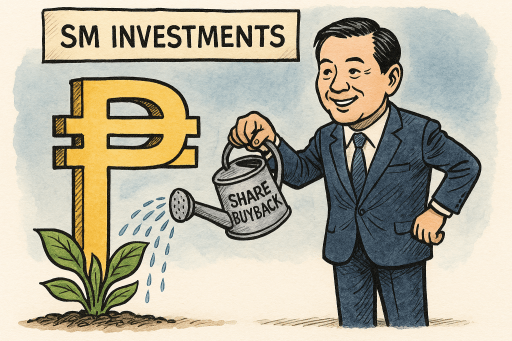
  • SM Investments Posts ₱88.8B Profit; Buyback Program Signals Confidence Amid Liquidity Pressures

    SM Investments Posts ₱88.8B Profit; Buyback Program Signals Confidence Amid Liquidity Pressures

    SM Investments Corporation (SMIC) reported consolidated revenues of ₱482.3 Billion for the nine months ended September 30, 2025, up 4.3% from last year, while net income after tax rose 5.6% to ₱88.8 Billion, according to its latest SEC filing. Net income attributable to the parent reached ₱64.4 Billion, driven by strong contributions from banking and property segments.

    Retail, which accounts for 66% of revenues, posted ₱318.1 Billion in sales and ₱12.2 Billion in net income. However, management flagged margin pressure from frequent flooding in Q3 and promotional activity in sports and athleisure categories. Merchandise inventories climbed to ₱47.9 Billion, raising concerns over potential markdowns if consumer demand softens.

    Property arm SM Prime delivered ₱103.4 Billion in revenues and ₱37.2 Billion in net income, supported by mall rental growth of nearly 7%. Still, residential sales slipped 2% amid slower revenue recognition, while capital expenditures surged to ₱59 Billion year-to-date, part of a ₱100 Billion full-year budget. Construction-in-progress now stands at ₱160.8 Billion, with ₱40.7 Billion in outstanding contractor commitments.

    Banking associates BDO and China Bank remain SMIC’s profit engine, contributing ₱39.1 Billion in equity earnings—around half of consolidated net income. Portfolio investments added ₱4.5 Billion, though Philippine Geothermal Production Company saw a 16% revenue drop due to lower steam prices pegged to WESM.

    Buyback Program: Boost for Valuation, Strain on Liquidity?

    In February, SMIC launched a ₱60 Billion share buyback program, repurchasing 3.7 Million shares at an average price of ₱764.08, totaling ₱2.8 Billion as of September. The move signals confidence and could support share price by reducing supply and lifting earnings per share, which rose to ₱52.73 year-to-date.

    Analysts note, however, that the buyback coincides with declining cash reserves—₱85.8 Billion, down 24% from year-end—and hefty near-term debt maturities of ₱126 Billion. “The program is positive for valuation, but balancing shareholder returns with liquidity and refinancing needs will be critical,” one market strategist said.

    Debt and Liquidity

    SMIC’s interest-bearing debt climbed to ₱511.4 Billion, while the current portion of long-term debt rose to ₱126 Billion. Despite this, leverage ratios remain stable, with a current ratio of 1.1x and interest cover at 8.6x.

    Outlook

    Management expects continued expansion in retail and property, with SM Prime targeting ₱100 Billion in capex for malls, residential projects, and integrated developments. However, risks loom from residential sales timing, banking sector dependency, and liquidity pressures amid aggressive capital allocation.