Tag: Real Estate

  • Financing Costs Take Center Stage at Villar’s Vista Land

    Financing Costs Take Center Stage at Villar’s Vista Land

    We’ve been blogging for free. If you enjoy our content, consider supporting us!

    Vista Land & Lifescapes (VLL) has always been a story of two engines: the cyclical churn of homebuilding and condo turnovers on one side, and the steadier cadence of rental income from commercial assets on the other. In the first nine months of 2025, both engines did their job—barely. Consolidated revenues rose a modest 2.2% to ₱28.399 billion, supported by real estate sales (+~3%) and rental income (+~3%).

    But the quarter’s real headline isn’t the topline. It’s the bill that arrives after the sales and rent checks clear: financing cost.

    A decent earnings print—until you look at the interest line

    VLL reported net income of ₱9.462 billion, up ~4.3% year-on-year (9M 2024: ₱9.076 billion), with EPS rising to ₱0.668 (from ₱0.627).

    On paper, that’s a clean, incremental improvement—especially in a market that’s still juggling buyer affordability, selective demand, and uneven project completion cycles. 

    Yet under the surface, the company’s progress is being increasingly “taxed” by the cost of money. Interest and other financing charges jumped ~17% to ₱5.925 billion (from ₱5.043 billion), with management attributing the increase primarily to lower capitalization of interest during the period—meaning more borrowing costs flowed directly to the income statement rather than being parked in asset costs.

    The financial soundness table tells the same story in a single ratio: EBITDA-to-total interest fell to 1.34x (from 1.89x a year earlier). That is not a crisis number, but it is a clear signal that interest burden is rising faster than operating cushion.

    Operating discipline helped—but it can’t fully outrun higher carry

    To VLL’s credit, the company did what businesses do when the interest meter runs fast: tighten the controllables. Operating expenses fell to ₱7.057 billion from ₱7.742 billion, supported by lower advertising and promotion, professional fees, and repairs and maintenance, per management’s discussion.

    Costs of real estate sales also edged down to ₱4.552 billion from ₱4.625 billion.

    This discipline is exactly why net income still grew. But it also highlights the key constraint: there is a limit to how far expense efficiency can go when financing costs are moving in the opposite direction. Eventually, the financing line starts dictating what kind of growth is “allowed”—how fast you can launch, how aggressively you can build investment properties, and how quickly you can recycle capital into new inventory.

    The balance sheet says “stable,” but leverage keeps the interest sensitivity high

    As of September 30, 2025, VLL’s total assets rose to ₱387.581 billion (from ₱377.939 billion at end-2024), while total liabilities stayed broadly flat at ₱242.599 billion (vs ₱241.852 billion). Equity improved to ₱144.982 billion (from ₱136.087 billion), reflecting the period’s earnings.

    Liquidity remained adequate but slightly softer: current ratio of 1.74x, down from 1.81x at end-2024.

    Meanwhile, VLL disclosed leverage measures such as debt-to-equity at ~1.10x and net debt-to-equity at ~0.84x as of period-end.

    The debt stack remains meaningful: notes payable at ₱104.240 billionbank loans at ₱54.653 billion, and loans payable at ₱11.442 billion, plus lease liabilities.

    VLL also described refinancing actions—most notably, loans payable fell ~41% as borrowings were refinanced into bank loans.

    This matters because when financing costs are the pressure point, debt mix changes—what’s fixed, what reprices, what can be prepaid—become as important as unit sales and mall occupancy.


    The Macro Catalyst: BSP rate cuts and the refinancing window

    BSP has already moved—rates are down, and the cycle may be near its end

    The Bangko Sentral ng Pilipinas (BSP) has delivered a meaningful easing cycle. In its December 11, 2025 decision, the BSP cut the policy (overnight RRP) rate by 25 bps to 4.50%, with the deposit and lending facility rates correspondingly adjusted. Reports also noted that the BSP has reduced rates by a cumulative ~200 bps since the easing cycle began (August 2024) and signaled that the easing cycle is “nearing its end” and future moves would be data-dependent. 

    Earlier in 2025, the BSP also cut rates to 5.25% in June (another 25 bps), reinforcing the broader downtrend in domestic benchmark rates. 

    How does this help VLL? It depends on what portion of debt can actually reprice

    A BSP rate cut is not a magic eraser for interest expense—especially for issuers with large chunks of fixed-rate bonds and notes. VLL itself discloses that much of its interest-bearing liabilities carry fixed rates, including notes payable with coupons across a wide band and peso bank loans with fixed rates in a mid-to-high single-digit range.

    Still, rate cuts matter in three practical ways:

    1. Cheaper refinancing of maturing peso obligations
      As policy rates fall, banks typically reprice new loans and rollovers lower (though not one-for-one). For a developer with ongoing maturities and refinancing activity, the real benefit arrives when old tranches are replaced with new ones at lower coupons. VLL’s own disclosures show continued funding activity and covenant monitoring, and it even noted a new ₱5 billion, three-year loan facility signed for refinancing purposes after the reporting period—suggesting refinancing remains an active playbook, not a theoretical one.
    2. Improved negotiating leverage with lenders
      In a lower-rate environment, issuers with scale and bank relationships can re-open conversations on pricing, tenor, and covenant headroom. VLL highlights compliance with key covenants (current ratio, leverage, DSCR-type measures) across its debt programs, which supports lender confidence and can translate into better refinancing terms.
    3. A slower growth penalty from interest carry
      The most immediate “earnings” impact is not always a dramatic reduction in interest expense; it can be a reduction in the incremental cost of funding new launches and capex. This matters for VLL because investment properties and project launches expanded during the period—investment properties rose to ₱145.524 billion and inventories to ₱61.692 billion—both of which typically have funding footprints. Lower benchmark rates can soften the future carrying-cost curve.

    The fine print: what BSP cuts won’t fix

    Two realities temper the optimism:

    • Fixed-rate debt doesn’t reprice unless it is refinanced early, called, or replaced at maturity—sometimes with redemption premiums and transaction costs. VLL’s disclosure includes multiple note and bond programs with specified terms and redemption features, implying refinancing benefits arrive unevenly across maturities.
    • USD debt costs are influenced more by global dollar rates and FX than by BSP alone. VLL has significant USD-denominated notes payable exposure and also holds USD investments, which means refinancing economics must consider both rate differentials and currency movements.

    Bottom line: VLL’s operating story is intact—its financing story is the swing factor

    VLL’s 9M 2025 results read like a company doing the right operational things: steadying revenues through rentals, managing costs, and keeping earnings modestly higher.

    But the same report makes it clear where the market should keep its flashlight trained: ₱5.925 billion of financing charges and an interest-coverage indicator that has weakened year-on-year.

    If the BSP’s easing cycle has indeed brought policy rates down to 4.50% and created a window for cheaper refinancing, VLL has a clear incentive to use it—especially with refinancing activity already evident and a new ₱5 billion facility signed for that purpose.

    In short: VLL can still sell homes and collect rents, but the next chapter may be written by the treasurer as much as by the sales team. In an environment where the BSP has cut rates and signaled the easing cycle may be nearing its end, execution on refinancing—timing, pricing, and maturity management—could be the difference between steady profits and squeezed returns.

    We’ve been blogging for free. If you enjoy our content, consider supporting us!

  • Rent Is the Engine, Refinancing Is the Weather: Reading SM Prime’s 9M 2025

    Rent Is the Engine, Refinancing Is the Weather: Reading SM Prime’s 9M 2025

    In a year when higher funding costs and mixed consumer signals have turned developers cautious, SM Prime Holdings (SMPH) just delivered a set of numbers that feel both familiar and instructive: steady rent‑led growthsoftness in residential, and a heavier–but manageable—refinancing calendar.

    On the headline figures, consolidated revenues rose 4% to ₱103.40B for the first nine months of 2025, carried by rent (up 7% to ₱60.99B), while real estate sales eased 2% to ₱31.20B. Costs and expenses fell 1%, pushing operating income up 9% to ₱51.90B and net income (attributable) up 10% to ₱37.24BEPS clocked in at ₱1.291, with a cash dividend of ₱0.480 already paid in May.

    The Core Story: Malls Still Do the Heavy Lifting

    SMPH’s malls continue to anchor earnings strength. In the nine months, Malls posted ₱60.92B in revenue and ₱31.51B in pre‑tax profit; Residential contributed ₱32.58B and ₱10.41B, respectively; Hotels & Conventions added ₱6.01B and ₱1.01BCommercial & Integrated Developments generated ₱3.89B and ₱3.01B. Operating leverage is visible: the company squeezed more profit out of largely flat third‑quarter revenues thanks to disciplined costs.

    This operating resilience rests on footprint and execution. SMPH opened SM City Laoag in May and SM City La Union in October, bringing the Philippine mall count to 89 (plus 8 in China). The pipeline of redevelopments also supports rent and occupancy, while hotels, offices, and conventions continue to offer steady—if smaller—contributions.

    Where the Fuel Mix Shows Some Octane Lag

    The Residential engine sputtered a bit: real estate sales slipped 2% year‑on‑year and segment profit ticked lower. Receivables and contract assets rose (₱107.25B), with unbilled revenue tied to construction milestones also higher—fine if build schedules and collections remain tight, more delicate if they don’t. Meanwhile, non‑cash OCI headwinds—FVOCI losses in the equity book and a weaker cash‑flow hedge reserve—trimmed total comprehensive income to ₱35.67B (from ₱37.21B), even as net income advanced.

    These are not structural breaks; they are friction points that investors should watch: project take‑up and construction cadencepricing power, and the sensitivity of SMPH’s OCI to market marks.

    Balance Sheet: Bigger Tank, Higher Octane Price

    On the funding side, interest‑bearing debt climbed to ₱419.82B (+8% YTD), while current maturities rose to ₱112.08B. SMPH notes these are “due for refinancing,” a normal course for a developer of this scale. Coverage remains sound: interest coverage at 7.06×debt/EBITDA at 4.84×, and net debt‑to‑equity at 46:54. Liquidity is adequate, with a current ratio of 2.28× and acid‑test 1.29× (excluding items flagged for refinancing).

    Hedging helps: after swaps, roughly 57% of long‑term borrowings are effectively fixed‑rate. Still, derivative assets came down with maturities and fair‑value changes—less cushion than last year, but consistent with a company rolling hedges as the book evolves.

    The Bottomline

    SMPH’s playbook still works: rent growth and operating discipline carry the income statement; capex and landbanking expand the footprint; hedges and market access keep the funding bridge sturdy. The residential wobble and OCI marks are the ballast on comprehensive profits, not the anchor. The refinancing calendar is heavier, but coverage and liquidity suggest it’s navigable—especially for a name that just placed ₱25B in retail bonds and continues to roll projects and tenants into an already dominant network.

    As with any property stock in a higher‑for‑longer world, the cost of money is the weather: if it worsens abruptly, sentiment and valuation can swing faster than the EPS math. But in the base case, SMPH’s rent engine remains powerful enough to keep the vehicle moving—just perhaps with a touch more fuel discipline and a keener eye on the road ahead.

    We’ve been blogging for free. If you enjoy our content, consider supporting us!

  • FLI’s Two‑Track Story: Gains on the Ground, Rates in the Rear‑View

    FLI’s Two‑Track Story: Gains on the Ground, Rates in the Rear‑View

    Filinvest Land, Inc. (FLI) has quietly stitched together a steady nine‑month performance that looks better beneath the surface than its modest headline growth might suggest. Yet the same report, which shows improving revenue, cash generation, and liquidity, also flags the familiar headwinds of higher financing costs and execution risk that could trip up momentum if conditions turn. Here’s the balanced read investors should care about—what’s getting better, and what could potentially derail the story. 

    What’s getting better

    1) Dual‑engine revenue: development + leasing both up.
    FLI’s consolidated revenue rose 7.9% to ₱18.99 billion for the nine months ended September 30, 2025, with real estate sales up 8.2% to ₱12.86 billion and rental & related services up 7.3% to ₱6.13 billion. The sales mix remains anchored in medium‑income housing (71%), while affordable/low segments (17%) widened their share—useful ballast when the market tilts toward value. Leasing gains came from higher occupancy and contractual escalations; even the co‑living pilot (The Crib Clark) added incremental pesos.

    2) Earnings drift higher with resilient margins.
    Net income improved 5.0% to ₱3.64 billionEPS ticked up to ₱0.14 (from ₱0.13). Under the hood, computed gross margins held sturdy—about 52% in real estate and 51% in leasing—despite cost inflation and a heavier depreciation footprint from asset additions. That margin resilience is the critical “quality” signal in a build‑and‑lease model.

    3) Operating cash flow and cash reserves strengthened.
    Operating cash flow climbed 5.1% to ₱7.09 billion, while cash & equivalents nearly doubled (+89.6%) to ₱7.55 billion. A lighter investing outflow—thanks to tempered net capex and larger dividends received from associates—helped the cash balance. In a rate‑heavy world, more cash on hand means more options.

    4) Liquidity ratios improve—more near‑term cushion.
    The current ratio rose to 3.07× (from 2.78× at year‑end 2024) and the quick ratio to 0.81× (from 0.71×). When maturities cluster, and contractors queue up for payments, these buffers matter—a lot.

    5) Collections and working capital discipline show up in the numbers.
    Other receivables fell by 7.3%, reflecting better tenant collections and liquidation of advances; expected credit losses remain modest. Contract assets declined 9.7%, which management ties to a higher percentage completion across projects—an indicator that work‑in‑progress is converting toward billable/saleable stages.

    6) Associates contribute more—and in cash.
    Equity in net earnings of associates jumped 48% to ₱371.7 million, and dividends received rose to ₱289.4 million (from ₱106.0 million)—a welcome auxiliary stream that diversifies cash sources beyond unit transfers and rental billings.

    7) Recurring platform scaled via the REIT.
    The Festival Mall – Main Mall property‑for‑share swap lifted FLI’s stake in Filinvest REIT Corp. (FILRT) to roughly 63%. The transaction (SEC valuation approved on May 27, 2025) underscores FLI’s capital‑recycling playbook: seed the REIT with stabilized assets, free up growth capital, and lean into recurring income through the platform.

    8) Pipeline depth: investment properties up; new retail underway.
    Investment properties (NBV) rose to ₱87.02 billion; fair value indications stand near ₱215.34 billion (Level‑3 appraisal). Retail projects in Cubao and Mimosa are under construction—future anchors that can compound footfall and lease yields if delivered on time and on budget.

    9) Shareholder cash is still visible.
    ₱0.05 common dividend (paid in May 2025) equated to a ~6.1% trailing yield on the ₱0.82 closing price as of September 30, 2025; the company’s reported P/E sat at 4.34×—low enough to make the carry look compelling, provided coverage metrics stay healthy.

    What could derail the story?

    1) Financing costs: the gravity that never sleeps.
    Interest & finance charges rose 18.8% to ₱3.14 billion. Coverage ratios edged down (EBITDA/interest 1.91×; EBIT/interest 2.38×). With ₱6.72 billion in bonds and ₱11.23 billion in loans maturing within 12 months (total ~₱17.95 billion), repricing risk is non‑trivial: tighter liquidity or wider spreads could bite into earnings and dividend headroom. FLI’s debt‑to‑equity ≈ 0.88× is comfortably within covenants (max 2.0–2.5×), but the direction of travel matters as much as the level. 

    2) Sales velocity and inventory turns.
    Real estate inventories rose to ₱73.33 billion (+4.8%). If buyer affordability weakens or cancellations tick up, inventory clears slower, cash conversion stalls, and carrying costs pile on. Receivable ageing shows meaningful “past‑due but not impaired” buckets—collections need to stay tight to keep momentum real, not just reported. 

    3) Leasing margin compression risk.
    Leasing revenue grew, but cost of rental services grew faster (+10.2%), propelled by depreciation on new builds and operating costs. If occupancy dips or escalations soften while opex keeps climbing, today’s ~51% gross margin in leasing can erode quickly. The retail pipeline is promising, but pre‑leasing discipline and tenant mix will determine how accretive those projects really are. 

    4) Execution complexity across a wide map.
    From Filinvest City to Cebu SRPClark Mimosa, and New Clark City, FLI manages multi‑site construction and leasing with varied regulatory pathways and counterparties (including BTO and long‑term leases). Delays, cost overruns, or contractor bottlenecks can ripple through the P&L and push out cash timelines. 

    5) Macro & policy overhangs.
    Higher rates, build‑cost inflation, or shifts in housing policy (including socialized housing thresholds) would amplify the pressures above. As a REIT sponsor, FLI also carries ongoing reinvestment and reporting obligations—non‑compliance isn’t the base case, but it’s a governance tripwire worth monitoring. 


    The bottom line

    FLI’s 2025 nine‑month tape shows a business doing the right things: growing both development and leasing, protecting margins, and strengthening liquidity—while smartly using the REIT to recycle capital. But the rate cycle is the villain in this play: financing costs are up, coverage ratios are thinner, and near‑term maturities mean execution and treasury strategy must stay sharp. If sell‑through holds and leasing stays firm, the math still works; if either wobbles while rates stay stubborn, the dividend and expansion pace could be tested. 


    What to watch next quarter

    • Coverage ratios: Aim for EBITDA/interest >2.0×; a sustained slip below that line raises caution.
    • OCF vs. cash commitments: Keep operating cash flow ≥ (capex + dividends) to avoid creeping dependence on debt.
    • Sell‑through & cancellations: Affordable/MRB projects should keep cycle times short; any elongation is a red flag.
    • Pre‑leasing & occupancy: Verify that new retail/office assets land anchor tenants early—and at rents that defend margins.
    • Covenant headroom: D/E, current ratio, DSCR—trend matters as much as absolute levels. 

    Subscribe to Support Free Independent Research

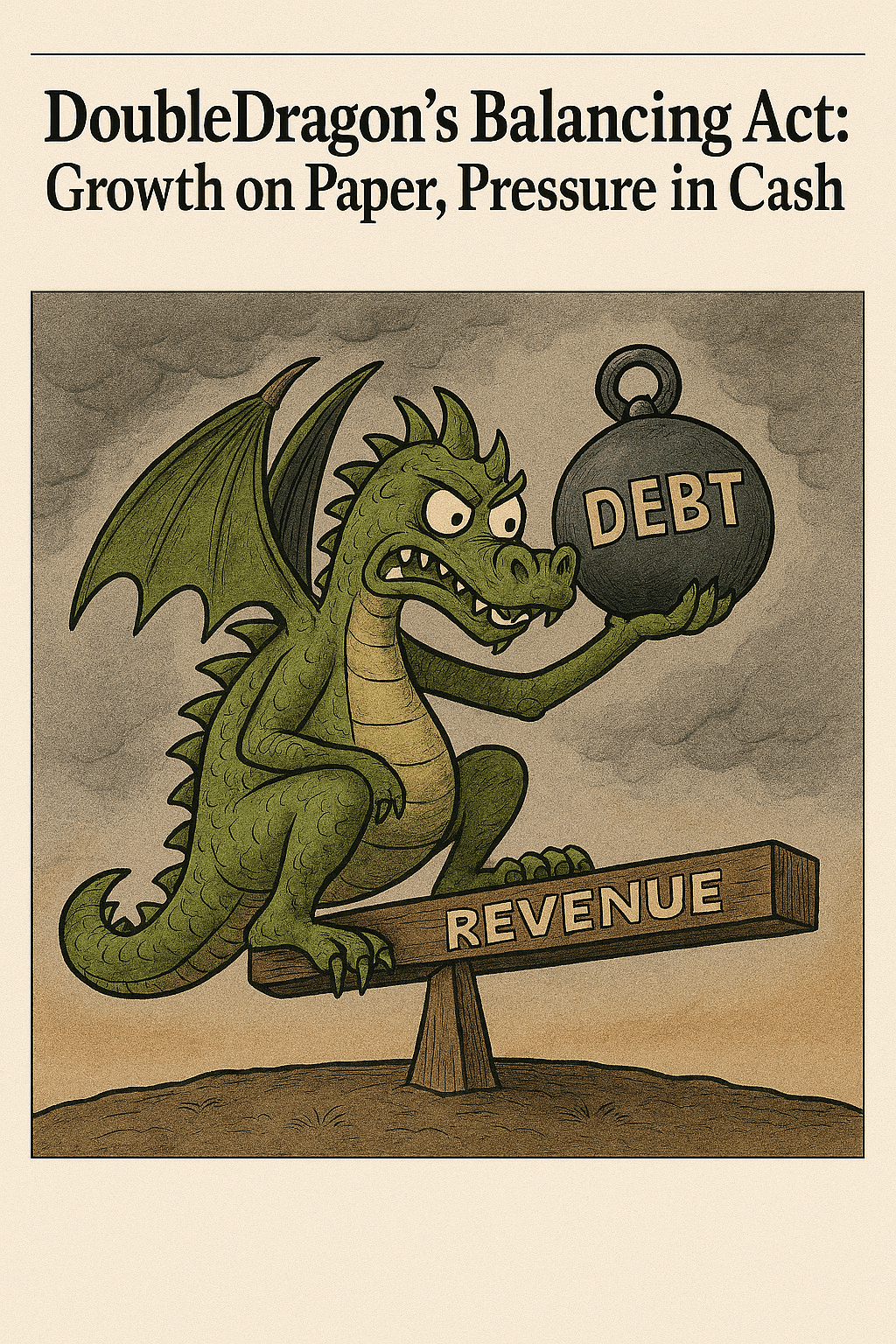
  • DoubleDragon’s Balancing Act: Growth on Paper, Pressure in Cash

    DoubleDragon’s Balancing Act: Growth on Paper, Pressure in Cash

    DoubleDragon Corporation’s latest quarterly filing paints a picture of ambition—and exposure. On the surface, the numbers sparkle: revenues surged 63% year-on-year to ₱10.5 billion for the first nine months of 2025, powered by real estate sales and steady rental streams. Net income held at ₱2.55 billion, barely up from last year, but enough to keep the optics positive.

    Scratch deeper, and the sheen dulls. Nearly 42% of that revenue came from unrealized fair value gains and tenant penalties—items that look good in a report but don’t pay the bills. Strip those out, and the core engine—rent and hotel operations—struggles to cover a ballooning interest tab. Financing costs doubled to ₱2.39 billion, and in the third quarter alone, they wiped out profits for common shareholders, leaving the parent with a ₱47.7 million loss.

    The balance sheet tells its own story: net debt hovers near ₱86 billion, cushioned by equity of ₱101 billion. Bonds issued this year lock in rates north of 7%, some as high as 9.5%, ensuring that interest pressure won’t ease soon. Operating cash flow? Deep in the red at negative ₱7.93 billion, offset only by ₱9 billion in fresh financing. Liquidity ratios look healthy on paper, but the reliance on debt markets is a vulnerability in any tightening cycle.

    Receivables ballooned to ₱21.8 billion, with impairment provisions climbing. Penalty income—₱2.5 billion so far—suggests tenants are paying late. Good for accounting, bad for cash. Add to that the execution risk of Hotel101’s global rollout and the long-promised industrial REIT, and you have a company juggling growth narratives with hard realities.

    To be fair, DoubleDragon is asset-rich and opportunistic. Investment properties rose to ₱169.6 billion, and its REIT arm continues to spin off dividends. But the question for investors is simple: can recurring cash flows catch up with the financing load before the next refinancing cycle? If leasing momentum and hotel pre-sales deliver, the story holds. If not, the cracks widen.

    For now, DoubleDragon remains a case study in modern property playbooks—leveraged growth, valuation-driven earnings, and a race against time to turn paper gains into hard cash. Watch the interest coverage ratio, operating cash flow, and receivables aging. In this game, liquidity isn’t just a metric—it’s survival. 

    Subscribe to Support Free & Independent Research

  • Cebu Landmasters Powers Ahead: Strong Q3 Results Signal Sustained Growth

    Cebu Landmasters Powers Ahead: Strong Q3 Results Signal Sustained Growth


    Cebu City, Philippines – Cebu Landmasters, Inc. (CLI), the VisMin real estate leader, delivered another quarter of resilient growth, reinforcing its position as one of the country’s fastest-expanding developers. For the nine months ended September 30, 2025, CLI posted ₱14.34 billion in consolidated revenues, up 13% on a comparable basis, and a net income of ₱3.10 billion, marking a 6% year-on-year increase despite a challenging macro environment.

    The company’s recurring income streams surged, with hospitality revenues doubling (+101%) and leasing income climbing 49%, underscoring CLI’s successful diversification beyond residential projects. Its hotel portfolio now spans four operational properties, including the newly opened Citadines Bacolod City, with two more hotels set to launch before year-end and six under construction—solidifying CLI’s future REIT ambitions.

    Residential demand remains robust, with reservation sales soaring 27% to ₱19.33 billion and an impressive 93% sell-out rate across its portfolio. The mid-market Garden Series led growth with a 31% revenue jump, while the economic Casa Mira Series continued to dominate VisMin’s affordable housing segment.

    CLI’s balance sheet remains strong, with total assets up 18% to ₱128.72 billion and a current ratio of 1.51x, comfortably meeting all debt covenants. Strategic funding moves—including a ₱5 billion sustainability-linked bond issuance and ₱1.59 billion redeemable preferred shares—position the company to accelerate expansion while maintaining financial flexibility.

    Investor confidence is high, buoyed by CLI’s consistent dividend payouts (₱0.18 per share in April) and a share price of ₱2.32, translating to an attractive ~7.8% yield. With recurring income scaling rapidly, a strong pipeline of projects, and VisMin market leadership reaffirmed by Colliers, CLI is poised for sustained growth and value creation.

    Bottom line: CLI’s Q3 performance signals a compelling growth story—anchored on robust residential demand, rising recurring income, and disciplined financial management. For investors seeking exposure to VisMin’s booming property market, CLI remains a standout pick.

    Subscribe to Support Independent Research