Tag: personal-finance

  • Financing Costs Take Center Stage at Villar’s Vista Land

    Financing Costs Take Center Stage at Villar’s Vista Land

    We’ve been blogging for free. If you enjoy our content, consider supporting us!

    Vista Land & Lifescapes (VLL) has always been a story of two engines: the cyclical churn of homebuilding and condo turnovers on one side, and the steadier cadence of rental income from commercial assets on the other. In the first nine months of 2025, both engines did their job—barely. Consolidated revenues rose a modest 2.2% to ₱28.399 billion, supported by real estate sales (+~3%) and rental income (+~3%).

    But the quarter’s real headline isn’t the topline. It’s the bill that arrives after the sales and rent checks clear: financing cost.

    A decent earnings print—until you look at the interest line

    VLL reported net income of ₱9.462 billion, up ~4.3% year-on-year (9M 2024: ₱9.076 billion), with EPS rising to ₱0.668 (from ₱0.627).

    On paper, that’s a clean, incremental improvement—especially in a market that’s still juggling buyer affordability, selective demand, and uneven project completion cycles. 

    Yet under the surface, the company’s progress is being increasingly “taxed” by the cost of money. Interest and other financing charges jumped ~17% to ₱5.925 billion (from ₱5.043 billion), with management attributing the increase primarily to lower capitalization of interest during the period—meaning more borrowing costs flowed directly to the income statement rather than being parked in asset costs.

    The financial soundness table tells the same story in a single ratio: EBITDA-to-total interest fell to 1.34x (from 1.89x a year earlier). That is not a crisis number, but it is a clear signal that interest burden is rising faster than operating cushion.

    Operating discipline helped—but it can’t fully outrun higher carry

    To VLL’s credit, the company did what businesses do when the interest meter runs fast: tighten the controllables. Operating expenses fell to ₱7.057 billion from ₱7.742 billion, supported by lower advertising and promotion, professional fees, and repairs and maintenance, per management’s discussion.

    Costs of real estate sales also edged down to ₱4.552 billion from ₱4.625 billion.

    This discipline is exactly why net income still grew. But it also highlights the key constraint: there is a limit to how far expense efficiency can go when financing costs are moving in the opposite direction. Eventually, the financing line starts dictating what kind of growth is “allowed”—how fast you can launch, how aggressively you can build investment properties, and how quickly you can recycle capital into new inventory.

    The balance sheet says “stable,” but leverage keeps the interest sensitivity high

    As of September 30, 2025, VLL’s total assets rose to ₱387.581 billion (from ₱377.939 billion at end-2024), while total liabilities stayed broadly flat at ₱242.599 billion (vs ₱241.852 billion). Equity improved to ₱144.982 billion (from ₱136.087 billion), reflecting the period’s earnings.

    Liquidity remained adequate but slightly softer: current ratio of 1.74x, down from 1.81x at end-2024.

    Meanwhile, VLL disclosed leverage measures such as debt-to-equity at ~1.10x and net debt-to-equity at ~0.84x as of period-end.

    The debt stack remains meaningful: notes payable at ₱104.240 billionbank loans at ₱54.653 billion, and loans payable at ₱11.442 billion, plus lease liabilities.

    VLL also described refinancing actions—most notably, loans payable fell ~41% as borrowings were refinanced into bank loans.

    This matters because when financing costs are the pressure point, debt mix changes—what’s fixed, what reprices, what can be prepaid—become as important as unit sales and mall occupancy.


    The Macro Catalyst: BSP rate cuts and the refinancing window

    BSP has already moved—rates are down, and the cycle may be near its end

    The Bangko Sentral ng Pilipinas (BSP) has delivered a meaningful easing cycle. In its December 11, 2025 decision, the BSP cut the policy (overnight RRP) rate by 25 bps to 4.50%, with the deposit and lending facility rates correspondingly adjusted. Reports also noted that the BSP has reduced rates by a cumulative ~200 bps since the easing cycle began (August 2024) and signaled that the easing cycle is “nearing its end” and future moves would be data-dependent. 

    Earlier in 2025, the BSP also cut rates to 5.25% in June (another 25 bps), reinforcing the broader downtrend in domestic benchmark rates. 

    How does this help VLL? It depends on what portion of debt can actually reprice

    A BSP rate cut is not a magic eraser for interest expense—especially for issuers with large chunks of fixed-rate bonds and notes. VLL itself discloses that much of its interest-bearing liabilities carry fixed rates, including notes payable with coupons across a wide band and peso bank loans with fixed rates in a mid-to-high single-digit range.

    Still, rate cuts matter in three practical ways:

    1. Cheaper refinancing of maturing peso obligations
      As policy rates fall, banks typically reprice new loans and rollovers lower (though not one-for-one). For a developer with ongoing maturities and refinancing activity, the real benefit arrives when old tranches are replaced with new ones at lower coupons. VLL’s own disclosures show continued funding activity and covenant monitoring, and it even noted a new ₱5 billion, three-year loan facility signed for refinancing purposes after the reporting period—suggesting refinancing remains an active playbook, not a theoretical one.
    2. Improved negotiating leverage with lenders
      In a lower-rate environment, issuers with scale and bank relationships can re-open conversations on pricing, tenor, and covenant headroom. VLL highlights compliance with key covenants (current ratio, leverage, DSCR-type measures) across its debt programs, which supports lender confidence and can translate into better refinancing terms.
    3. A slower growth penalty from interest carry
      The most immediate “earnings” impact is not always a dramatic reduction in interest expense; it can be a reduction in the incremental cost of funding new launches and capex. This matters for VLL because investment properties and project launches expanded during the period—investment properties rose to ₱145.524 billion and inventories to ₱61.692 billion—both of which typically have funding footprints. Lower benchmark rates can soften the future carrying-cost curve.

    The fine print: what BSP cuts won’t fix

    Two realities temper the optimism:

    • Fixed-rate debt doesn’t reprice unless it is refinanced early, called, or replaced at maturity—sometimes with redemption premiums and transaction costs. VLL’s disclosure includes multiple note and bond programs with specified terms and redemption features, implying refinancing benefits arrive unevenly across maturities.
    • USD debt costs are influenced more by global dollar rates and FX than by BSP alone. VLL has significant USD-denominated notes payable exposure and also holds USD investments, which means refinancing economics must consider both rate differentials and currency movements.

    Bottom line: VLL’s operating story is intact—its financing story is the swing factor

    VLL’s 9M 2025 results read like a company doing the right operational things: steadying revenues through rentals, managing costs, and keeping earnings modestly higher.

    But the same report makes it clear where the market should keep its flashlight trained: ₱5.925 billion of financing charges and an interest-coverage indicator that has weakened year-on-year.

    If the BSP’s easing cycle has indeed brought policy rates down to 4.50% and created a window for cheaper refinancing, VLL has a clear incentive to use it—especially with refinancing activity already evident and a new ₱5 billion facility signed for that purpose.

    In short: VLL can still sell homes and collect rents, but the next chapter may be written by the treasurer as much as by the sales team. In an environment where the BSP has cut rates and signaled the easing cycle may be nearing its end, execution on refinancing—timing, pricing, and maturity management—could be the difference between steady profits and squeezed returns.

    We’ve been blogging for free. If you enjoy our content, consider supporting us!
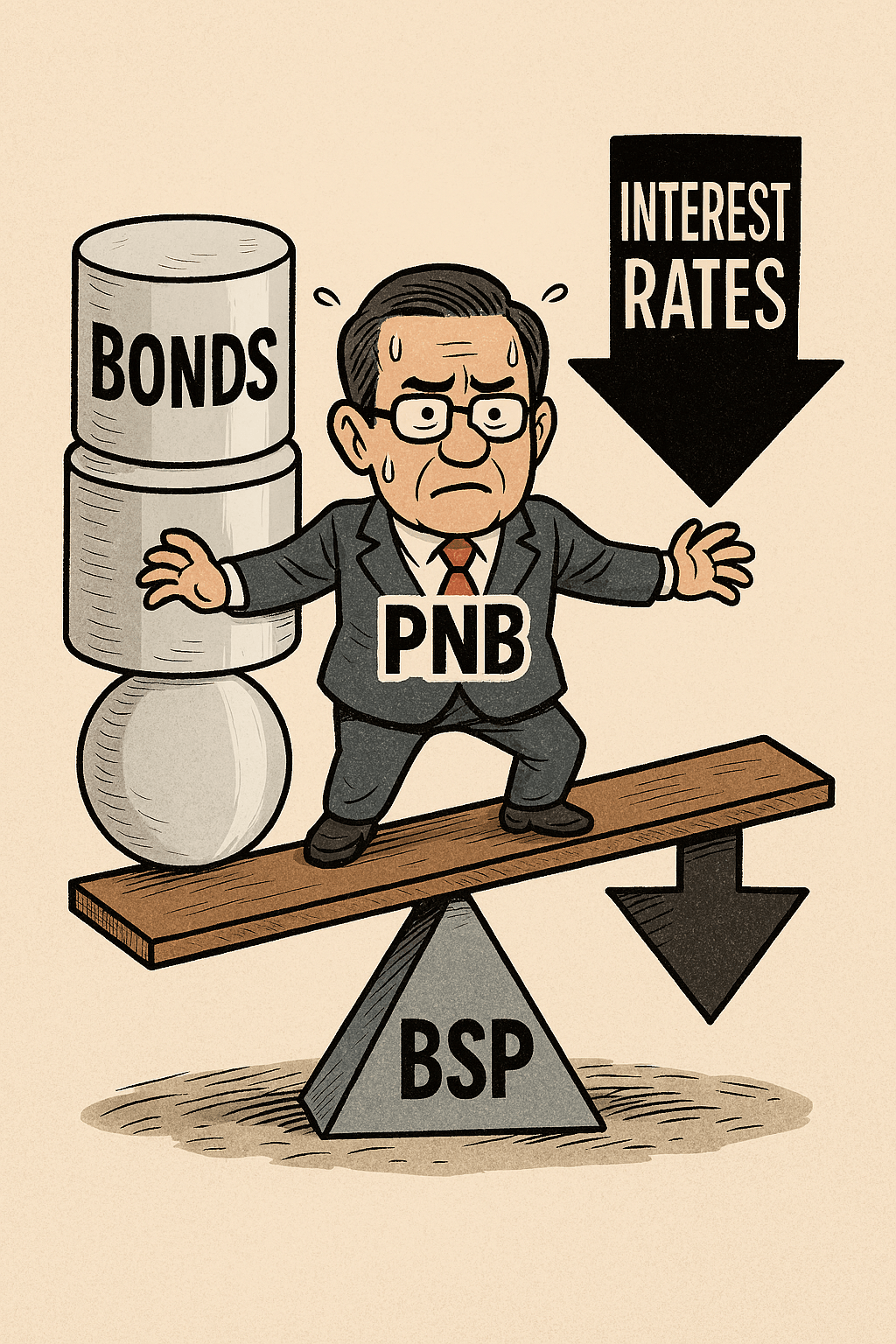
  • PNB’s Bond Move Meets a BSP Rate Cut—The New Squeeze — When Rate Cuts Meet Fixed-Rate Bank Bonds

    PNB’s Bond Move Meets a BSP Rate Cut—The New Squeeze — When Rate Cuts Meet Fixed-Rate Bank Bonds

    We’ve been blogging for free. If you enjoy our content, consider supporting us!

    Philippine National Bank’s return to the peso bond market would normally be filed under “good news”: strong demand, a sizeable PHP 15.7 billion raise, and a clear promise to funnel proceeds into eligible projects under its Sustainable Financing Framework. But markets don’t grade banks on deal headlines—they grade them on spread, the narrow space between what a bank earns on assets and what it pays for money. And that spread is now facing a two-sided pincer: a fresh BSP rate cut that can pull loan yields down, and new fixed-rate bond funding that doesn’t reprice lower

    A bond deal priced for yesterday’s rate environment

    PNB’s issuance came in two tranches: Series A (3-year) at 5.4877% and Series B (5-year) at 5.7764%, for a combined PHP 15.7 billion. Those are clean, tradable coupons investors like because they are predictable. For the bank, however, predictability cuts both ways: these rates are locked in, creating a relatively firm “floor” for a portion of PNB’s funding costs over the next three to five years.

    That matters because PNB’s earnings machine is still overwhelmingly powered by net interest income. In its latest quarterly filing covering the period ended September 30, 2025, PNB reported net interest income of PHP 39.3 billion and a net interest margin (NIM) of 4.7% for the first nine months of the year. When a bank introduces more wholesale, fixed-rate funding into the mix, it increases the chance that overall funding costs drift upward—unless the proceeds are deployed into assets that earn meaningfully more than that fixed coupon. 

    Then came the BSP’s easing move—lower policy rates, lower pricing gravity

    On December 11, 2025, the Bangko Sentral ng Pilipinas cut the target reverse repurchase (RRP) rate by 25 bps to 4.50%, citing benign inflation and weaker growth, while signaling the easing cycle may be nearing its end. A policy rate cut is not just a macro headline; it’s a pricing signal that seeps into the banking system. Over time, it can soften interest rates across the curve—deposit pricing, wholesale funding benchmarks, and critically, loan pricing

    And that’s where the profitability tension sharpens. In easing cycles, banks often hope for a benign sequence: funding costs fall faster than asset yields, supporting NIM. But when a bank adds fresh fixed-rate bond funding, it risks changing that sequence. Bond coupons don’t follow the BSP downward. Meanwhile, loan yields—especially for new production or repriced credits—can trend lower as the overall cost of money declines and competition intensifies. 

    The core risk: loan yields may fall, but bond funding stays expensive

    Here is the cleanest way to see the risk: the BSP’s rate cut pulls down the “gravity” of borrowing costs. When benchmark rates move lower, banks typically face pressure to reprice or originate loans at lower rates—particularly in competitive segments and for high-quality borrowers. That means asset yields can fall over time. 

    But PNB’s new bond funding is priced in the mid‑5% range and is fixed. If loan yields soften due to easing—while bond coupons remain unchanged—then the spread between what PNB earns and what it pays can narrow. That is textbook margin compression: assets reprice down, liabilities don’t fully follow, and NIM drifts lower even when volumes are growing. 

    The risk is not theoretical. PNB’s 17‑Q already shows how meaningful interest expense is to the model: for the first nine months of 2025, total interest expense was PHP 13.07 billion, including PHP 630.3 million for “bonds payable.” Add more bond funding and—unless deployment is swift and high-yielding—interest expense becomes stickier at precisely the moment the BSP is trying to make money cheaper. 

    Why the first few quarters after issuance matter most

    A second layer of risk is timing. Bond proceeds arrive quickly; loan deployment—especially into projects that meet sustainability criteria—can take longer. PNB itself states the net proceeds will be used to finance or refinance eligible projects under its framework. If deployment lags, banks often park funds temporarily in liquid assets. In a falling-rate environment, those liquid assets may earn less, while bond coupons keep running—turning the early months into a “negative carry” window that can pull on NIM. 

    This is why investors shouldn’t judge the bond deal by oversubscription alone. The real scoreboard is whether the bank can keep its margin stable while adding fixed-rate funding. PNB’s reported 4.7% NIM provides a useful baseline heading into the post-issuance period. 

    The counterpoint: rate cuts can boost loan demand—volume can cushion the squeeze

    To be fair, BSP easing can also be helpful for banks. Lower policy rates are designed to support activity; they can lift credit demand, encourage refinancing, and reduce debt service burdens. If loan volumes accelerate enough, banks can sometimes offset thinner spreads with higher earning-asset balances. PNB’s own 17‑Q shows that loans and receivables rose 6.5% versus year-end 2024, indicating momentum in asset growth even before the December cut. 

    But volume is not a free pass. When rates fall, banks must avoid the temptation to buy growth at the expense of pricing discipline—especially if they are carrying fixed-rate liabilities that won’t reprice lower. If PNB uses the bond proceeds to fund assets that are either low-yielding or aggressively priced, the “growth story” can still translate into weaker NIM.

    What to watch: three tells that reveal whether NIM holds or slips

    Because the bond was listed on December 11, 2025, the post-issuance effect will show up more clearly in subsequent periods rather than the September 30, 2025 filing. When PNB reports new numbers, three items will tell the story quickly: 

    1. Loan yield trend — do new bookings and repricings show softening rates consistent with BSP easing? 
    2. Funding cost mix — does the new bond carry make interest expense less responsive to falling rates? 
    3. NIM direction vs 4.7% baseline — does it hold, or does the combination of lower loan yields and fixed bond coupons compress the spread? 

    Bottom line

    PNB’s bond issuance strengthens funding diversification and signals confidence, but the macro backdrop has shifted: the BSP has lowered the policy rate to 4.50%, reinforcing a downtrend in borrowing costs that can pull loan yields lower. With PNB’s new bond financing locked at 5.49%–5.78%, a portion of the bank’s funding costs becomes fixed and comparatively expensive just as the system is easing. If loan rates fall faster than the bank’s blended funding costs, the natural result is net interest margin compression—a risk that will only be confirmed (or disproved) in the coming quarters’ NIM and net interest income prints.

    We’ve been blogging for free. If you enjoy our content, consider supporting us!

  • From Gas to Media: Why a ₱50‑Billion Windfall Could Be the Lopez Group’s Lifeline

    From Gas to Media: Why a ₱50‑Billion Windfall Could Be the Lopez Group’s Lifeline

    The Weekend Read from the Trading Desk: How upstreaming First Gen’s proceeds to First Philippine Holdings could stabilize ABS‑CBN—and safeguard the conglomerate’s access to bank capital.

    The moment that changed the calculus

    When Prime Infrastructure Capital, Inc. reached financial close on November 17–18, 2025, for its ₱50‑billion purchase of a 60% stake in First Gen Corporation’s (FGEN) Batangas gas platform—spanning the Santa Rita, San Lorenzo, San Gabriel, Avion plants and the offshore LNG terminal—the news cycle framed it as an energy transition milestone. But the deal also cracked open a once‑in‑a‑decade capital window for the Lopez Group: with liquidity crystallized at FGEN, the conglomerate can channel cash upstream to First Philippine Holdings (FPH) and redeploy it where reputational risk is highest—ABS‑CBN

    Prime Infra’s majority control across the mid‑stream and downstream gas value chain complements its upstream Malampaya operations, while FGEN retains 40% and a strategic voice—ensuring continuity and synergies even as capital is released. For Lopez watchers, the takeaway is simple: a ₱50‑billion windfall now sits where intercorporate cash movements are feasible and fast.


    Why the windfall matters beyond energy

    FPH directly and indirectly owns ~67.84% of FGEN’s common stock, giving it clear governance over dividend policy. That ownership is documented in PSE corporate filings and corroborated by independent market data services. In other words, FPH is positioned to receive any special cash dividends that FGEN’s board might declare in the wake of the Prime Infra transaction. 

    Critically, intercorporate dividends from a domestic corporation to another domestic corporation are tax‑exempt under Philippine law; such dividends are excluded from the recipient’s taxable income. This means FGEN → FPH cash upstreaming can occur with minimal leakage—a powerful lever when capital needs to move quickly within a group to neutralize risk elsewhere.


    The crisis in the media arm—now a group‑wide concern

    ABS‑CBN’s financial condition remains strained five years after the franchise loss. Public disclosures and Q3 2025 updates indicate ongoing losses and—more worryingly—technical default dynamics: loan covenant breaches and reclassification of interest‑bearing loans as current, which signal heightened acceleration risk. Even as content partnerships and digital pivots slowly rebuild revenue, liquidity remains tight. 

    Under the Financial Rehabilitation and Insolvency Act (FRIA), insolvency is assessed via cash‑flow (inability to pay debts as they fall due) and balance‑sheet (liabilities exceeding assets) tests. ABS‑CBN is not balance‑sheet insolvent today, but the cash‑flow risk is elevated because a technical default can quickly morph into payment default if lenders accelerate. That is the trigger point boards are paid to anticipate—and defuse.


    The imperative: protect bankability across the Lopez constellation

    Why move now? Because bank lenders assess conglomerates holistically. A distressed flagship can contaminate credit perceptions for siblings; in practice, ABS‑CBN’s covenant issues may constrain Lopez units’ access to new loans or favorable terms, no matter how robust their standalone metrics. For a group whose growth engine relies on long‑tenor project finance in power, real estate, and infrastructure, this is existential. The Prime Infra–FGEN deal gives Lopez the means to restore confidence quickly by stabilizing ABS‑CBN and thereby protecting the group’s credit story

    In capital markets, optics matter as much as numbers: a clean resolution of ABS‑CBN’s near‑term maturities and covenants reassures banks and rating committees that the group can manage cross‑portfolio risk. That reassurance is exactly what the windfall is designed to buy.


    How the money moves: fast, tax‑efficient upstreaming

    Mechanically, the simplest route is for FGEN to declare a special cash dividend, which FPH receives tax‑exempt as a domestic intercorporate dividend. FPH can then deploy proceeds into ABS‑CBN through equity infusionsecured shareholder loans, or escrowed cure funds structured to address current debt and lender waivers. The tax rules are clear, and the corporate records confirm FPH’s control of FGEN—a high‑certainty path with minimal friction. 

    Alternative capital return mechanisms—such as share buybacks or capital reductions—exist, but dividends are faster and cleaner for a time‑critical stabilization. The key is calibrating size: ₱12–₱15 billion can cure covenants, reclassify loans to noncurrent, and restore working capital₱20–₱24 billion provides a full reset, retiring near‑term debt and funding a 12‑month runway for operational turnaround.


    The rescue blueprint in three moves

    Move 1: Cure acceleration risk.
    FPH funds an escrow to prepay or secure waivers on ABS‑CBN’s current loans, taking the oxygen away from technical default. This resets the maturity wall, buys time, and signals lender discipline at the corporate center. 

    Move 2: Rebuild working capital.
    An equity injection restores the current ratio >1.0 and provides operating liquidity, crucial while monetization from content/IP and digital distribution scales. Stabilization capital is a bridge, not a destination. 

    Move 3: Consolidate governance—cash acquisition or share swap.
    FPH can buy Lopez, Inc.’s 55.82% block of ABS‑CBN (documented in PSE Top‑100 stockholders lists and media ownership monitors), triggering a mandatory tender offer to minorities at the same price; or execute a share‑for‑share exchange that may qualify as a tax‑free reorganization under Section 40(C)(2). Both routes put ABS‑CBN inside FPH—simplifying accountability and capital discipline. 


    The rules of engagement: tender offers and antitrust

    In the Philippines, the Securities Regulation Code (SRC) Rule 19 requires a mandatory tender offer when a person or group crosses control thresholds (e.g., ≥35% or >50%), or builds ≥15% within a year with intent declared. Offers can be cash or shares; fairness opinions are standard to protect minority holders. Proper sequencing and disclosures keep the process compliant and clean. 

    On antitrust, the Philippine Competition Commission (PCC) increased notification thresholds effective March 1, 2025, to ₱8.5 billion (Size of Party) and ₱3.5 billion (Size of Transaction). A FPH–ABS‑CBN control deal would likely surpass both, requiring compulsory notification and a formal review. PCC practice is established; early pre‑consultations can streamline timelines.


    Share‑for‑share swaps: attractive—but mind the dilution

    share‑for‑share exchange offers an elegant, potentially tax‑deferred path under Section 40(C)(2) (CREATE), provided consideration is solely voting stock and the acquirer gains control. However, swaps issue new FPH shares, risking dilution of Lopez’s control at FPH if minorities receive paper. Boards must calibrate swap ratios to preserve governance while achieving consolidation. 

    The cash acquisition alternative addresses dilution outright. With liquidity from FGEN in hand, FPH can buy the controlling block and run the tender offer in cash—a faster, simpler route when the imperative is stability and bank optics


    FRIA as the backstop—why you don’t want to use it

    While FRIA provides a court‑supervised path for rehabilitation with stay orders and receiver oversight, it is a backstop—not a strategy. Filing invites public scrutiny and can chill lenders across the group. The smarter move is pre‑emptive stabilization: cure covenants, remove acceleration threat, and avoid the optics of judicial intervention. Rescue capital is cheaper than the uncertainty of FRIA

    In short, FRIA is your Plan Z. If FGEN’s windfall exists precisely to avoid cross‑portfolio contagion, using FRIA would contradict the whole purpose of upstreaming liquidity. 


    Banking relationships: the real prize

    For a conglomerate like Lopez, bankability underpins everything—from geothermal expansions to industrial parks and high‑rise communities. The Prime Infra–FGEN deal strengthens the energy narrative, but ABS‑CBN’s unresolved maturities can still cast a shadow. Stabilization is therefore not merely a media rescue; it is a capital markets strategy to protect borrowing capacity at scale. 

    Bank credit committees do not compartmentalize risk as neatly as organograms do. Demonstrating swift, disciplined resolution at ABS‑CBN sends a signal that group governance is active and integrated—a signal banks reward with pricing and availability


    Governance and optics: doing right by minorities

    If FPH acquires ABS‑CBN control, minority shareholders must be offered the same price via the tender offer. Independent fairness opinions and transparent valuation disclosures mitigate controversy and preserve trust. In prior public M&A, these mechanics have helped align stakeholder expectations and reduce litigation risk. The playbook is established; the onus is on execution quality. 

    For antitrust, scheduling and completeness matter. PCC has clear thresholds and review processes; a disciplined filing is table stakes. Early engagement often trims the calendar and clarifies scope, limiting uncertainty for lenders and markets. 


    A realistic timeline

    Weeks 0–8: FGEN Board approves special dividend; FPH receives cash tax‑exempt and announces allocation priorities.
    Weeks 4–16: FPH funds loan cure/waivers and injects working capital into ABS‑CBN; public updates reinforce lender confidence.
    Weeks 8–26: Execute cash acquisition of controlling block and launch tender offernotify PCC; close and integrate governance. 


    What success looks like in 12–18 months

    • ABS‑CBN: No technical default; current ratio >1.0; maturities normalized; EBITDA trending positive on content/IP monetization and disciplined costs. 
    • FPH: Governance simplified (FPH → ABS‑CBN), capital discipline visible, and borrowing capacity intact for renewables and real estate. 
    • FGEN: Balanced energy portfolio post‑transaction, with renewables expansion funded and gas partnership synergy intact.

    The cost of inaction

    Conglomerates are judged by how they manage the weakest link. If ABS‑CBN’s debt profile remains unresolved, lenders will price risk across the group, blurring distinctions between strong and weak units. With ₱50 billion already realized at FGEN, failing to upstream and act would be a strategy error—one that risks higher funding costs and constrained growth at precisely the wrong moment for the Philippines’ clean‑energy and infrastructure agenda.

    The Lopez Group has the tools, the capital, and—thanks to Prime Infra—the timing. This isn’t just about saving a media icon; it’s about protecting bankability and future‑proofing a storied conglomerate. Rescue capital today is the price of strategic freedom tomorrow. 


    Sidebar: Who owns what—and why it helps

    Public data shows Lopez, Inc. as ABS‑CBN’s controlling shareholder (about 55.82% of common shares), with FPH controlling FGEN and thereby the dividend spigot. Consolidation of ABS‑CBN into FPH—whether by cash acquisition or share swap—aligns incentives and simplifies lender narratives. Ownership clarity and capital discipline are precisely what credit committees want to see when risk needs to be re‑rated. 


    The closing argument

    ₱50‑billion energy transaction has created a once‑in‑a‑generation opportunity to stabilize ABS‑CBN and protect the Lopez Group’s access to bank capital. The mechanics are straightforward, the tax path is efficient, and the regulatory routes are well‑trodden. In corporate strategy, timing is everything. The Lopez Group’s moment is now.

    Subscribe to Support Free & Independent Research

  • MERALCO’s Debt Surge Powers Strategic Growth, Not a Red Flag

    MERALCO’s Debt Surge Powers Strategic Growth, Not a Red Flag


    Manila Electric Company (MERALCO) reported a sharp increase in its consolidated debt to ₱213.4 billion as of September 30, 2025, more than double its year-end 2024 level of ₱94.8 billion. While the spike raised eyebrows among market watchers, the company emphasized that the borrowing spree is part of a deliberate strategy to fund income-generating assets and future-proof its energy portfolio.

    The surge stems primarily from a ₱75-billion term loan drawn in January 2025 and additional project financing at subsidiaries, including ₱25.2 billion for MTerra Solar’s 3.5-GWp solar and battery storage project. MERALCO also deployed significant capital for its ₱85.4-billion investment in Chromite Holdings, a joint venture that acquired stakes in the Ilijan and EERI gas-fired plants and the Linseed LNG terminal.

    “These are not idle investments,” the company noted. “They are already contributing to earnings and strengthening our generation footprint.” Indeed, equity income from associates surged 70% to ₱13.1 billion, driven by the newly acquired gas assets, while consolidated net income rose 10% to ₱38.1 billion despite flat electricity volumes and regulatory refunds.

    MERALCO’s core EBITDA climbed 14% to ₱67.2 billion, underscoring the accretive nature of these projects. The LNG terminal and EERI units achieved commercial operation earlier this year, providing stable returns and enhancing supply security. Meanwhile, renewable projects under MTerra Solar are expected to start contributing from 2026 onward, aligning with the country’s clean energy transition.

    Although leverage ratios have increased — debt-to-equity now stands at 1.29x — management assured investors that the balance sheet remains healthy, with strong operating cash flows and compliance with all loan covenants. “This is strategic debt, not distress,” the company stressed. “We are investing in assets that deliver long-term value.”

    Analysts agree that the debt build-up is not a concern given MERALCO’s regulated distribution business, predictable cash flows, and growing generation portfolio. The company’s dividend policy remains intact, with ₱25.1 billion in cash dividends declared in 2025, signaling confidence in sustained earnings.

    Subscribe to Support Independent Research