Tag: investing

  • Meralco as a “Natural Hedge”: How JG Summit Buffered a Cyclical Petrochemical Bet

    Meralco as a “Natural Hedge”: How JG Summit Buffered a Cyclical Petrochemical Bet

    We’ve been blogging for free. If you enjoy our content, consider supporting us!

    In conglomerate finance, the most effective hedges are not always derivatives. Often, they are portfolio choices—owning a defensive, cash-generative asset that can steady the ship when a cyclical business turns against you. JG Summit Holdings (JGS) offers a timely example. While its petrochemical unit has endured a punishing global downcycle, JGS’s long-held stake in Manila Electric Co. (Meralco, MER) has acted as a stabilizer through recurring dividends, a large mark-to-market value, and a demonstrated ability to raise cash via block sales when needed.

    The contrast is stark. Petrochemicals are exposed to global supply additions, feedstock spreads, and demand swings—variables that can remain unfavorable for years. JGS itself acknowledged that “unfavorable polymer margins” continued to weigh on JG Summit Olefins Corp. (JGSOC) even as the group posted stronger consolidated revenues in 2024. Market reports describing JGSOC’s performance underscore the severity of the trough: 2024 revenue rose on higher volumes, yet margins remained under pressure, translating into sizable EBITDA and net losses and culminating in an indefinite commercial shutdown early 2025 to stem further losses.

    Against that backdrop, Meralco sits on the other end of the risk spectrum. As a regulated distribution utility, it is structurally positioned to generate steadier cash flows than commodity-linked petrochemicals. JGS highlights Meralco among its core investments, disclosing an equity stake of 26.4% and placing the market value of that stake at ₱145.0 billion as of December 27, 2024—a clear signal of the holding’s financial weight at the parent level. That “core investment” framing matters: it suggests Meralco is not merely a passive financial bet, but a strategic anchor that contributes to dividends, balance-sheet flexibility, and investor confidence—especially when other units face headwinds.

    Built early: the hedge predates the petrochem stress

    The Meralco position was not assembled as an after-the-fact rescue line. JGS built it early and deliberately. In 2013, the group made its initial Meralco investment by purchasing San Miguel’s stake—reported at ₱72 billion—marking JGS’s entry into power distribution and diversifying its earnings base. This foundation was later reinforced: by mid-2017, JGS disclosed it acquired an additional 27.5 million Meralco shares at ₱250 per share, raising its stake to 29.56%—a move that increased its exposure to Meralco’s dividend stream and long-term value.

    Then came a critical feature of good hedges: optional liquidity. In July 2022, JGS executed a block sale of 36 million Meralco shares at ₱344 per share, raising ₱12.384 billion and reducing its stake from roughly 29.56% to “over 26%.” The transaction demonstrated that the Meralco holding was not only valuable on paper—it could also be mobilized to strengthen the parent balance sheet when market windows open, without fully exiting the investment.

    The cash engine: dividends that keep arriving

    Dividends are where the hedge becomes tangible. Meralco’s dividend history shows a consistent pattern of cash distributions, including semi-annual payouts in recent years (for example, declared cash dividends in 2024 and 2025). For a holding company, these recurring inflows serve multiple purposes: they can support debt service, fund capex elsewhere, or provide a buffer during periods when a cyclical subsidiary requires support.

    In JGS’s case, this dynamic is particularly relevant given management’s disclosures about macro and segment headwinds. JGS’s 2024 CEO report explicitly cited prolonged petrochemical weakness as one of the group’s major crosswinds, even as other units benefited from improving demand. When a cyclical business is under stress, stable dividends from core investments become more than a yield story—they become time and optionality for the parent.

    Mark-to-market ballast: the stake is big enough to matter

    A hedge is only as good as its scale. Here, Meralco’s contribution is not marginal. JGS itself disclosed a ₱145.0 billion market value for its Meralco stake as of late December 2024, making it one of the parent’s most financially consequential portfolio assets. Moreover, publicly available market quotes around early October 2025 place Meralco shares in the mid-₱500s range, reinforcing that the stake remains a substantial mark-to-market component of JGS’s overall valuation picture.

    This matters in a very practical way. If investors are assessing worst-case scenarios for petrochemicals—such as heavy impairments or debt absorption—Meralco’s stake provides an immediately observable asset base that can temper those fears. It does not erase risk, but it changes the conversation from “existential threat” to “balance-sheet management,” especially when the parent reports consolidated equity and maintains access to capital markets.

    A portfolio lesson: manage correlation, not just exposure

    The broader lesson for Philippine holding companies is about correlation. Cyclical businesses can be profitable over time, but they can also compress cash flows simultaneously—especially in downturns that hit multiple sectors. A portfolio that includes a large, dividend-paying, comparatively defensive investment can soften the blow and preserve strategic flexibility.

    JG Summit’s experience illustrates how this can work in practice: a volatile industrial business faces a prolonged trough, while a regulated utility stake continues to provide cash returns and balance-sheet ballast. The Meralco position—built in 2013, expanded in 2017, partially monetized in 2022, and still meaningful today—has effectively served as a natural hedge against the risks inherent in heavy-asset cyclicals.

    In the end, the most useful hedge is the one you can hold through the storm. For JGS, Meralco has been that asset—cash-generative, sizable, and credibly monetizable—while petrochemicals navigates an unforgiving global cycle. 

    We’ve been blogging for free. If you enjoy our content, consider supporting us!

  • Financing Costs Take Center Stage at Villar’s Vista Land

    Financing Costs Take Center Stage at Villar’s Vista Land

    We’ve been blogging for free. If you enjoy our content, consider supporting us!
    Vista Land & Lifescapes (VLL) has always been a story of two engines: the cyclical churn of homebuilding and condo turnovers on one side, and the steadier cadence of rental income from commercial assets on the other. In the first nine months of 2025, both engines did their job—barely. Consolidated revenues rose a modest 2.2% to ₱28.399 billion, supported by real estate sales (+~3%) and rental income (+~3%).

    But the quarter’s real headline isn’t the topline. It’s the bill that arrives after the sales and rent checks clear: financing cost.

    A decent earnings print—until you look at the interest line

    VLL reported net income of ₱9.462 billion, up ~4.3% year-on-year (9M 2024: ₱9.076 billion), with EPS rising to ₱0.668 (from ₱0.627).

    On paper, that’s a clean, incremental improvement—especially in a market that’s still juggling buyer affordability, selective demand, and uneven project completion cycles. 

    Yet under the surface, the company’s progress is being increasingly “taxed” by the cost of money. Interest and other financing charges jumped ~17% to ₱5.925 billion (from ₱5.043 billion), with management attributing the increase primarily to lower capitalization of interest during the period—meaning more borrowing costs flowed directly to the income statement rather than being parked in asset costs.

    The financial soundness table tells the same story in a single ratio: EBITDA-to-total interest fell to 1.34x (from 1.89x a year earlier). That is not a crisis number, but it is a clear signal that interest burden is rising faster than operating cushion.

    Operating discipline helped—but it can’t fully outrun higher carry

    To VLL’s credit, the company did what businesses do when the interest meter runs fast: tighten the controllables. Operating expenses fell to ₱7.057 billion from ₱7.742 billion, supported by lower advertising and promotion, professional fees, and repairs and maintenance, per management’s discussion.

    Costs of real estate sales also edged down to ₱4.552 billion from ₱4.625 billion.

    This discipline is exactly why net income still grew. But it also highlights the key constraint: there is a limit to how far expense efficiency can go when financing costs are moving in the opposite direction. Eventually, the financing line starts dictating what kind of growth is “allowed”—how fast you can launch, how aggressively you can build investment properties, and how quickly you can recycle capital into new inventory.

    The balance sheet says “stable,” but leverage keeps the interest sensitivity high

    As of September 30, 2025, VLL’s total assets rose to ₱387.581 billion (from ₱377.939 billion at end-2024), while total liabilities stayed broadly flat at ₱242.599 billion (vs ₱241.852 billion). Equity improved to ₱144.982 billion (from ₱136.087 billion), reflecting the period’s earnings.

    Liquidity remained adequate but slightly softer: current ratio of 1.74x, down from 1.81x at end-2024.

    Meanwhile, VLL disclosed leverage measures such as debt-to-equity at ~1.10x and net debt-to-equity at ~0.84x as of period-end.

    The debt stack remains meaningful: notes payable at ₱104.240 billionbank loans at ₱54.653 billion, and loans payable at ₱11.442 billion, plus lease liabilities.

    VLL also described refinancing actions—most notably, loans payable fell ~41% as borrowings were refinanced into bank loans.

    This matters because when financing costs are the pressure point, debt mix changes—what’s fixed, what reprices, what can be prepaid—become as important as unit sales and mall occupancy.


    The Macro Catalyst: BSP rate cuts and the refinancing window

    BSP has already moved—rates are down, and the cycle may be near its end

    The Bangko Sentral ng Pilipinas (BSP) has delivered a meaningful easing cycle. In its December 11, 2025 decision, the BSP cut the policy (overnight RRP) rate by 25 bps to 4.50%, with the deposit and lending facility rates correspondingly adjusted. Reports also noted that the BSP has reduced rates by a cumulative ~200 bps since the easing cycle began (August 2024) and signaled that the easing cycle is “nearing its end” and future moves would be data-dependent. 

    Earlier in 2025, the BSP also cut rates to 5.25% in June (another 25 bps), reinforcing the broader downtrend in domestic benchmark rates. 

    How does this help VLL? It depends on what portion of debt can actually reprice

    A BSP rate cut is not a magic eraser for interest expense—especially for issuers with large chunks of fixed-rate bonds and notes. VLL itself discloses that much of its interest-bearing liabilities carry fixed rates, including notes payable with coupons across a wide band and peso bank loans with fixed rates in a mid-to-high single-digit range.

    Still, rate cuts matter in three practical ways:

    1. Cheaper refinancing of maturing peso obligations
      As policy rates fall, banks typically reprice new loans and rollovers lower (though not one-for-one). For a developer with ongoing maturities and refinancing activity, the real benefit arrives when old tranches are replaced with new ones at lower coupons. VLL’s own disclosures show continued funding activity and covenant monitoring, and it even noted a new ₱5 billion, three-year loan facility signed for refinancing purposes after the reporting period—suggesting refinancing remains an active playbook, not a theoretical one.
    2. Improved negotiating leverage with lenders
      In a lower-rate environment, issuers with scale and bank relationships can re-open conversations on pricing, tenor, and covenant headroom. VLL highlights compliance with key covenants (current ratio, leverage, DSCR-type measures) across its debt programs, which supports lender confidence and can translate into better refinancing terms.
    3. A slower growth penalty from interest carry
      The most immediate “earnings” impact is not always a dramatic reduction in interest expense; it can be a reduction in the incremental cost of funding new launches and capex. This matters for VLL because investment properties and project launches expanded during the period—investment properties rose to ₱145.524 billion and inventories to ₱61.692 billion—both of which typically have funding footprints. Lower benchmark rates can soften the future carrying-cost curve.

    The fine print: what BSP cuts won’t fix

    Two realities temper the optimism:

    • Fixed-rate debt doesn’t reprice unless it is refinanced early, called, or replaced at maturity—sometimes with redemption premiums and transaction costs. VLL’s disclosure includes multiple note and bond programs with specified terms and redemption features, implying refinancing benefits arrive unevenly across maturities.
    • USD debt costs are influenced more by global dollar rates and FX than by BSP alone. VLL has significant USD-denominated notes payable exposure and also holds USD investments, which means refinancing economics must consider both rate differentials and currency movements.

    Bottom line: VLL’s operating story is intact—its financing story is the swing factor

    VLL’s 9M 2025 results read like a company doing the right operational things: steadying revenues through rentals, managing costs, and keeping earnings modestly higher.

    But the same report makes it clear where the market should keep its flashlight trained: ₱5.925 billion of financing charges and an interest-coverage indicator that has weakened year-on-year.

    If the BSP’s easing cycle has indeed brought policy rates down to 4.50% and created a window for cheaper refinancing, VLL has a clear incentive to use it—especially with refinancing activity already evident and a new ₱5 billion facility signed for that purpose.

    In short: VLL can still sell homes and collect rents, but the next chapter may be written by the treasurer as much as by the sales team. In an environment where the BSP has cut rates and signaled the easing cycle may be nearing its end, execution on refinancing—timing, pricing, and maturity management—could be the difference between steady profits and squeezed returns.

    We’ve been blogging for free. If you enjoy our content, consider supporting us!

  • PNB’s Bond Move Meets a BSP Rate Cut—The New Squeeze — When Rate Cuts Meet Fixed-Rate Bank Bonds

    PNB’s Bond Move Meets a BSP Rate Cut—The New Squeeze — When Rate Cuts Meet Fixed-Rate Bank Bonds

    We’ve been blogging for free. If you enjoy our content, consider supporting us!

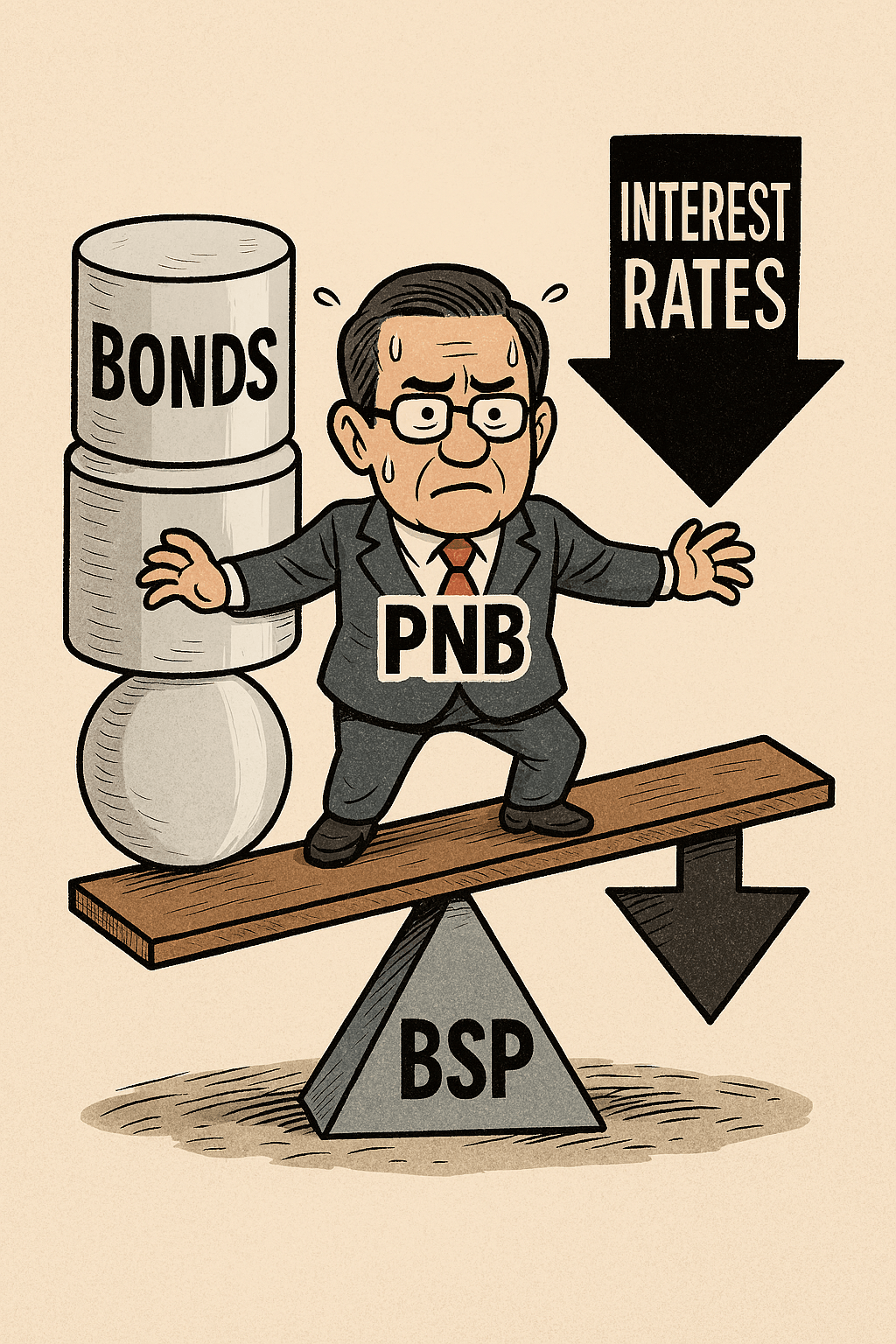
    Philippine National Bank’s return to the peso bond market would normally be filed under “good news”: strong demand, a sizeable PHP 15.7 billion raise, and a clear promise to funnel proceeds into eligible projects under its Sustainable Financing Framework. But markets don’t grade banks on deal headlines—they grade them on spread, the narrow space between what a bank earns on assets and what it pays for money. And that spread is now facing a two-sided pincer: a fresh BSP rate cut that can pull loan yields down, and new fixed-rate bond funding that doesn’t reprice lower

    A bond deal priced for yesterday’s rate environment

    PNB’s issuance came in two tranches: Series A (3-year) at 5.4877% and Series B (5-year) at 5.7764%, for a combined PHP 15.7 billion. Those are clean, tradable coupons investors like because they are predictable. For the bank, however, predictability cuts both ways: these rates are locked in, creating a relatively firm “floor” for a portion of PNB’s funding costs over the next three to five years.

    That matters because PNB’s earnings machine is still overwhelmingly powered by net interest income. In its latest quarterly filing covering the period ended September 30, 2025, PNB reported net interest income of PHP 39.3 billion and a net interest margin (NIM) of 4.7% for the first nine months of the year. When a bank introduces more wholesale, fixed-rate funding into the mix, it increases the chance that overall funding costs drift upward—unless the proceeds are deployed into assets that earn meaningfully more than that fixed coupon. 

    Then came the BSP’s easing move—lower policy rates, lower pricing gravity

    On December 11, 2025, the Bangko Sentral ng Pilipinas cut the target reverse repurchase (RRP) rate by 25 bps to 4.50%, citing benign inflation and weaker growth, while signaling the easing cycle may be nearing its end. A policy rate cut is not just a macro headline; it’s a pricing signal that seeps into the banking system. Over time, it can soften interest rates across the curve—deposit pricing, wholesale funding benchmarks, and critically, loan pricing

    And that’s where the profitability tension sharpens. In easing cycles, banks often hope for a benign sequence: funding costs fall faster than asset yields, supporting NIM. But when a bank adds fresh fixed-rate bond funding, it risks changing that sequence. Bond coupons don’t follow the BSP downward. Meanwhile, loan yields—especially for new production or repriced credits—can trend lower as the overall cost of money declines and competition intensifies. 

    The core risk: loan yields may fall, but bond funding stays expensive

    Here is the cleanest way to see the risk: the BSP’s rate cut pulls down the “gravity” of borrowing costs. When benchmark rates move lower, banks typically face pressure to reprice or originate loans at lower rates—particularly in competitive segments and for high-quality borrowers. That means asset yields can fall over time. 

    But PNB’s new bond funding is priced in the mid‑5% range and is fixed. If loan yields soften due to easing—while bond coupons remain unchanged—then the spread between what PNB earns and what it pays can narrow. That is textbook margin compression: assets reprice down, liabilities don’t fully follow, and NIM drifts lower even when volumes are growing. 

    The risk is not theoretical. PNB’s 17‑Q already shows how meaningful interest expense is to the model: for the first nine months of 2025, total interest expense was PHP 13.07 billion, including PHP 630.3 million for “bonds payable.” Add more bond funding and—unless deployment is swift and high-yielding—interest expense becomes stickier at precisely the moment the BSP is trying to make money cheaper. 

    Why the first few quarters after issuance matter most

    A second layer of risk is timing. Bond proceeds arrive quickly; loan deployment—especially into projects that meet sustainability criteria—can take longer. PNB itself states the net proceeds will be used to finance or refinance eligible projects under its framework. If deployment lags, banks often park funds temporarily in liquid assets. In a falling-rate environment, those liquid assets may earn less, while bond coupons keep running—turning the early months into a “negative carry” window that can pull on NIM. 

    This is why investors shouldn’t judge the bond deal by oversubscription alone. The real scoreboard is whether the bank can keep its margin stable while adding fixed-rate funding. PNB’s reported 4.7% NIM provides a useful baseline heading into the post-issuance period. 

    The counterpoint: rate cuts can boost loan demand—volume can cushion the squeeze

    To be fair, BSP easing can also be helpful for banks. Lower policy rates are designed to support activity; they can lift credit demand, encourage refinancing, and reduce debt service burdens. If loan volumes accelerate enough, banks can sometimes offset thinner spreads with higher earning-asset balances. PNB’s own 17‑Q shows that loans and receivables rose 6.5% versus year-end 2024, indicating momentum in asset growth even before the December cut. 

    But volume is not a free pass. When rates fall, banks must avoid the temptation to buy growth at the expense of pricing discipline—especially if they are carrying fixed-rate liabilities that won’t reprice lower. If PNB uses the bond proceeds to fund assets that are either low-yielding or aggressively priced, the “growth story” can still translate into weaker NIM.

    What to watch: three tells that reveal whether NIM holds or slips

    Because the bond was listed on December 11, 2025, the post-issuance effect will show up more clearly in subsequent periods rather than the September 30, 2025 filing. When PNB reports new numbers, three items will tell the story quickly: 

    1. Loan yield trend — do new bookings and repricings show softening rates consistent with BSP easing? 
    2. Funding cost mix — does the new bond carry make interest expense less responsive to falling rates? 
    3. NIM direction vs 4.7% baseline — does it hold, or does the combination of lower loan yields and fixed bond coupons compress the spread? 

    Bottom line

    PNB’s bond issuance strengthens funding diversification and signals confidence, but the macro backdrop has shifted: the BSP has lowered the policy rate to 4.50%, reinforcing a downtrend in borrowing costs that can pull loan yields lower. With PNB’s new bond financing locked at 5.49%–5.78%, a portion of the bank’s funding costs becomes fixed and comparatively expensive just as the system is easing. If loan rates fall faster than the bank’s blended funding costs, the natural result is net interest margin compression—a risk that will only be confirmed (or disproved) in the coming quarters’ NIM and net interest income prints.

    We’ve been blogging for free. If you enjoy our content, consider supporting us!

  • Cebu Air’s Underlying Momentum Is Real — and It Shows

    Cebu Air’s Underlying Momentum Is Real — and It Shows

    Start with the basics. For the nine months to September 30, 2025, CEB logged ₱87.6 billion in revenue, up 18% year‑on‑year. Passenger sales rose 17% to ₱59.7 billion on broad‑based demand recovery; cargo accelerated 30% to ₱5.2 billion; and ancillary revenues—those high‑margin add‑ons like baggage, seat selection, and bundles—climbed 17% to ₱22.8 billion. The top‑line story isn’t just about reopening—it’s about retention and monetization.

    More telling than growth is quality. Operating costs did rise (+16% to ₱79.8 billion), as you’d expect with more flights and a bigger fleet. But the key heavy lines behaved: flying operations were essentially flat (+1%), thanks to lower fuel prices offsetting higher consumption and crew counts; depreciation (+21%) and aircraft/traffic servicing (+41%) reflect capacity normalization rather than inefficiency; and short‑term lease costs fell sharply (−80%), signposting better asset planning. Net result: operating income of ₱7.8 billion, up 37%

    The best lens for “underlying momentum” is CEB’s pre‑tax core net income, which filters out outsized, non‑recurring items. On that basis, CEB delivered ₱2.9 billiondouble last year’s ₱1.45 billion. Pair that with an EBITDA of ₱22.2 billion and a 25.3% EBITDA margin (up from 23.6%), and you see a business extracting more cash profit per peso of revenue even as it rebuilds capacity. Efficiency metrics corroborate the trend: Cost per ASK ticked down to ₱3.05 from ₱3.10, with the seat load factor steady at 84.8%—proof that routes and pricing are holding. 

    Of course, the reported net income of ₱9.47 billion (+181%) needs context. Two items gave the year a big glow: ₱5.99 billion booked as other income for five free‑of‑charge Pratt & Whitney GTF engines—a fair‑value recognition tied to industry‑wide AOG mitigation—and ₱226 million from remeasurement on the step‑acquisition of 1Aviation (ground handling), which moved from joint venture to subsidiary. These don’t recur, and the market should normalize them. But they also matter: the engines improve near‑term fleet availability, while consolidating 1Aviation strengthens service control and integration. (Source: CEB Form 17‑Q, 9M 2025)

    If there’s a headwind, it’s below the line. Financing costs rose 17% to ₱5.6 billion as deliveries and lease liabilities scaled, and foreign‑exchange losses hit ₱1.25 billion on peso depreciation versus USD and JPY—the currency mix in aviation is stubborn. Yet even here, the interest coverage ratio improved to 1.57x (from 1.32x), reflecting stronger earnings capacity to carry debt and leases. 

    Balance‑sheet optics have turned decisively better. Equity grew to ₱16.1 billion (from ₱10.0 billion), and book value per common share jumped to ₱21.00 (from ₱7.18), driven by profits despite an active buyback and a ₱2.82 billion dividend to preferred shareholders. On liquidity, the current ratio is a low 0.53x, and current liabilities still exceed current assets by ~₱30 billion—that’s the nature of airline working capital. But cash generation is the counterweight: ₱15.41 billion net cash from operations year‑to‑date, ₱4.78 billion net inflows on investing (proceeds and PDP/security‑deposit refunds, net of capex), and deliberate ₱24.46 billion outflows in financing (debt/lease repayments, treasury purchases, dividends). The company is using cash to de‑risk.

    Operationally, the platform is deeper and more resilient. CEB now flies 98 aircraft with an average age of ~6.1 years, across 82 domestic and 42 international routes with roughly 2,700 weekly flights. The AirSWIFT acquisition broadens leisure connectivity (El Nido and other tourist nodes), while 1Aviation consolidation tightens ground operations across thirty‑plus airports. Those moves aren’t mere trophies; they reinforce the commercial engine—better schedule reliability, more ancillary throughput, and improved customer experience that sustains yield. 

    There are risks worth watching. Fuel and FX remain volatile, and hedging is prudently modest; heavy maintenance accruals (₱5.68 billion HMV YTD) and return condition provisions (₱0.83 billion) underline a busy engineering calendar as utilization rises; lease liabilities are substantial (₱116.84 billion), keeping discipline front‑and‑center. Still, the levers are visible: route profitability, ancillary monetization, tighter ground operations, normalized lease mix, and efficiency at scale. 

    Bottom line: If you’re trying to decide whether CEB’s 2025 bounce is cosmetic or structural, the core tells the story. Pre‑tax core earnings doubledmargins expandedCASK declined, and cash flows are funding de‑risking, not just growth. The headline numbers benefited from exceptional items, yes—but the business beneath them is sturdier than it was a year ago. For investors, valuation should key off normalized earnings and EV/EBITDA, but the direction of travel is favorable: an airline that’s earning more per flight and per customer, with a wider network, better integration, and improving balance‑sheet optics.

    In a sector where momentum can be fleeting, Cebu Air’s looks real—and increasingly repeatable.

    We’ve been blogging for free. If you enjoy our content, consider supporting us!

  • SPC’s outsized 2025 dividend: signal, not trap—yet

    SPC’s outsized 2025 dividend: signal, not trap—yet

    SPC Power Corporation surprised the market with a year‑end ₱0.80/share cash dividend—lifting full‑year distributions to ₱1.20/share—after its Board approval on December 9, 2025 (record Dec 26, payable on/before Jan 9, 2026). That move caps a year of margin recovery and leaves investors wondering whether it is sustainable or a one‑off flourish. 

    At ₱9.00, the combined ₱1.20/share payout implies a ~13.3% full‑year yield—eye‑catching for a net‑cash utility. On trailing measures, independent trackers had SPC’s yield in the 4.4–5.0% range before the latest announcement, reflecting the earlier ₱0.40 mid‑year dividend; the step‑up reframes the yield conversation decisively.

    Crucially, 2025’s earnings quality improved. SPC’s 9M‑2025 total comprehensive income rose to ₱1.744B, and EPS reached ₱1.17, even as reported revenues dipped (–10.3%) due to lower pass‑through fuel costs. The gross margin surged to ₱1.494B (from ₱228.5M in 9M‑2024) on cost optimization and better plant utilization; management notes the generation segment contributed ~72% of net income this year, tilting results back toward core operations rather than associates.

    On coverage, the numbers are reassuring—but nuanced. Operating cash flow (OCF) for 9M‑2025 stood at ₱1.279B, while cash & cash equivalents were a hefty ₱6.181B—with a current ratio of 11.47 and debt ratio ~0.06, underscoring a net‑cash profile. That means the ₱0.80 year‑end dividend (~₱1.197B) is cash‑covered with room to spare; total FY dividends (~₱1.796B) are covered ~3.4× by cash on hand, though only ~0.71× by 9M OCF—so Q4 cash generation matters for purists who want dividends funded from operations alone.

    Associates still play a material role. SPC’s equity share in the earnings of KSPC/MECO was ₱491.0M in 9M‑2025 (down year‑on‑year), yet cash dividends received from associates reached about ₱852.4M over the same period—significant support for parent‑level liquidity. The strategic overlay: Korean media report KEPCO plans to divest its 60% stake in KSPC (SPC owns 40%), potentially reshaping governance and dividend policy at the associate level. That is not inherently negative, but it warrants monitoring because associate cash flows have historically augmented SPC’s payout capacity.

    Market conditions are a swing factor, too. The Independent Electricity Market Operator (IEMOP) has expressed optimism for stable/lower WESM prices in 2025 amid ample supply—good for consumers, more challenging for merchant margins if generators cannot offset via efficiency or contracted sales. SPC’s 2025 margin expansion shows it can win on costs; sustaining this in a soft price environment will demand continued operational discipline.

    One structural lever is battery energy storage. On October 17, 2025, a wholly owned subsidiary signed supply and EPC contracts for BESS projects in Panay (100 MWh) and Bohol (60 MWh)—positioning SPC to capture ancillary and flexibility revenues as rules mature. The policy groundwork for BESS in the WESM has been laid over recent years; execution will dictate how quickly these assets translate into earnings that can buttress future dividends.

    So is SPC’s dividend sustainable—or a value trap? On the evidence, not a value trap. SPC in 2025 showed improved core margins, sits on net cash with minimal leverage, and holds ample liquidity to fund distributions, even at the enhanced year‑end rate. The magnitude of the ₱1.20/share payout, however, is above a normal run rate and depends on Q4 earnings and, to a degree, associate cash flows. In other words, ongoing dividends look supportable; repeating 2025’s size every year would require continued operational strength and no adverse surprises from KSPC or WESM pricing.

    For investors, the watch‑list is straightforward: (1) FY‑2025/Q4 results to confirm post‑payout cash and operating cover; (2) KSPC ownership changes and any shift in dividend policy; (3) WESM price trajectory and SPC’s contracted versus merchant mix; and (4) BESS milestones and monetization in the ancillary/Reserve Market. If these line up, baseline dividends (₱0.40–₱0.60) look comfortably repeatable, with top‑ups plausible in stronger years. 

    We’ve been blogging for free. If you enjoy our content, consider supporting us!

  • Rent Is the Engine, Refinancing Is the Weather: Reading SM Prime’s 9M 2025

    Rent Is the Engine, Refinancing Is the Weather: Reading SM Prime’s 9M 2025

    In a year when higher funding costs and mixed consumer signals have turned developers cautious, SM Prime Holdings (SMPH) just delivered a set of numbers that feel both familiar and instructive: steady rent‑led growthsoftness in residential, and a heavier–but manageable—refinancing calendar.

    On the headline figures, consolidated revenues rose 4% to ₱103.40B for the first nine months of 2025, carried by rent (up 7% to ₱60.99B), while real estate sales eased 2% to ₱31.20B. Costs and expenses fell 1%, pushing operating income up 9% to ₱51.90B and net income (attributable) up 10% to ₱37.24BEPS clocked in at ₱1.291, with a cash dividend of ₱0.480 already paid in May.

    The Core Story: Malls Still Do the Heavy Lifting

    SMPH’s malls continue to anchor earnings strength. In the nine months, Malls posted ₱60.92B in revenue and ₱31.51B in pre‑tax profit; Residential contributed ₱32.58B and ₱10.41B, respectively; Hotels & Conventions added ₱6.01B and ₱1.01BCommercial & Integrated Developments generated ₱3.89B and ₱3.01B. Operating leverage is visible: the company squeezed more profit out of largely flat third‑quarter revenues thanks to disciplined costs.

    This operating resilience rests on footprint and execution. SMPH opened SM City Laoag in May and SM City La Union in October, bringing the Philippine mall count to 89 (plus 8 in China). The pipeline of redevelopments also supports rent and occupancy, while hotels, offices, and conventions continue to offer steady—if smaller—contributions.

    Where the Fuel Mix Shows Some Octane Lag

    The Residential engine sputtered a bit: real estate sales slipped 2% year‑on‑year and segment profit ticked lower. Receivables and contract assets rose (₱107.25B), with unbilled revenue tied to construction milestones also higher—fine if build schedules and collections remain tight, more delicate if they don’t. Meanwhile, non‑cash OCI headwinds—FVOCI losses in the equity book and a weaker cash‑flow hedge reserve—trimmed total comprehensive income to ₱35.67B (from ₱37.21B), even as net income advanced.

    These are not structural breaks; they are friction points that investors should watch: project take‑up and construction cadencepricing power, and the sensitivity of SMPH’s OCI to market marks.

    Balance Sheet: Bigger Tank, Higher Octane Price

    On the funding side, interest‑bearing debt climbed to ₱419.82B (+8% YTD), while current maturities rose to ₱112.08B. SMPH notes these are “due for refinancing,” a normal course for a developer of this scale. Coverage remains sound: interest coverage at 7.06×debt/EBITDA at 4.84×, and net debt‑to‑equity at 46:54. Liquidity is adequate, with a current ratio of 2.28× and acid‑test 1.29× (excluding items flagged for refinancing).

    Hedging helps: after swaps, roughly 57% of long‑term borrowings are effectively fixed‑rate. Still, derivative assets came down with maturities and fair‑value changes—less cushion than last year, but consistent with a company rolling hedges as the book evolves.

    The Bottomline

    SMPH’s playbook still works: rent growth and operating discipline carry the income statement; capex and landbanking expand the footprint; hedges and market access keep the funding bridge sturdy. The residential wobble and OCI marks are the ballast on comprehensive profits, not the anchor. The refinancing calendar is heavier, but coverage and liquidity suggest it’s navigable—especially for a name that just placed ₱25B in retail bonds and continues to roll projects and tenants into an already dominant network.

    As with any property stock in a higher‑for‑longer world, the cost of money is the weather: if it worsens abruptly, sentiment and valuation can swing faster than the EPS math. But in the base case, SMPH’s rent engine remains powerful enough to keep the vehicle moving—just perhaps with a touch more fuel discipline and a keener eye on the road ahead.

    We’ve been blogging for free. If you enjoy our content, consider supporting us!

  • Why ABS is likely to move under FPH—funded by First Gen

    Why ABS is likely to move under FPH—funded by First Gen

    From the Trading Desk. 

    The Lopez Group faces a moment that calls for clear, steady action. TV5’s notice to end its content deal with ABS‑CBN—which ABS says it’s working to resolve—puts pressure on ABS’s cash flows and its relationships with partners. Letting that pressure linger risks bigger problems. 

    The most straightforward fix is to bring ABS under First Philippine Holdings (FPH) through a share swap—and then use First Gen (FGEN) cash to help ABS regain its footing. Here’s why this path makes sense, quickly and simply:

    1) Put ABS under the strongest umbrella

    Inside the Lopez Group, ABS sits under Lopez Holdings, while FPH is the parent for major businesses like First Gen (power) and Rockwell Land (property). Moving ABS under FPH aligns responsibility and resources in one place and avoids messy intercompany band‑aids. It’s a clean, familiar step for listed companies in the Philippines.

    2) Use the cash that already exists

    In November 2025First Gen closed a ₱50 billion deal with Prime Infrastructure, selling 60% of its Batangas gas plants and the LNG terminal while keeping 40% (Tokyo Gas holds 20% in the LNG hub). That transaction brought in real cash. A special dividend from FGEN to FPH immediately equips FPH with funds to settle partner obligations, stabilize operations, and give ABS breathing room after the share swap. 

    There’s a bonus: in the Philippines, cash dividends between local companies aren’t taxed at the recipient company, making FGEN → FPH a fast, efficient way to move support where it’s needed. 

    3) This doesn’t weaken Lopez control of FPH—if anything, it can increase it

    Some might worry that issuing new FPH shares for a 100% ABS swap would dilute Lopez control. In practice, it won’t:

    • Before the swap, Lopez Holdings (LPZ) owns about 55.6% of FPH (per FPH’s Public Ownership Report). 
    • After a full ABS‑for‑FPH share swap (priced on recent trading averages), LPZ’s stake in FPH would likely tick up—roughly into the low‑to‑mid 60% range—because LPZ would receive the new FPH shares issued as consideration. In other words: more FPH shares end up with Lopez Holdings, so control does not fall; it can rise(This is based on recent market data for ABS and FPH and simple share‑count math; inputs such as ABS’s outstanding shares and recent prices come from PSE EDGE.) 

    And since FPH already has a healthy public float, that small increase in Lopez ownership does not threaten the exchange’s minimum public‑ownership rules. 

    4) Doing nothing costs more

    Waiting invites headlines, frays trust with partners, and makes a later fix more expensive. A share swap + FGEN special dividend is decisive, transparent, and fast. It shows banks, advertisers, and viewers that ABS’s finances are under firm stewardship—with the scale and discipline of FPH behind it.

    Bottom line:
    The likely move is ABS under FPH via share swap, funded by an FGEN special dividend—and Lopez control of FPH won’t be diluted by doing this. It’s the simplest way to restore confidence and give ABS the time it needs to get fully back on its feet.

    Because the FGEN cash is already real, many investors will naturally front‑run the possibility of a special dividend flowing to FPH—and, by extension, to all FGEN shareholders. In that sense, the market may treat FGEN like a buy‑for‑dividend‑optionality story right now, pending board moves. (Again, this is sentiment—not a recommendation.) 

    SUBSCRIBE TO SUPPORT FREE INDEPENDENT RESEARCH

  • FLI’s Two‑Track Story: Gains on the Ground, Rates in the Rear‑View

    FLI’s Two‑Track Story: Gains on the Ground, Rates in the Rear‑View

    Filinvest Land, Inc. (FLI) has quietly stitched together a steady nine‑month performance that looks better beneath the surface than its modest headline growth might suggest. Yet the same report, which shows improving revenue, cash generation, and liquidity, also flags the familiar headwinds of higher financing costs and execution risk that could trip up momentum if conditions turn. Here’s the balanced read investors should care about—what’s getting better, and what could potentially derail the story. 

    What’s getting better

    1) Dual‑engine revenue: development + leasing both up.
    FLI’s consolidated revenue rose 7.9% to ₱18.99 billion for the nine months ended September 30, 2025, with real estate sales up 8.2% to ₱12.86 billion and rental & related services up 7.3% to ₱6.13 billion. The sales mix remains anchored in medium‑income housing (71%), while affordable/low segments (17%) widened their share—useful ballast when the market tilts toward value. Leasing gains came from higher occupancy and contractual escalations; even the co‑living pilot (The Crib Clark) added incremental pesos.

    2) Earnings drift higher with resilient margins.
    Net income improved 5.0% to ₱3.64 billionEPS ticked up to ₱0.14 (from ₱0.13). Under the hood, computed gross margins held sturdy—about 52% in real estate and 51% in leasing—despite cost inflation and a heavier depreciation footprint from asset additions. That margin resilience is the critical “quality” signal in a build‑and‑lease model.

    3) Operating cash flow and cash reserves strengthened.
    Operating cash flow climbed 5.1% to ₱7.09 billion, while cash & equivalents nearly doubled (+89.6%) to ₱7.55 billion. A lighter investing outflow—thanks to tempered net capex and larger dividends received from associates—helped the cash balance. In a rate‑heavy world, more cash on hand means more options.

    4) Liquidity ratios improve—more near‑term cushion.
    The current ratio rose to 3.07× (from 2.78× at year‑end 2024) and the quick ratio to 0.81× (from 0.71×). When maturities cluster, and contractors queue up for payments, these buffers matter—a lot.

    5) Collections and working capital discipline show up in the numbers.
    Other receivables fell by 7.3%, reflecting better tenant collections and liquidation of advances; expected credit losses remain modest. Contract assets declined 9.7%, which management ties to a higher percentage completion across projects—an indicator that work‑in‑progress is converting toward billable/saleable stages.

    6) Associates contribute more—and in cash.
    Equity in net earnings of associates jumped 48% to ₱371.7 million, and dividends received rose to ₱289.4 million (from ₱106.0 million)—a welcome auxiliary stream that diversifies cash sources beyond unit transfers and rental billings.

    7) Recurring platform scaled via the REIT.
    The Festival Mall – Main Mall property‑for‑share swap lifted FLI’s stake in Filinvest REIT Corp. (FILRT) to roughly 63%. The transaction (SEC valuation approved on May 27, 2025) underscores FLI’s capital‑recycling playbook: seed the REIT with stabilized assets, free up growth capital, and lean into recurring income through the platform.

    8) Pipeline depth: investment properties up; new retail underway.
    Investment properties (NBV) rose to ₱87.02 billion; fair value indications stand near ₱215.34 billion (Level‑3 appraisal). Retail projects in Cubao and Mimosa are under construction—future anchors that can compound footfall and lease yields if delivered on time and on budget.

    9) Shareholder cash is still visible.
    ₱0.05 common dividend (paid in May 2025) equated to a ~6.1% trailing yield on the ₱0.82 closing price as of September 30, 2025; the company’s reported P/E sat at 4.34×—low enough to make the carry look compelling, provided coverage metrics stay healthy.

    What could derail the story?

    1) Financing costs: the gravity that never sleeps.
    Interest & finance charges rose 18.8% to ₱3.14 billion. Coverage ratios edged down (EBITDA/interest 1.91×; EBIT/interest 2.38×). With ₱6.72 billion in bonds and ₱11.23 billion in loans maturing within 12 months (total ~₱17.95 billion), repricing risk is non‑trivial: tighter liquidity or wider spreads could bite into earnings and dividend headroom. FLI’s debt‑to‑equity ≈ 0.88× is comfortably within covenants (max 2.0–2.5×), but the direction of travel matters as much as the level. 

    2) Sales velocity and inventory turns.
    Real estate inventories rose to ₱73.33 billion (+4.8%). If buyer affordability weakens or cancellations tick up, inventory clears slower, cash conversion stalls, and carrying costs pile on. Receivable ageing shows meaningful “past‑due but not impaired” buckets—collections need to stay tight to keep momentum real, not just reported. 

    3) Leasing margin compression risk.
    Leasing revenue grew, but cost of rental services grew faster (+10.2%), propelled by depreciation on new builds and operating costs. If occupancy dips or escalations soften while opex keeps climbing, today’s ~51% gross margin in leasing can erode quickly. The retail pipeline is promising, but pre‑leasing discipline and tenant mix will determine how accretive those projects really are. 

    4) Execution complexity across a wide map.
    From Filinvest City to Cebu SRPClark Mimosa, and New Clark City, FLI manages multi‑site construction and leasing with varied regulatory pathways and counterparties (including BTO and long‑term leases). Delays, cost overruns, or contractor bottlenecks can ripple through the P&L and push out cash timelines. 

    5) Macro & policy overhangs.
    Higher rates, build‑cost inflation, or shifts in housing policy (including socialized housing thresholds) would amplify the pressures above. As a REIT sponsor, FLI also carries ongoing reinvestment and reporting obligations—non‑compliance isn’t the base case, but it’s a governance tripwire worth monitoring. 


    The bottom line

    FLI’s 2025 nine‑month tape shows a business doing the right things: growing both development and leasing, protecting margins, and strengthening liquidity—while smartly using the REIT to recycle capital. But the rate cycle is the villain in this play: financing costs are up, coverage ratios are thinner, and near‑term maturities mean execution and treasury strategy must stay sharp. If sell‑through holds and leasing stays firm, the math still works; if either wobbles while rates stay stubborn, the dividend and expansion pace could be tested. 


    What to watch next quarter

    • Coverage ratios: Aim for EBITDA/interest >2.0×; a sustained slip below that line raises caution.
    • OCF vs. cash commitments: Keep operating cash flow ≥ (capex + dividends) to avoid creeping dependence on debt.
    • Sell‑through & cancellations: Affordable/MRB projects should keep cycle times short; any elongation is a red flag.
    • Pre‑leasing & occupancy: Verify that new retail/office assets land anchor tenants early—and at rents that defend margins.
    • Covenant headroom: D/E, current ratio, DSCR—trend matters as much as absolute levels. 

    Subscribe to Support Free Independent Research

  • What it will take for DITO to break even

    What it will take for DITO to break even

    By any reasonable yardstick, DITO is still far from break‑even. But the path is not unknowable—it’s arithmetic, capital discipline, and execution. The company’s 3Q25 filing lays out the challenge in stark numbers: nine‑month net loss of ₱24.93BEBIT (operating loss) of ₱9.73B, and EBITDA of ₱1.565B—up 112% year‑on‑year, yet nowhere near enough to absorb heavy depreciation (₱11.47B)interest (₱12.82B) and FX losses (₱2.23B). On that math, DITO would need roughly ₱26–27B of EBITDA over nine months—or ~₱35–36B annualized—to hit net break‑even today. 

    Scale the cash engine—fast, and with margin integrity.
    No telco breaks even on hope; it breaks even on EBITDA. With nine‑month revenues at ₱14.9B and an EBITDA margin of ~10.5%, the cash engine is underpowered. The first lever is scale and margin: push data monetization (already 86% of service revenue) while rebuilding ARPU (mobile blended down to ₱100, FWA up modestly to ₱306). Even at a healthier 25–30% EBITDA margin—more typical for mature operators—the company would still need ₱90–120B in annual revenue to generate ₱22–36B of EBITDA, the minimum needed to neutralize fixed charges. That implies aggressive growth in consumer data, enterprise connectivity, and wholesale (carrier) lines, plus disciplined promo management to prevent volume from cannibalizing yield. 

    Make finance costs smaller—or fewer.
    The second lever is the price of money. Nine‑month interest expense of ₱12.82B—largely tied to US$3.241B and CNY2.561B drawn on project‑finance facilities—remains the single biggest drag after depreciation. Two paths help: (1) Refinance and repricing where possible (SOFR and LPR resets, margin negotiation) and (2) deleverage through primary equity and asset monetization. DITO has a Subscription Framework with Summit Telco to subscribe up to 9B primary shares; execution speed and terms will matter more than headlines. Parallel moves—tower sale‑leasebacks, partial fiber IRU monetization, and selective disposal of non‑core assets—can chip away at principal and lower interest, even if lease expense rises. The net objective is a multi‑billion‑peso annual reduction in interest payments to narrow the break‑even gap.

    Tame the currency roller-coaster

    DITO’s FX sensitivity is enormous: a ~9.7% move in USD/₱ shifts loss before tax by ±₱19.4B; a ~9.2% move in CNY/₱ shifts it by ±₱7.0B. FX losses already ran ₱2.23B in 9M25. That volatility is too significant to leave unmanaged. The company needs a formal, disclosed hedging policy—currency swaps or forwards aligned to semi‑annual interest and principal amortization calendars, plus natural hedges from USD/CNY-denominated costs and (where viable) revenues. Hedging won’t create profit, but it will stop FX from destroying operating gains. 

    Keep capex lean; keep sites lit.
    Post‑audit, capex dropped 76% YoY to ₱2.475B in 9M25. That restraint is welcome, but it cannot come at the cost of performance; the installed base still demands maintenance (₱2.70B) and utilities (₱2.15B) over nine months. The capex rule of thumb now is: spend only where it lifts EBITDA per site—densification that raises throughput in revenue‑rich pockets; enterprise builds with contracted returns; and upgrades that cut energy or maintenance per bit carried. That is how asset intensity turns into margin, not just footprint. 

    Work the P&L: opex trim without starving growth.
    GS&A rose 18% to ₱12.03B. Some lines must keep rising (network ops), but several can be bent: advertising was prudently down 35%; outside services were flat; yet taxes & licenses (+42%) and parts of repairs (+29%) warrant a deeper review—contract re‑cuts, shared services, automation in field ops, and energy optimization programs (smart cooling, solar hybrids) at base stations. Every ₱1B trimmed from opex is ₱1B closer to EBITDA levels that make break‑even plausible. 

    Fix the liquidity optics—then the substance.
    The optics are brutal: current ratio ~0.06x (₱6.08B current assets vs ₱96.12B current liabilities), total liabilities ₱304.65B, and capital deficiency ₱95.31B. Management itself discloses material uncertainty on going‑concern, citing undrawn portions of project finance and shareholder support as mitigants. Break‑even will not arrive without first de‑risking liquidity—locking in the undrawn facilities, terming out near‑dated trade/lease payables, converting portions of accrued project costs to longer‑tenor instruments, and most critically, closing equity infusions to rebuild the cushion. Markets reward certainty; paperwork in progress doesn’t pay interest. 

    Price, product, and partners: grow smarter.
    Two commercial pivots can raise EBITDA productivity per subscriber:

    • Price discipline—dial back deep free‑data promos, steer to tiered bundles with speed/latency guarantees for prosumers and SMEs; protect ARPU creep without choking gross adds.
    • Partnerships—expand MVNOs, campus and enterprise programs (already lifting carrier/enterprise revenue), and bundle OTT/video‑gaming that drives high‑margin nighttime traffic. More enterprise SLAs and wholesale carriage contracts mean stickier, forecastable EBITDA

    A reality check on timelines.
    Even with momentum—revenues +25%EBITDA +112%capex normalized—DITO is not “near” break‑even on earnings or fully‑loaded cash. Operating cash inflow (₱3.81B) was offset by capex and finance/lease payments, leaving cash down ₱416M for 9M25 and ₱763M on hand at period end (with ~₱558M pledged as collateral). The journey to earnings break‑even will be measured not in quarters but in EBITDA multiplesinterest reductions, and FX stability achieved. Investors should benchmark progress against three quarterly scorecards: (1) EBITDA run‑rate (targeting ₱8–10B annual within 12–18 months), (2) interest/FX drag (cut by at least ₱3–5B p.a. via refinancing, hedging, and deleveraging), and (3) liquidity coverage (current ratio >0.5x via executed equity and extended vendor terms). Anything less, and break‑even remains theoretical. 

    The bottom line:
    Break‑even is not a mystery. It is the sum of bigger, higher‑margin EBITDAsmaller, cheaper debt, and less currency noise—backed by hard, executed capital. DITO’s network quality and subscriber growth are real strengths; now the company must turn them into cash at a pace that outstrips depreciation, interest, and FX. In telco finance, gravity always wins; DITO’s task is to lighten the load and power the engine—quickly.

    Subscribe to Support Free Independent Research

  • ABS-CBN Faces Financial Crisis as TV5 Exits Over ₱1B Dispute: Why Lopez Group Must Use Its ₱50B Windfall to Rescue Its Media Flagship

    ABS-CBN Faces Financial Crisis as TV5 Exits Over ₱1B Dispute: Why Lopez Group Must Use Its ₱50B Windfall to Rescue Its Media Flagship

    TV5’s termination of its partnership with ABS-CBN over a ₱1 billion payment demand exposes deep financial cracks. With ₱13 billion in payables and cash reserves down to ₱718 million, the Lopez Group must act fast—using its ₱50 billion windfall from First Gen’s sale to Enrique Razon—to prevent a collapse that could damage its entire credit reputation.

    When TV5, backed by the Manny Pangilinan group, pulled the plug on its partnership with ABS-CBN and demanded a ₱1 billion payment, it wasn’t just a broken deal—it was a warning shot. A signal that the financial cracks in ABS-CBN are widening, and the tremors could shake the entire Lopez Group.

    The numbers are stark: ABS-CBN’s SEC filing shows ₱13 billion in trade and other payables, a ₱11 billion working capital deficit, and cash reserves down to ₱718 million. These aren’t minor hiccups—they’re existential threats. When a major partner like TV5 walks away over unpaid obligations, others will take notice. Talent agencies, event venues, content licensors—they could all demand immediate settlement. If that domino effect begins, ABS-CBN’s operational lifeline could snap.

    Here’s the irony: the Lopez Group is sitting on a ₱50 billion windfall from the sale of its natural gas assets under First Gen Corp. to Enrique Razon’s Prime Infra. That deal was hailed as a strategic pivot to renewables. But what good is a green future if the flagship media arm collapses today? Deploying even a fraction of that windfall—₱10 to ₱15 billion—could stabilize ABS-CBN, clear critical payables, and restore partner confidence.

    And here’s the urgency: declare a portion of that windfall as dividends to First Philippine Holdings (FPH). Why? So FPH can acquire ABS-CBN outright and inject fresh capital to fix its battered finances. This isn’t just about saving a network—it’s about protecting the Lopez Group’s credit reputation. Letting ABS-CBN be hounded by creditors, suppliers, and banks will tarnish the group’s standing in the financial community. For a conglomerate that relies heavily on bank financing for power and infrastructure projects, that’s a risk too costly to ignore.

    This is no longer about pride or politics. It’s about survival. The Lopez Group must act decisively. Upstream the funds. Shore up ABS-CBN’s balance sheet. Send a message to partners and creditors: we pay our bills, we honor our commitments, and we protect our brands.

    Because in business, perception is reality. And right now, reality is screaming for leadership.

    Subscribe to Support Free Independent Research