Tag: finance

  • SSI Group’s Nine-Month Profit Plunges 49% Amid Rising Operating Costs

    SSI Group’s Nine-Month Profit Plunges 49% Amid Rising Operating Costs

    SSI Group, Inc. reported a sharp decline in profitability for the nine months ended September 30, 2025, as operating expenses surged despite flat revenue growth.

    The specialty retailer posted ₱639.8 million in net income, down 49.3% from ₱1.26 billion in the same period last year. Third-quarter earnings fell even steeper, dropping 65% to ₱188.1 million.

    Sales remained largely unchanged, inching up 0.7% to ₱20.32 billion, while gross profit improved slightly to ₱9.08 billion, with margins rising to 44.7% from 44.2%. However, operating income plunged 44.9% to ₱914 million as expenses ballooned.

    “The increase in costs was driven by store network expansion and technology investments,” SSI said in its quarterly filing.

    Operating expenses climbed 12.4% to ₱8.18 billion, fueled by higher rent, depreciation, and personnel costs linked to a 13.6% increase in selling space and the rollout of SAP and ETP enterprise systems. Selling and distribution costs rose to ₱6.58 billion, while general and administrative expenses jumped 17.4% to ₁.60 billion.

    The company opened 17 new stores during the quarter, bringing its total to 613 outlets nationwide, and expanded its brand portfolio to 103 names. E-commerce contributed ₱1.57 billion, or 7.7% of total sales.

    SSI ended the period with ₱2.78 billion in cash, down from ₱5.14 billion at year-end 2024, after spending ₱1.20 billion on capital expenditures, paying ₱503.6 million in dividends, and repurchasing shares worth ₱50.4 million.

    Despite the earnings slump, SSI maintained a net cash position of ₱1.39 billion and a current ratio of 2.11, signaling adequate liquidity ahead of the holiday season, traditionally its strongest quarter.


    Outlook / Investor Takeaway

    • Holiday Quarter Critical: SSI’s inventory build to ₱13.15 billion positions it for peak season sales, but execution risk is high. Strong sell-through and markdown discipline will be key to converting stock into cash.
    • Margin Recovery Hinges on Cost Control: ERP transition costs and store expansion drove operating margin down to 4.5%. Normalization of G&A and leveraging new stores will determine if margins rebound in Q4.
    • Liquidity Cushion Intact: Net cash and low leverage (Debt/Equity at 0.08) provide breathing room, but free cash flow needs improvement after negative operating cash flow in 9M25.
    • Watch Luxury Segment: Luxury and Bridge sales fell 3.8%, signaling discretionary weakness. Performance in this category during the holidays will be a bellwether for 2026.
    • Valuation Implication: With EPS at ₱0.19 (vs ₱0.38 last year), investors may reassess growth expectations. Near-term upside depends on holiday performance and cost discipline.

  • STI Holdings Posts Strong Earnings Despite Enrollment Dip; Stock Seen as Undervalued

    STI Holdings Posts Strong Earnings Despite Enrollment Dip; Stock Seen as Undervalued

    STI Education Systems Holdings, Inc. (PSE: STI) delivered a robust financial performance for the quarter ended September 30, 2025, defying a slight decline in student headcount with a higher revenue mix and improved operating leverage.

    The listed education group reported ₱1.44 billion in revenues, up 39% year-on-year, driven by strong tuition collections and a shift toward higher-yield tertiary programs. Net income surged 135% to ₱619 million, while earnings per share doubled to ₱0.06 from ₱0.03 in the same period last year.

    Operating income soared to ₱657.5 million, driven by tight cost control and a 75% gross margin. EBITDA climbed to ₱878 million, translating to an EBITDA margin of 61%, underscoring the group’s efficiency gains.

    The upbeat results came despite a 4% drop in total enrollment to 132,941 students for School Year 2025–2026. Management attributed the decline to an earlier start of classes in public schools, which affected Senior High School intake. However, CHED-regulated programs grew to 77% of total enrollment, up from 73% last year. These programs generate significantly higher revenue per student compared to DepEd-regulated levels, helping offset the impact of fewer Senior High School enrollees.

    Liquidity remained strong with ₱3.2 billion in cash, while interest-bearing debt fell to ₱1.44 billion, improving the debt-to-equity ratio to 0.30x. STI also booked ₱955 million in operating cash flow, reinforcing its ability to fund ongoing campus expansion projects, including new academic centers in Meycauayan, Tanauan, and Alabang.

    Stock Price and Valuation

    STI shares closed at ₱1.42 on November 17, 2025, giving the company a market capitalization of about ₱14.06 billion. The stock has traded between ₱1.17 and ₱1.81 over the past 52 weeks and is up roughly 18–22% year-on-year, outperforming the broader PSE index. [edge.pse.com.ph][dragonfi.ph][bing.com]

    Valuation metrics suggest STI remains undervalued relative to peers:

    • Price-to-Earnings (P/E): ~6.1x vs peer average of ~9x (FEU: 9.4x, CEU: 9.7x, iPeople: 5.8x). [simplywall.st]
    • Price-to-Book (P/B): ~1.1x, below sector norms. [stockanalysis.com]
    • Fair Value Estimate: Independent models peg STI’s intrinsic value at ₱3.48, implying a ~59% upside from current levels. [simplywall.st]

    The company also offers a 3.1% dividend yield, supported by a policy to distribute at least 25% of prior year core income.

    Investor Takeaway

    With strong quarterly earnings, a favorable enrollment mix, and a healthy balance sheet, STI Holdings appears positioned for sustained profitability. At current levels, the stock trades at a discount to both its estimated fair value and sector multiples, making it an attractive option for investors seeking exposure to the Philippine education sector.

  • First Gen’s ₱50-Billion Gas Asset Sale Could Boost Dividends While Reshaping Balance Sheet and Debt Profile

    First Gen’s ₱50-Billion Gas Asset Sale Could Boost Dividends While Reshaping Balance Sheet and Debt Profile

    First Gen Corporation has completed the sale of a 60% stake in its natural gas business to Prime Infrastructure Capital Inc. for ₱50 billion, a landmark transaction that significantly strengthens the company’s financial position.

    Under the deal, Prime Infra acquired controlling interests in the Santa Rita, San Lorenzo, San Gabriel, and Avion power plants, the proposed Santa Maria project, and the Batangas LNG Terminal. First Gen retains a 40% stake, ensuring continued participation in the gas platform while unlocking substantial liquidity.

    Impact on Balance Sheet
    The ₱50-billion inflow will boost First Gen’s cash reserves, making the parent company effectively debt-free after having prepaid its ₱20-billion loans earlier this year. The transaction also positions First Gen with a strong net cash position, enhancing flexibility for future investments in renewable energy projects.

    Potential for Higher Shareholder Returns

    With a debt-free parent and substantial cash inflows, First Gen is in a position to return more capital to shareholders. This could come in the form of higher dividends or even special payouts, subject to board approval and regulatory requirements. The transaction provides financial headroom for the company to balance reinvestment in renewables with rewarding its investors.

    Debt Profile Transformation
    Before the sale, First Gen’s consolidated long-term debt stood at $2.106 billion, largely concentrated in subsidiaries such as EDC and the gas plants. With the deconsolidation of 60% of gas-related loans (about $159 million) and LNG lease liabilities, consolidated leverage will drop significantly.

    • Debt-to-equity ratio, previously at 0.86x, is expected to improve markedly.
    • Interest-bearing debt obligations will decline, reducing financing costs and strengthening solvency metrics.

    Strategic Outlook
    First Gen will continue to report earnings from the gas business under the equity method, while redeploying capital toward geothermal, hydro, wind, and solar projects. “This partnership strengthens energy security and accelerates our transition to clean energy,” said First Gen Chairman and CEO Federico R. Lopez.

    The deal underscores a strategic pivot: from heavy capital exposure in gas infrastructure to a more balanced portfolio focused on renewables, backed by a robust cash position and lower debt burden.

  • Philippine Food & Beverage Giants Show Resilience Amid Market Headwinds

    Philippine Food & Beverage Giants Show Resilience Amid Market Headwinds

    Three of the country’s leading food and beverage companies — San Miguel Food and Beverage Inc. (SMFB)Universal Robina Corporation (URC), and RFM Corporation — posted stronger results for the first nine months of 2025, signaling resilience despite cost pressures and shifting consumer dynamics.


    SMFB Leads with Broad-Based Growth

    SMFB delivered a 4.1% increase in consolidated revenues to ₱302.9 billion, while net income surged 10.8% to ₱33.7 billion. Growth was supported by all major segments: Food, Beer & Non-Alcoholic Beverages, and Spirits. The company also strengthened its balance sheet, reducing total liabilities to ₱187.2 billion and maintaining a hefty cash position of ₱62.4 billion. Dividend payouts totaling ₱2.00 per share year-to-date underscore confidence in sustained performance.


    URC Maintains Stability Amid Margin Pressure

    URC posted ₱124.6 billion in revenues, up 4.8% year-on-year, and net income of ₱9.03 billion, a 4.6% improvement. While gross margins eased to 26.5% due to higher coffee input costs, URC’s diversified portfolio — spanning branded consumer foods, commodities, and agro-industrial products — cushioned the impact. Strong financial metrics, including a gearing ratio of 0.19x and interest coverage of 14.4x, highlight its capacity to weather volatility.


    RFM Delivers Quiet Strength

    RFM reported ₱15.23 billion in revenues, up 1.8%, and net income of ₱1.25 billion, marking a 12.3% jump from last year. Cost discipline and lower general and administrative expenses supported profitability. Liquidity improved with a current ratio of 1.36x, while total liabilities fell to ₱8.67 billion, reinforcing financial stability.


    Defensive Qualities in a Volatile Market

    Analysts view SMFB, URC, and RFM as defensive plays in the Philippine equity market. Their core businesses — food staples, beverages, and packaged goods — cater to essential consumer demand, which tends to remain stable even during economic slowdowns.

    • SMFB benefits from a diversified portfolio across food and alcoholic beverages, ensuring steady cash flows and dividend payouts.
    • URC’s strong presence in branded snacks and beverages, coupled with commodity operations, provides a natural hedge against input cost swings.
    • RFM, with its focus on pasta, milk, and ice cream, serves everyday consumption needs, making it less vulnerable to discretionary spending cuts.

    These companies combine consistent earningsrobust balance sheets, and high liquidity, positioning them as attractive options for investors seeking stability amid inflationary pressures and global uncertainty.

  • SM Investments Posts ₱88.8B Profit; Buyback Program Signals Confidence Amid Liquidity Pressures

    SM Investments Posts ₱88.8B Profit; Buyback Program Signals Confidence Amid Liquidity Pressures

    SM Investments Corporation (SMIC) reported consolidated revenues of ₱482.3 Billion for the nine months ended September 30, 2025, up 4.3% from last year, while net income after tax rose 5.6% to ₱88.8 Billion, according to its latest SEC filing. Net income attributable to the parent reached ₱64.4 Billion, driven by strong contributions from banking and property segments.

    Retail, which accounts for 66% of revenues, posted ₱318.1 Billion in sales and ₱12.2 Billion in net income. However, management flagged margin pressure from frequent flooding in Q3 and promotional activity in sports and athleisure categories. Merchandise inventories climbed to ₱47.9 Billion, raising concerns over potential markdowns if consumer demand softens.

    Property arm SM Prime delivered ₱103.4 Billion in revenues and ₱37.2 Billion in net income, supported by mall rental growth of nearly 7%. Still, residential sales slipped 2% amid slower revenue recognition, while capital expenditures surged to ₱59 Billion year-to-date, part of a ₱100 Billion full-year budget. Construction-in-progress now stands at ₱160.8 Billion, with ₱40.7 Billion in outstanding contractor commitments.

    Banking associates BDO and China Bank remain SMIC’s profit engine, contributing ₱39.1 Billion in equity earnings—around half of consolidated net income. Portfolio investments added ₱4.5 Billion, though Philippine Geothermal Production Company saw a 16% revenue drop due to lower steam prices pegged to WESM.

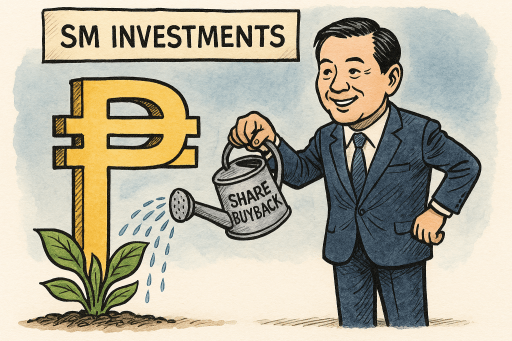
    Buyback Program: Boost for Valuation, Strain on Liquidity?

    In February, SMIC launched a ₱60 Billion share buyback program, repurchasing 3.7 Million shares at an average price of ₱764.08, totaling ₱2.8 Billion as of September. The move signals confidence and could support share price by reducing supply and lifting earnings per share, which rose to ₱52.73 year-to-date.

    Analysts note, however, that the buyback coincides with declining cash reserves—₱85.8 Billion, down 24% from year-end—and hefty near-term debt maturities of ₱126 Billion. “The program is positive for valuation, but balancing shareholder returns with liquidity and refinancing needs will be critical,” one market strategist said.

    Debt and Liquidity

    SMIC’s interest-bearing debt climbed to ₱511.4 Billion, while the current portion of long-term debt rose to ₱126 Billion. Despite this, leverage ratios remain stable, with a current ratio of 1.1x and interest cover at 8.6x.

    Outlook

    Management expects continued expansion in retail and property, with SM Prime targeting ₱100 Billion in capex for malls, residential projects, and integrated developments. However, risks loom from residential sales timing, banking sector dependency, and liquidity pressures amid aggressive capital allocation.

  • First Gen’s ₱50B Gas Asset Sale Signals Strategic Pivot Amid Earnings Decline and Execution Risk

    First Gen’s ₱50B Gas Asset Sale Signals Strategic Pivot Amid Earnings Decline and Execution Risk

    First Gen Corporation (FGEN) is moving forward with a landmark transaction to sell 60% of its gas-fired power generation and LNG infrastructure business to Prime Infrastructure Capital Inc. for ₱50 billion, following regulatory clearance from the Philippine Competition Commission (PCC). The deal includes the Santa Rita, San Lorenzo, San Gabriel, and Avion gas plants, as well as the Batangas LNG terminal, which began commercial operations in January 2025.

    The transaction marks a strategic pivot for the Lopez-led energy firm, which is increasingly focused on expanding its renewable energy portfolio and infrastructure assets. First Gen will retain a 40% stake in the gas platform, ensuring continuity and future upside participation.


    Revenue and Earnings Decline Underscore Strategic Urgency

    For the nine months ended September 30, 2025, consolidated revenues fell 3.3% year-on-year to US$1.786 billion, while net income declined 2.0% to US$265.8 million. The downturn was driven primarily by the gas generation segment, where San Gabriel’s transition to merchant trading following the expiry of its power supply agreement in February 2024 led to a 61% drop in revenue and a swing to net loss.

    Despite stronger performance from Santa Rita and San Lorenzo, the overall natural gas platform’s net income attributable to the parent fell 5.5%. The geothermal and wind segment (EDC) also faced pressure due to lower selling priceshigher depreciation, and increased interest expenses from recent borrowings. However, the Batangas LNG terminal emerged as a bright spot, contributing ₱1.92 billion in net income in its first nine months of operations.


    Execution Risk: Will the Deal Materialize?

    While the transaction has cleared regulatory hurdles, its ₱50 billion valuation—nearly equivalent to FGEN’s entire market capitalization—raises questions about execution risk.

    “This is a high-stakes transaction,” said an energy sector analyst. “Prime Infra is essentially valuing the gas platform at more than the whole company. If market conditions shift or LNG economics deteriorate, there’s a real possibility they could reassess.”

    The deal’s success hinges on final documentation, closing conditions, and Prime Infra’s continued appetite for gas infrastructure amid global energy transition pressures.


    Outlook: What Happens to FGEN Shares if the Deal Falls Through?

    Analysts warn that failure to close the transaction could weigh heavily on investor sentiment. The market has partially priced in expectations of a ₱50 billion cash infusion, which would strengthen FGEN’s balance sheet and accelerate its renewable energy expansion.

    If the deal collapses:

    • Share price downside risk: FGEN could trade back toward its pre-announcement levels, as the anticipated deleveraging and growth funding would evaporate.
    • Valuation pressure: Investors may re-focus on the merchant risk at San Gabriel, earnings volatility in the gas segment, and slower capital recycling.
    • Strategic overhang: Questions on FGEN’s ability to execute its pivot to clean energy without the transaction proceeds could dampen multiples.

    Conversely, if the deal closes as planned, analysts expect a potential re-rating driven by improved earnings quality, lower leverage, and clearer renewable growth visibility.


    Strategic Reset in Motion

    First Gen has already prepaid ₱20 billion in peso-denominated loans, signaling its intent to use the proceeds for deleveragingrenewable energy expansion, and potential shareholder returns. The company is advancing projects such as the Aya pumped-storage facilityTanawon geothermal plant, and multiple battery energy storage systems (BESS).

    “This is a strategic reset,” said a source familiar with the transaction. “First Gen is positioning itself for the next decade of clean energy growth, while monetizing assets that are becoming more volatile.”

    The transaction is expected to close in the coming months, subject to final documentation and remaining closing conditions.