Tag: finance

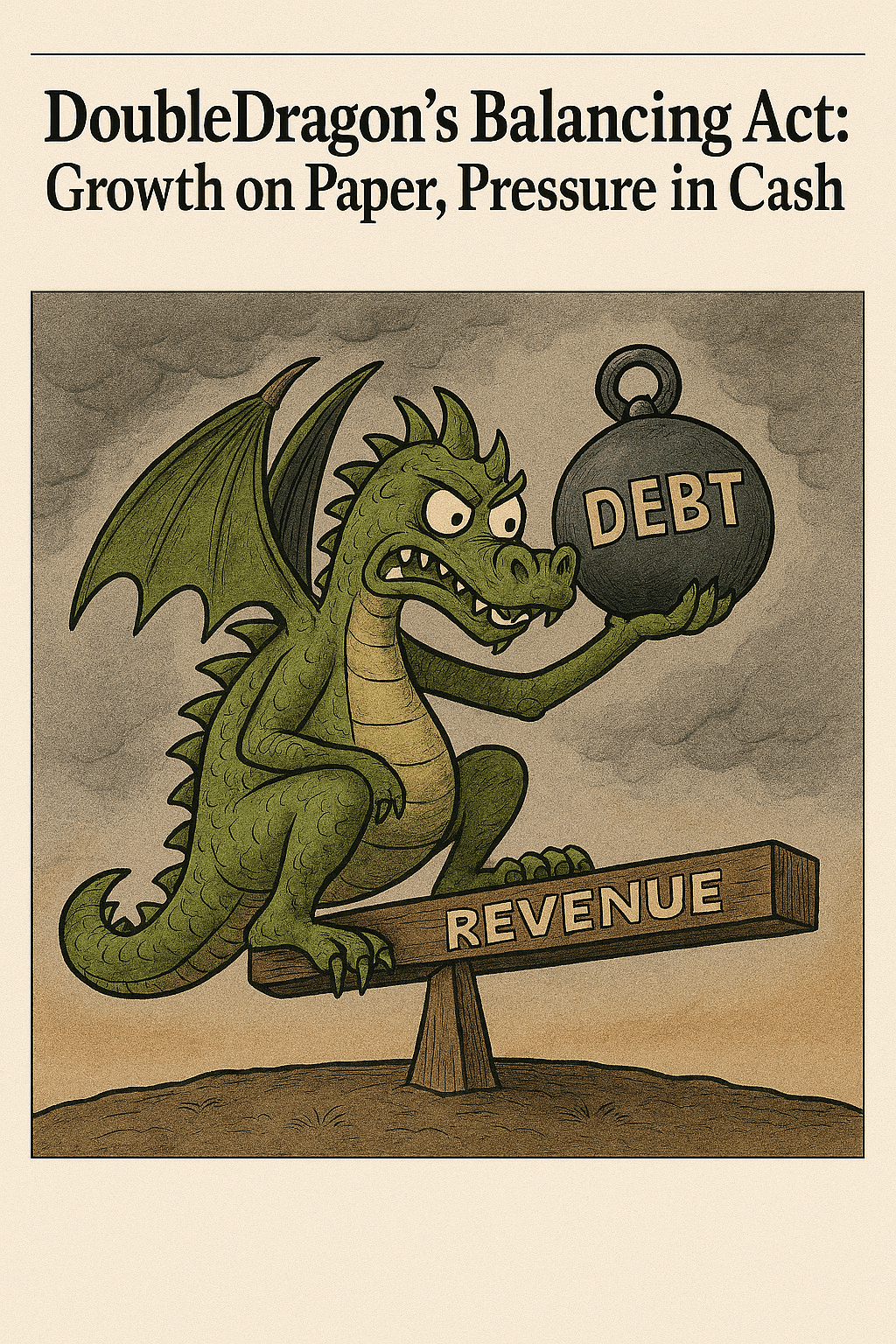
  • DoubleDragon’s Balancing Act: Growth on Paper, Pressure in Cash

    DoubleDragon’s Balancing Act: Growth on Paper, Pressure in Cash

    DoubleDragon Corporation’s latest quarterly filing paints a picture of ambition—and exposure. On the surface, the numbers sparkle: revenues surged 63% year-on-year to ₱10.5 billion for the first nine months of 2025, powered by real estate sales and steady rental streams. Net income held at ₱2.55 billion, barely up from last year, but enough to keep the optics positive.

    Scratch deeper, and the sheen dulls. Nearly 42% of that revenue came from unrealized fair value gains and tenant penalties—items that look good in a report but don’t pay the bills. Strip those out, and the core engine—rent and hotel operations—struggles to cover a ballooning interest tab. Financing costs doubled to ₱2.39 billion, and in the third quarter alone, they wiped out profits for common shareholders, leaving the parent with a ₱47.7 million loss.

    The balance sheet tells its own story: net debt hovers near ₱86 billion, cushioned by equity of ₱101 billion. Bonds issued this year lock in rates north of 7%, some as high as 9.5%, ensuring that interest pressure won’t ease soon. Operating cash flow? Deep in the red at negative ₱7.93 billion, offset only by ₱9 billion in fresh financing. Liquidity ratios look healthy on paper, but the reliance on debt markets is a vulnerability in any tightening cycle.

    Receivables ballooned to ₱21.8 billion, with impairment provisions climbing. Penalty income—₱2.5 billion so far—suggests tenants are paying late. Good for accounting, bad for cash. Add to that the execution risk of Hotel101’s global rollout and the long-promised industrial REIT, and you have a company juggling growth narratives with hard realities.

    To be fair, DoubleDragon is asset-rich and opportunistic. Investment properties rose to ₱169.6 billion, and its REIT arm continues to spin off dividends. But the question for investors is simple: can recurring cash flows catch up with the financing load before the next refinancing cycle? If leasing momentum and hotel pre-sales deliver, the story holds. If not, the cracks widen.

    For now, DoubleDragon remains a case study in modern property playbooks—leveraged growth, valuation-driven earnings, and a race against time to turn paper gains into hard cash. Watch the interest coverage ratio, operating cash flow, and receivables aging. In this game, liquidity isn’t just a metric—it’s survival. 

    Subscribe to Support Free & Independent Research

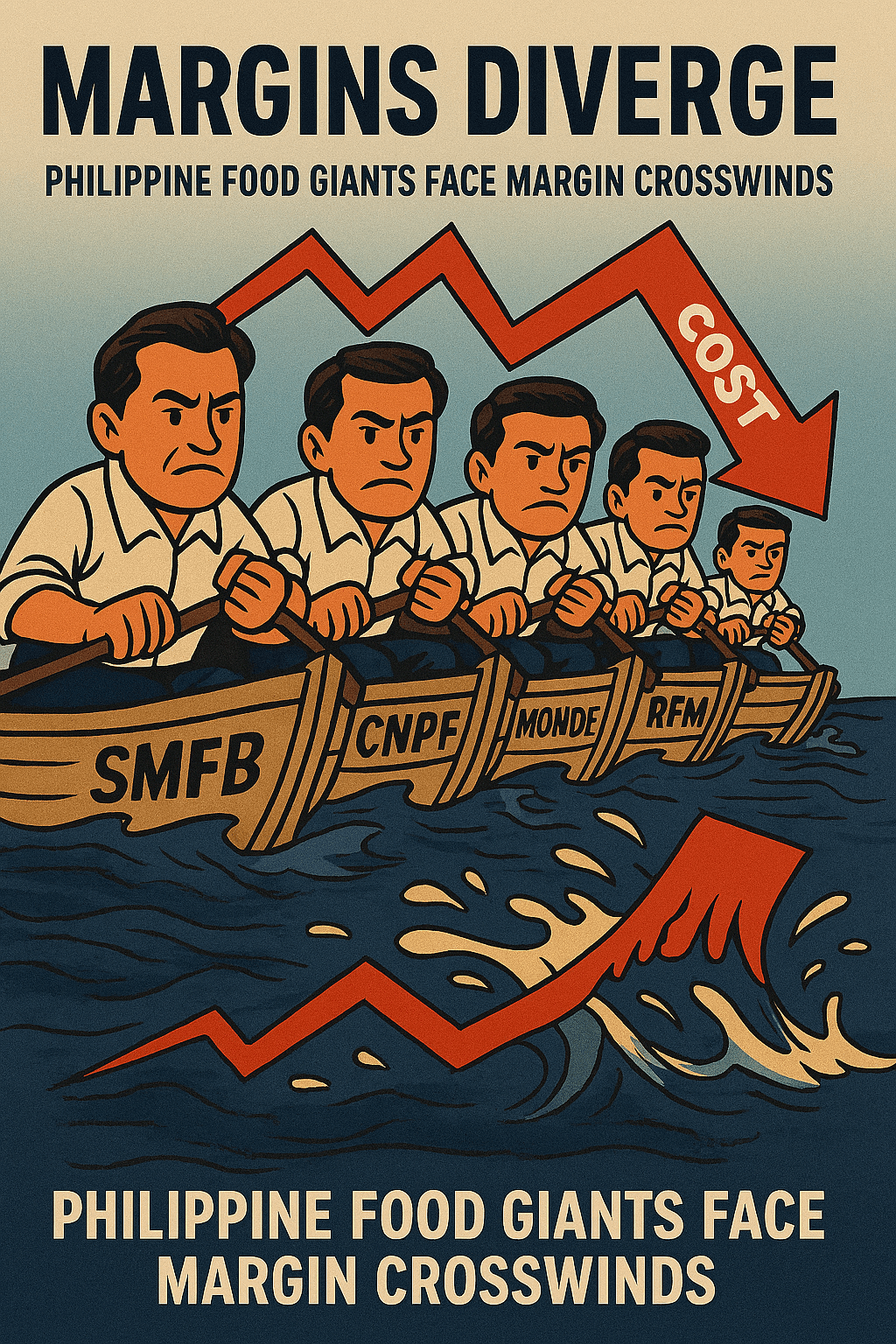
  • Margins Diverge as Philippine Food Majors Face Cost Crosswinds

    Margins Diverge as Philippine Food Majors Face Cost Crosswinds

    SMFB widens profitability; CNPF and MONDE see compression; URC nudged lower; RFM holds firm despite cash flow squeeze

    The Philippines’ leading packaged food and beverage players posted mixed margin outcomes in their nine‑month 2025 results, highlighting how input-cost volatility, pricing discipline, and working‑capital choices are reshaping profitability across the sector. Sales growth was broadly positive, but margin trajectories diverged: San Miguel Food and Beverage (SMFB) expanded margins; Century Pacific Food (CNPF) and Monde Nissin (MONDE) saw compression; Universal Robina Corp. (URC) edged lower; and RFM Corp. preserved healthy margins while absorbing a hit to operating cash flows.

    Sales: Mid‑single to high‑single digit growth, with branded segments leading

    SMFB’s consolidated revenues rose 4% to ₱302.9 billion on resilient demand and brand execution across food, beer, and spirits—food up 7%, spirits up 7%, beer steady—supporting scale benefits into the third quarter. Management underscored supply chain productivity and capacity expansion as margin enablers alongside revenue momentum. 

    URC delivered ~5% top‑line growth (TTM revenue ₱166.1 billion), propelled by snacks and ready‑to‑drink beverages domestically and stronger performance from Munchy’s in Malaysia and Indonesia. However, elevated coffee input costs—still roughly twice 2023 levels—tempered EBIT expansion, setting the stage for margin pressure despite volume gains.

    CNPF’s sales grew 8% to ₱61.8 billion, with the branded portfolio up 12% and OEM exports recovering after a soft first half. Management flagged “all‑weather” staples demand, easing inflation (notably rice), and brand investments as the primary growth drivers into Q3, where quarterly revenue accelerated 15% year‑on‑year.

    Monde Nissin posted 3.5% growth to ₱63.3 billion, anchored by APAC Branded Food & Beverage (BFB) up 4.4% year‑to‑date, while meat alternatives contracted 3.9% on a constant‑currency basis. The company cited biscuits and “others” categories as domestic volume pillars and guided to sequential BFB margin improvement heading into 4Q25–2Q26.

    RFM recorded 1.8% sales growth to ₱15.23 billion, indicative of flat-to-steady demand in pasta, milk, flour, buns, and ice cream JV products. Despite modest revenue growth, management reiterated its confidence in a stronger fourth quarter driven by category momentum and historical seasonality.


    Margins: SMFB expands; CNPF and MONDE compress; URC softens; RFM resilient

    SMFB: Group profitability improved, with EBITDA up 13% to ₱58.4 billion and overall margins widening to 19%. Margin gains were attributed to cost and operational efficiencies across divisions, most notably in food and spirits, with disciplined pricing underpinning resilience against weather‑related disruptions.

    URC: Gross margin around 26.1% on a trailing basis, below FY2024’s ~27.0% and the company’s five‑year average (~27.7%), reflecting persistent coffee cost inflation and normalization across commodities. Management acknowledged EBIT pressure in the Philippines, partially offset by overseas scale and cost programs, implying modest margin decline versus last year despite top‑line strength. 

    CNPF: Gross margin compressed by 110 bps to 25.5% year‑to‑date, driven by normalizing input costs after a period of favorable commodity tailwinds. Notably, operating expenses fell 90 bps as a share of sales, cushioning the margin squeeze and allowing net income to grow 10% to ₱5.8 billion

    Monde Nissin: Consolidated gross margin declined 160 bps to 33.3% for nine months, with edible oil inflation weighing on APAC BFB even as sequential margin recovery emerged on pricing actions and reformulation. Meat alternatives posted gross margin improvement and EBITDA positivity, but the segment’s revenue contraction offset group‑level gains, resulting in overall margin decline year‑to‑date.

    RFM: Margins remained strong despite flat sales—EBITDA of ₱830 million, implying an EBITDA margin of ~15.2%—as lower selling and marketing expenses and lean G&A lifted operating margin to ~11.2%. While the company did not report year‑on‑year basis‑point changes, commentary and segment detail point to a stable-to‑improving margin mix led by consumer products.


    Operating Cash Flow: Strength for MONDE and URC; strain at RFM; SMFB and CNPF steady

    Monde Nissin reported ₱8.7 billion operating cash flow in the period, supported by lower operating costs in meat alternatives, foreign‑exchange tailwinds, and targeted pricing in APAC BFB, even as edible oils remained a drag on gross margins. URC likewise showed solid cash generation (TTM operating cash flow ₱12.86 billion), underpinned by working‑capital normalization across branded and commodities businesses.

    RFM’s operating cash flow fell sharply to ₱141 million from ₱1.3 billion a year ago, largely due to inventory buildup (over ₱1 billion) and reduced payables, which tightened liquidity despite sound income statement margins. Management emphasized inventory normalization and cash discipline as fourth‑quarter priorities. 

    SMFB highlighted a solid financial position—with sustained earnings power and prudent capital management—but did not disclose detailed nine‑month OCF figures. CNPF continued to invest in strategic growth (plant‑based and coconut operations) while maintaining low leverage and healthy liquidity metrics, reinforcing cash resilience despite gross margin compression. 

    Balance Sheets: Liquidity cushions intact; leverage disciplined

    SMFB’s disclosures show total consolidated debt of ₱ 187.2 billion as of September 30, 2025, balanced by robust earnings and margin expansion across key segments, providing flexibility for capacity investments and brand support. 

    URC’s financials reflect a strong asset base and conservative leverage, with ongoing margin headwinds from coffee mitigated by international scale and cost controls; CNPF maintains a current ratio of ~2.0 and a debt‑to‑equity ratio of ~0.24, indicating prudent gearing. 

    Monde Nissin maintains a net cash position (₱11.2 billion), a current ratio of 2.34, and minimal debt, reinforcing flexibility to sustain dividend payouts and fund margin‑restoration initiatives in APAC BFB. RFM also sits on net cash with current ratio ~1.36, though the nine‑month working‑capital swing is a near‑term watch‑item.


    Bottom Line: Five companies, five margin paths

    • SMFB stands out for margin expansion via cost discipline and pricing, despite weather and input‑cost noise. 
    • URC delivers volume‑led growth but faces slightly lower gross margin amid elevated coffee costs. 
    • CNPF sustains double‑digit profit growth even as gross margin compresses on commodity normalization.
    • Monde Nissin shows sequential margin recovery but a year‑to‑date decline, with edible oils the main headwind and meat alternatives improving.
    • RFM maintains strong margins but must rebuild operating cash flow after a working‑capital drawdown. 

    Investor lens: Expect continued focus on pricing, mix, and cost programs to protect margins, with working‑capital discipline (especially inventories and payables) a differentiator into year‑end. Companies with net cash and low leverage (Monde, RFM, CNPF) retain optionality for dividends and capex, while scale players (SMFB, URC) leverage brand strength to buffer input volatility.

    SUBSCRIBE TO SUPPORT FREE & INDEPENDENT RESEARCH

  • Century Pacific Food Posts Solid Q3 Growth, But Working Capital and Margin Pressures Loom

    Century Pacific Food Posts Solid Q3 Growth, But Working Capital and Margin Pressures Loom

    Century Pacific Food, Inc. (PSE: CNPF), one of the country’s leading branded food manufacturers, reported strong third-quarter results, with consolidated revenues and earnings accelerating on the back of robust branded segment growth. However, the company faces emerging financial and operational risks tied to margin compression, working capital strain, and export volatility.

    Earnings Surge Amid Branded Segment Strength

    For the nine months ended September 30, 2025, CNPF posted ₱61.79 billion in revenues, up 8.5% year-on-year, while net income rose 9.6% to ₱5.78 billion. Earnings per share climbed to ₱1.63 from ₱1.49 last year.
    Third-quarter performance was even stronger, with revenues jumping 14.9% to ₱22.07 billion and net income up 14.8% to ₱1.89 billion, signaling accelerating momentum in branded categories such as marine, meat, and dairy.

    Management attributed the gains to double-digit volume growth in branded products and improved consumer purchasing power amid stable inflation. Meanwhile, OEM exports (tuna and coconut) softened by 5% year-to-date but showed signs of recovery in Q3 as global trade conditions stabilized.


    Risk Areas Identified

    Despite the upbeat earnings, the report reveals several vulnerabilities that investors should monitor:

    1. Working Capital Pressure
      • Trade receivables surged 30% to ₱13.95 billion, while advances to suppliers more than doubled (+118%).
      • Operating cash flow fell sharply to ₱2.97 billion from ₱4.87 billion last year, reflecting heavier working capital requirements.
    2. Margin Sensitivity
      • Gross margin contracted 110 basis points to 25.5%, driven by higher input costs.
      • While operating expenses were trimmed to offset some pressure, commodity price volatility and FX risk remain key threats.
    3. OEM Export Volatility
      • Tuna and coconut exports declined 5% year-to-date, exposing CNPF to global trade uncertainties and demand cycles.
    4. Debt Maturity Concentration
      • Short-term notes payable ballooned to ₱4.02 billion from ₱200 million, with ₱4.0 billion due within 12 months.
      • Although gearing remains low at 0.19x, refinancing risk could rise if liquidity tightens.
    5. Inventory Build-Up
      • Inventories climbed nearly 9% to ₱20.24 billion, extending the cash conversion cycle to 80 days, which could increase exposure to obsolescence and price swings.

    Capital Allocation and Outlook

    CNPF declared ₱1.10 per share in dividends (₱0.55 regular and ₱0.55 special), representing a 61% payout ratio. Capital expenditures reached ₱2.2 billion, including plant upgrades and the acquisition of U.S.-based plant-based brand Loma Linda, reinforcing its health and wellness portfolio.

    Looking ahead, management will need to balance growth investments with tighter working capital discipline and margin protection. The company’s ability to manage input cost volatility, normalize cash flows, and sustain branded momentum will be critical as it navigates global trade uncertainties and domestic inflation risks.


    Bottom Line: Century Pacific Food delivered strong Q3 earnings and revenue growth, but rising working capital needs, margin compression, and short-term debt obligations underscore the importance of disciplined financial management in the coming quarters.

    SUBSCRIBE TO SUPPORT FREE & INDEPENDENT RESEARCH

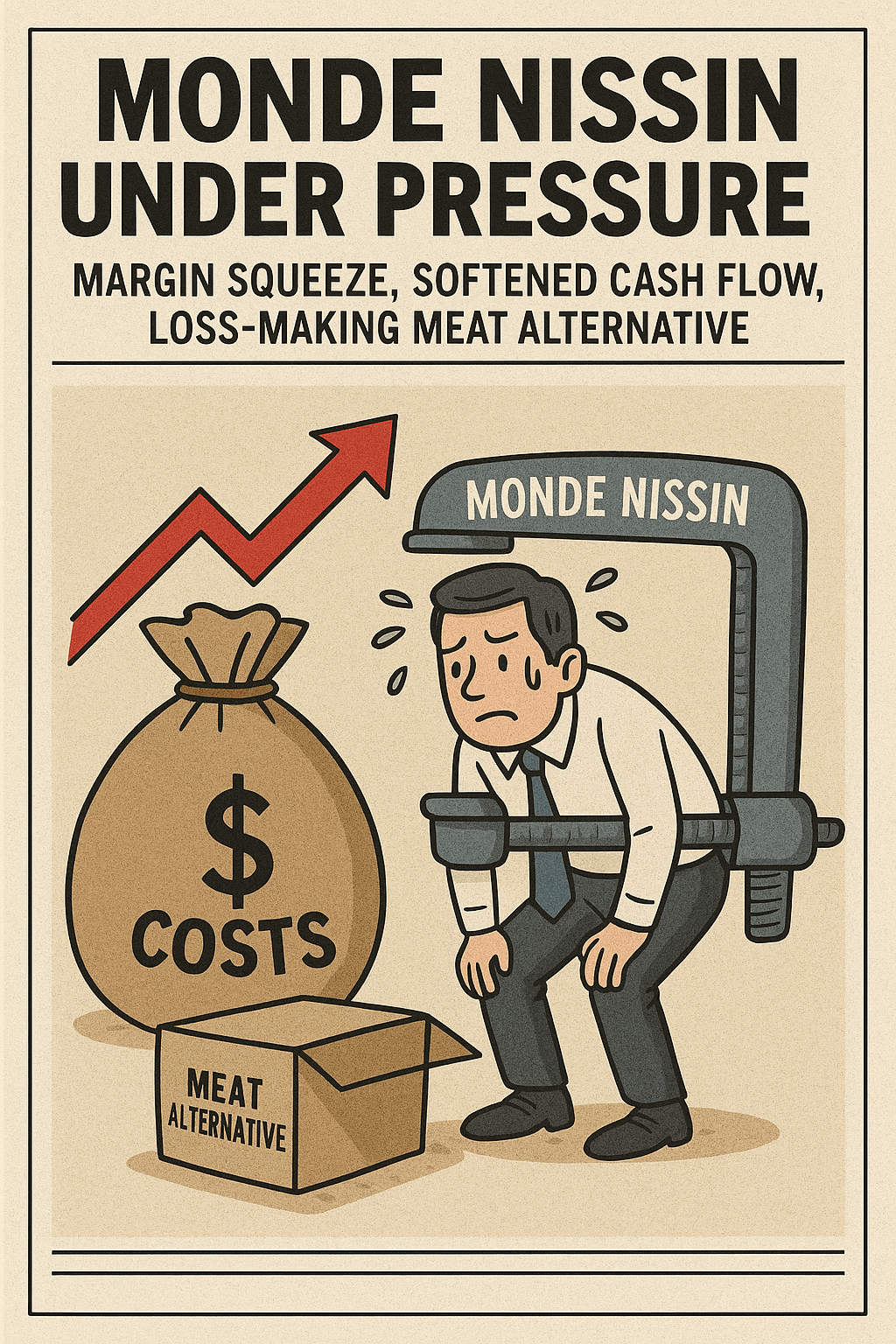
  • Monde Nissin Faces Margin Squeeze Amid Rising Input Costs; Operating Cash Flow Softens, Meat Alternative Still in the Red

    Monde Nissin Faces Margin Squeeze Amid Rising Input Costs; Operating Cash Flow Softens, Meat Alternative Still in the Red

    Monde Nissin Corporation reported continued pressure on its profit margins for the first nine months of 2025 as soaring edible oil prices weighed on its core branded food business, even as net income rose on cost initiatives and foreign exchange gains.

    The company’s gross margin slipped to 33.3% from 34.9% a year earlier, with its Asia-Pacific Branded Food & Beverage segment posting a sharper decline to 34.8%. Management attributed the drop to higher palm and coconut oil costs, which offset stable wheat prices and early benefits from price adjustments and cost-saving measures.

    “Commodity inflation remains a key headwind,” the company said in its quarterly filing, noting that while raw material requirements for 2025 have been secured, volatility could persist into 2026.

    Despite the margin squeeze, Monde Nissin booked a 9.6% increase in net income to ₱6.67 billion, supported by lower financing costs and a swing to foreign exchange gains. However, cash generation showed signs of strain.

    Operating cash flow for the nine-month period edged down to ₱8.74 billion from ₱8.91 billion last year, as inventories climbed 6.3% to ₱9.48 billion and prepayments surged nearly 40%, tying up liquidity. The company also settled trust receipt payables early to manage interest and currency exposure, further reducing cash reserves.

    Meanwhile, Monde’s Meat Alternative business, which includes the Quorn brand, remained loss-making despite signs of improvement. The segment posted a ₱1.04 billion net loss year-to-date, narrower than last year’s ₱2.05 billion deficit, as supply chain transformation and cost efficiencies lifted gross margin to 25% from 21.4%. UK retail sales stabilized in the second and third quarters, but category softness and lower production volumes continue to weigh on performance.

    Monde Nissin closed the quarter with ₱14.45 billion in cash, a debt-to-equity ratio of 0.34x, and announced a ₱0.16 per share dividend payable in January 2026. Analysts say the group’s strong balance sheet provides a buffer, but warn that prolonged commodity volatility, working capital pressures, and ongoing losses in the Meat Alternative segment could weigh on future cash flows.

    SUBSCRIBE TO SUPPORT FREE & INDEPENDENT RESEARCH

  • China Bank: A Core Engine Running Strong—But Can It Outpace Market Headwinds?

    China Bank: A Core Engine Running Strong—But Can It Outpace Market Headwinds?

    When China Banking Corporation filed its third-quarter report with the SEC this November, the headline number—₱20.23 billion in nine-month net income—looked reassuring. A 10% year-on-year increase in profit is no small feat in a year marked by global volatility and a domestic economy slowing to 4% GDP growth. But as always, the story behind the numbers is where the real insight lies.

    The Core Strengths
    China Bank’s core banking engine is humming. Net interest income surged 15.2% to ₱53.5 billion, powered by a 6.2% expansion in loans and an improved net interest margin of 4.58%. These are enviable metrics in a competitive market. Efficiency gains are evident too: the cost-to-income ratio improved to 45% from 48%, signaling disciplined expense management even as the bank invests in technology and talent.

    Asset quality remains a bright spot. Non-performing loans are steady at 1.6%, and coverage is a robust 123%. Capital ratios—CET1 at 14.97% and total CAR at 15.85%—comfortably clear regulatory minimums, giving the bank room to grow and reward shareholders. Speaking of rewards, the board declared a hefty ₱ 2.50-per-share dividend earlier this year, including a special ₱1.00 payout. For investors seeking stability, these are reassuring signals.

    The Cracks Beneath the Surface
    Yet, the picture isn’t all rosy. Treasury operations have been a thorn in China Bank’s side, with trading and securities losses ballooning to ₱10.54 billion year-to-date. In a rising-rate environment, a securities book that accounts for roughly a third of total assets is a double-edged sword—liquid, yes, but vulnerable to mark-to-market swings. Add to that a funding mix tilted toward time deposits (CASA ratio stuck at 44.7%), and you have a franchise more exposed to interest rate pressures than peers with stronger low-cost deposit bases.

    Credit provisioning is another watchpoint. The bank set aside ₱6.99 billion for impairment and credit losses—nearly five times last year’s level. While this speaks to prudence, it also eats into earnings momentum. And while non-interest income flipped positive, much of it came from one-off gains: ₱6.99 billion from asset foreclosures and a ₱1.4 billion boost from associates, thanks to the renewal of its bancassurance joint venture with Manulife. Strip these out, and the underlying run-rate looks less spectacular.

    The Bigger Picture
    China Bank’s franchise remains formidable. It boasts strong governance credentials, industry accolades, and a diversified footprint spanning retail, institutional, and wealth segments. Subsidiaries like China Bank Savings and China Bank Capital add breadth to its offering. But the challenge ahead is clear: sustain core growth while taming volatility in treasury and building a more resilient funding base.

    For investors, the takeaway is nuanced. If markets stabilize and credit costs normalize, China Bank’s fundamentals could shine brighter than its current headline numbers suggest. But if rate swings persist and one-off gains dry up, expect earnings to feel the strain.

    In short, China Bank is a study in contrasts—a high-quality engine navigating a bumpy road. The question for 2026 is whether management can keep the wheels turning smoothly when the terrain gets rough.

    Subscribe to Support Free & Independent Research

  • Shakey’s Bold Expansion: Growth at a Cost

    Shakey’s Bold Expansion: Growth at a Cost

    Shakey’s Pizza Asia Ventures Inc. (PSE: PIZZA) has long been a household name in the Philippines, and its latest quarterly filing shows why: systemwide sales surged 14% to ₱17.7 billion, and net revenue climbed 12% to ₱11.24 billion for the first nine months of 2025. On the surface, this looks like a victory lap for a brand celebrating its 50th year in the country.

    But dig deeper into the numbers, and a more nuanced story emerges—one of growth bought at a price.


    The Expansion Gamble

    Shakey’s is in the middle of an aggressive rollout, adding new stores, renovating existing ones, and expanding its multi-brand portfolio, which includes Peri-Peri Charcoal Chicken and Potato Corner. This strategy is designed to cement its dominance in casual dining and kiosks, but it comes with short-term pain.

    The company’s gross margin slipped to 22.6% from 24.3%, and operating margin fell to 8.9%, despite double-digit revenue growth. Why? Pre-opening costs and renovation expenses—the unavoidable toll of rapid expansion. Management admits as much in its SEC filing: improving input costs were overshadowed by network investments.


    Debt and Interest: The Hidden Weight

    Expansion isn’t cheap. Shakey’s poured ₱693 million into capital expenditures this year, and while operating cash flow remains strong at ₱1.03 billion, the company leaned on debt to keep the engine running. Interest expense jumped 18% to ₱348 million, fueled by a loan repricing to 6.3% and short-term borrowings swelling to ₱1.32 billion.

    This financing burden shaved pretax margins and dragged EPS down to ₱0.34 from ₱0.40. Yet, in a move that will please shareholders but raise eyebrows among analysts, Shakey’s still declared a ₱ 0.20-per-share dividend—tightening internal funding at a time when liquidity is already under pressure.


    Liquidity: A Thinner Cushion

    Cash reserves fell to ₱821 million from ₱1.32 billion at year-end 2024. The current ratio eased to 1.3x, signaling a slimmer buffer against short-term obligations. While the company’s cash conversion cycle improved to 17 days—a testament to operational discipline—the reality is clear: expansion has narrowed financial flexibility.


    The Bigger Picture

    None of this means Shakey’s is in trouble. Its core EBITDA rose 14% to ₱1.8 billion, and its franchising model remains a powerful lever for long-term growth. But investors should recognize the trade-off: today’s margin squeeze and liquidity strain are the price of tomorrow’s market share.

    The question is whether the payoff will justify the cost. If new stores ramp up quickly and financing costs stabilize, Shakey’s could emerge stronger than ever. If not, the company may find itself juggling debt, leases, and shareholder expectations in a tougher consumer environment.


    Bottom line: Shakey’s is betting big—and for now, the bet is eating into margins and cash. For growth-focused investors, that may be acceptable. For those who prize near-term profitability, caution is warranted.

    Subscribe to Support Free & Independent Research

  • From Gas to Media: Why a ₱50‑Billion Windfall Could Be the Lopez Group’s Lifeline

    From Gas to Media: Why a ₱50‑Billion Windfall Could Be the Lopez Group’s Lifeline

    The Weekend Read from the Trading Desk: How upstreaming First Gen’s proceeds to First Philippine Holdings could stabilize ABS‑CBN—and safeguard the conglomerate’s access to bank capital.

    The moment that changed the calculus

    When Prime Infrastructure Capital, Inc. reached financial close on November 17–18, 2025, for its ₱50‑billion purchase of a 60% stake in First Gen Corporation’s (FGEN) Batangas gas platform—spanning the Santa Rita, San Lorenzo, San Gabriel, Avion plants and the offshore LNG terminal—the news cycle framed it as an energy transition milestone. But the deal also cracked open a once‑in‑a‑decade capital window for the Lopez Group: with liquidity crystallized at FGEN, the conglomerate can channel cash upstream to First Philippine Holdings (FPH) and redeploy it where reputational risk is highest—ABS‑CBN

    Prime Infra’s majority control across the mid‑stream and downstream gas value chain complements its upstream Malampaya operations, while FGEN retains 40% and a strategic voice—ensuring continuity and synergies even as capital is released. For Lopez watchers, the takeaway is simple: a ₱50‑billion windfall now sits where intercorporate cash movements are feasible and fast.


    Why the windfall matters beyond energy

    FPH directly and indirectly owns ~67.84% of FGEN’s common stock, giving it clear governance over dividend policy. That ownership is documented in PSE corporate filings and corroborated by independent market data services. In other words, FPH is positioned to receive any special cash dividends that FGEN’s board might declare in the wake of the Prime Infra transaction. 

    Critically, intercorporate dividends from a domestic corporation to another domestic corporation are tax‑exempt under Philippine law; such dividends are excluded from the recipient’s taxable income. This means FGEN → FPH cash upstreaming can occur with minimal leakage—a powerful lever when capital needs to move quickly within a group to neutralize risk elsewhere.


    The crisis in the media arm—now a group‑wide concern

    ABS‑CBN’s financial condition remains strained five years after the franchise loss. Public disclosures and Q3 2025 updates indicate ongoing losses and—more worryingly—technical default dynamics: loan covenant breaches and reclassification of interest‑bearing loans as current, which signal heightened acceleration risk. Even as content partnerships and digital pivots slowly rebuild revenue, liquidity remains tight. 

    Under the Financial Rehabilitation and Insolvency Act (FRIA), insolvency is assessed via cash‑flow (inability to pay debts as they fall due) and balance‑sheet (liabilities exceeding assets) tests. ABS‑CBN is not balance‑sheet insolvent today, but the cash‑flow risk is elevated because a technical default can quickly morph into payment default if lenders accelerate. That is the trigger point boards are paid to anticipate—and defuse.


    The imperative: protect bankability across the Lopez constellation

    Why move now? Because bank lenders assess conglomerates holistically. A distressed flagship can contaminate credit perceptions for siblings; in practice, ABS‑CBN’s covenant issues may constrain Lopez units’ access to new loans or favorable terms, no matter how robust their standalone metrics. For a group whose growth engine relies on long‑tenor project finance in power, real estate, and infrastructure, this is existential. The Prime Infra–FGEN deal gives Lopez the means to restore confidence quickly by stabilizing ABS‑CBN and thereby protecting the group’s credit story

    In capital markets, optics matter as much as numbers: a clean resolution of ABS‑CBN’s near‑term maturities and covenants reassures banks and rating committees that the group can manage cross‑portfolio risk. That reassurance is exactly what the windfall is designed to buy.


    How the money moves: fast, tax‑efficient upstreaming

    Mechanically, the simplest route is for FGEN to declare a special cash dividend, which FPH receives tax‑exempt as a domestic intercorporate dividend. FPH can then deploy proceeds into ABS‑CBN through equity infusionsecured shareholder loans, or escrowed cure funds structured to address current debt and lender waivers. The tax rules are clear, and the corporate records confirm FPH’s control of FGEN—a high‑certainty path with minimal friction. 

    Alternative capital return mechanisms—such as share buybacks or capital reductions—exist, but dividends are faster and cleaner for a time‑critical stabilization. The key is calibrating size: ₱12–₱15 billion can cure covenants, reclassify loans to noncurrent, and restore working capital₱20–₱24 billion provides a full reset, retiring near‑term debt and funding a 12‑month runway for operational turnaround.


    The rescue blueprint in three moves

    Move 1: Cure acceleration risk.
    FPH funds an escrow to prepay or secure waivers on ABS‑CBN’s current loans, taking the oxygen away from technical default. This resets the maturity wall, buys time, and signals lender discipline at the corporate center. 

    Move 2: Rebuild working capital.
    An equity injection restores the current ratio >1.0 and provides operating liquidity, crucial while monetization from content/IP and digital distribution scales. Stabilization capital is a bridge, not a destination. 

    Move 3: Consolidate governance—cash acquisition or share swap.
    FPH can buy Lopez, Inc.’s 55.82% block of ABS‑CBN (documented in PSE Top‑100 stockholders lists and media ownership monitors), triggering a mandatory tender offer to minorities at the same price; or execute a share‑for‑share exchange that may qualify as a tax‑free reorganization under Section 40(C)(2). Both routes put ABS‑CBN inside FPH—simplifying accountability and capital discipline. 


    The rules of engagement: tender offers and antitrust

    In the Philippines, the Securities Regulation Code (SRC) Rule 19 requires a mandatory tender offer when a person or group crosses control thresholds (e.g., ≥35% or >50%), or builds ≥15% within a year with intent declared. Offers can be cash or shares; fairness opinions are standard to protect minority holders. Proper sequencing and disclosures keep the process compliant and clean. 

    On antitrust, the Philippine Competition Commission (PCC) increased notification thresholds effective March 1, 2025, to ₱8.5 billion (Size of Party) and ₱3.5 billion (Size of Transaction). A FPH–ABS‑CBN control deal would likely surpass both, requiring compulsory notification and a formal review. PCC practice is established; early pre‑consultations can streamline timelines.


    Share‑for‑share swaps: attractive—but mind the dilution

    share‑for‑share exchange offers an elegant, potentially tax‑deferred path under Section 40(C)(2) (CREATE), provided consideration is solely voting stock and the acquirer gains control. However, swaps issue new FPH shares, risking dilution of Lopez’s control at FPH if minorities receive paper. Boards must calibrate swap ratios to preserve governance while achieving consolidation. 

    The cash acquisition alternative addresses dilution outright. With liquidity from FGEN in hand, FPH can buy the controlling block and run the tender offer in cash—a faster, simpler route when the imperative is stability and bank optics


    FRIA as the backstop—why you don’t want to use it

    While FRIA provides a court‑supervised path for rehabilitation with stay orders and receiver oversight, it is a backstop—not a strategy. Filing invites public scrutiny and can chill lenders across the group. The smarter move is pre‑emptive stabilization: cure covenants, remove acceleration threat, and avoid the optics of judicial intervention. Rescue capital is cheaper than the uncertainty of FRIA

    In short, FRIA is your Plan Z. If FGEN’s windfall exists precisely to avoid cross‑portfolio contagion, using FRIA would contradict the whole purpose of upstreaming liquidity. 


    Banking relationships: the real prize

    For a conglomerate like Lopez, bankability underpins everything—from geothermal expansions to industrial parks and high‑rise communities. The Prime Infra–FGEN deal strengthens the energy narrative, but ABS‑CBN’s unresolved maturities can still cast a shadow. Stabilization is therefore not merely a media rescue; it is a capital markets strategy to protect borrowing capacity at scale. 

    Bank credit committees do not compartmentalize risk as neatly as organograms do. Demonstrating swift, disciplined resolution at ABS‑CBN sends a signal that group governance is active and integrated—a signal banks reward with pricing and availability


    Governance and optics: doing right by minorities

    If FPH acquires ABS‑CBN control, minority shareholders must be offered the same price via the tender offer. Independent fairness opinions and transparent valuation disclosures mitigate controversy and preserve trust. In prior public M&A, these mechanics have helped align stakeholder expectations and reduce litigation risk. The playbook is established; the onus is on execution quality. 

    For antitrust, scheduling and completeness matter. PCC has clear thresholds and review processes; a disciplined filing is table stakes. Early engagement often trims the calendar and clarifies scope, limiting uncertainty for lenders and markets. 


    A realistic timeline

    Weeks 0–8: FGEN Board approves special dividend; FPH receives cash tax‑exempt and announces allocation priorities.
    Weeks 4–16: FPH funds loan cure/waivers and injects working capital into ABS‑CBN; public updates reinforce lender confidence.
    Weeks 8–26: Execute cash acquisition of controlling block and launch tender offernotify PCC; close and integrate governance. 


    What success looks like in 12–18 months

    • ABS‑CBN: No technical default; current ratio >1.0; maturities normalized; EBITDA trending positive on content/IP monetization and disciplined costs. 
    • FPH: Governance simplified (FPH → ABS‑CBN), capital discipline visible, and borrowing capacity intact for renewables and real estate. 
    • FGEN: Balanced energy portfolio post‑transaction, with renewables expansion funded and gas partnership synergy intact.

    The cost of inaction

    Conglomerates are judged by how they manage the weakest link. If ABS‑CBN’s debt profile remains unresolved, lenders will price risk across the group, blurring distinctions between strong and weak units. With ₱50 billion already realized at FGEN, failing to upstream and act would be a strategy error—one that risks higher funding costs and constrained growth at precisely the wrong moment for the Philippines’ clean‑energy and infrastructure agenda.

    The Lopez Group has the tools, the capital, and—thanks to Prime Infra—the timing. This isn’t just about saving a media icon; it’s about protecting bankability and future‑proofing a storied conglomerate. Rescue capital today is the price of strategic freedom tomorrow. 


    Sidebar: Who owns what—and why it helps

    Public data shows Lopez, Inc. as ABS‑CBN’s controlling shareholder (about 55.82% of common shares), with FPH controlling FGEN and thereby the dividend spigot. Consolidation of ABS‑CBN into FPH—whether by cash acquisition or share swap—aligns incentives and simplifies lender narratives. Ownership clarity and capital discipline are precisely what credit committees want to see when risk needs to be re‑rated. 


    The closing argument

    ₱50‑billion energy transaction has created a once‑in‑a‑generation opportunity to stabilize ABS‑CBN and protect the Lopez Group’s access to bank capital. The mechanics are straightforward, the tax path is efficient, and the regulatory routes are well‑trodden. In corporate strategy, timing is everything. The Lopez Group’s moment is now.

    Subscribe to Support Free & Independent Research

  • AUB’s Growth Story: Strong Numbers, Subtle Cracks

    AUB’s Growth Story: Strong Numbers, Subtle Cracks

    Asia United Bank (AUB) closed the third quarter of 2025 with a headline that would make any banker proud: ₱9.37 billion in nine-month net income, up 9% year-on-year, and a balance sheet that swelled to ₱417 billion. Loans surged 29%, deposits climbed 19%, and capital ratios remain comfortably above Basel III floors. On paper, it’s a picture of resilience and ambition.

    But beneath the glossy numbers, there are pressure points investors and industry watchers should not ignore.

    Margins under strain. AUB’s net interest margin slipped to 5.0% from 5.3% a year ago. Why? Deposit costs jumped 35%, while yields on securities fell 12%. With the Bangko Sentral ng Pilipinas cutting reserve requirements earlier this year, liquidity is abundant, competition is fierce, and repricing gaps are widening. For a bank that thrives on spread income, this is a structural headwind.

    Trading gains: friend or fickle? Non-interest income helped cushion the margin squeeze, rising 18% for the nine-month period. Yet the third quarter told a different story: other operating income fell 9%, dragged by weaker forex and miscellaneous gains. When markets turn, these buffers vanish quickly.

    Loan growth vs. credit risk. AUB’s loan book ballooned to ₱256.9 billion, but provisions—though up 141%—still look light against system averages. Non-performing loans are impressively low at 0.36%, far below the industry’s 3.3%, but rapid growth often tests underwriting discipline. A normalization in credit costs could dent future earnings.

    Funding mix: a double-edged sword. Demand deposits soared 26%, while savings and time deposits shrank. This tilt toward transactional balances keeps funding cheap, but it also makes liquidity more sensitive to corporate flows and competitive pull from e-wallet giants like GCash and Maya. AUB’s own HelloMoney wallet is scaling, yet the digital battlefield is crowded and unforgiving.

    Capital and liquidity cushions remain strong, with CAR at 19.5% and liquid assets at 36% of total assets. Still, the trend shows a shift toward longer-duration assets, exposing the bank to interest-rate volatility—a risk already visible in its ₱1 billion unrealized loss on FVOCI securities.

    The bigger picture? AUB is executing well: growing loans, defending CASA, and pushing digital partnerships. But the narrative for 2026 will hinge on three things: protecting margins in a low-rate, high-liquidity environment; converting HelloMoney into a daily-use ecosystem to fend off fintech giants; and keeping credit discipline tight as growth accelerates.

    For now, AUB remains a solid performer—but in banking, strength today can mask fragility tomorrow. Investors would do well to watch the cracks before they widen.

    Subscribe to Support Free & Independent Research
  • Retail Giant Puregold Posts Solid Growth, But Expansion Risks Loom

    Retail Giant Puregold Posts Solid Growth, But Expansion Risks Loom

    Puregold Price Club, Inc. (PGOLD) has once again demonstrated its resilience in the Philippine retail landscape, posting a net income of ₱7.3 billion for the first nine months of 2025, up 5.6% year-on-year. Sales surged 10.6% to ₱168.1 billion, powered by aggressive store expansion and steady same-store sales growth. Yet behind the headline numbers, a closer look at the company’s latest SEC filing reveals operational pressure points that could shape its trajectory into 2026.


    The Good News: Scale and Margins Hold

    Puregold’s top line benefited from the full-year impact of 2024 openings and 174 new stores launched in 2025, including one S&R warehouse. Same-store sales growth was healthy: Puregold +4.8%S&R +5.4%, signaling consumer stickiness despite inflationary headwinds.

    Gross margin improved to 18.7% from 18.2%, thanks to supplier rebates and scale efficiencies. Operating income rose 8.2% to ₱11.3 billion, though operating margin slipped slightly to 6.7%. Net margin eased to 4.3%, reflecting higher financing costs and foreign exchange losses.


    The Pressure Points

    While management asserts “no known material uncertainties,” the numbers tell a nuanced story:

    • Opex Surge: Operating expenses jumped 16.5%, outpacing sales growth. Expansion costs—manpower, utilities, depreciation—are biting into margins.
    • Lease-Heavy Model: Lease liabilities ballooned to ₱49.7 billion, underscoring Puregold’s reliance on rented space. Gains from lease terminations hint at active pruning but also raise questions about site-selection discipline.
    • S&R Basket Conundrum: Traffic soared 15.8%, yet average basket size fell 9%. More trips, smaller baskets—a trend that could pressure profitability if not reversed during the holiday peak.
    • Working Capital Strain: Inventory climbed 16.1% to ₱34.2 billion, while cash dropped 28.7%. Liquidity remains strong (current ratio 3.22x), but cash conversion will be critical in Q4.
    • Finance and FX Costs: Other charges rose 25%, driven by interest and a ₱288 million FX loss, partially offset by lease termination gains.

    Governance and Related-Party Exposure

    The report also flags significant related-party leases, totaling ₱5.7 billion. While common in Philippine retail, such arrangements warrant scrutiny for pricing fairness and renewal risk.


    Investor Takeaways

    Puregold’s fundamentals remain solid: strong brand equity, scale advantages, and liquidity buffers. But the cost discipline challenge is real. Expansion is a double-edged sword—fueling growth while amplifying execution risk. For investors, the Q4 holiday season will be the litmus test: can Puregold convert inventory into cash, normalize S&R baskets, and defend margins?

    If it succeeds, PGOLD stays a defensive play in consumer staples. If not, 2026 could bring margin compression and a rethink of its lease-heavy growth model.


    Bottom Line: Puregold is still a growth story—but one that demands sharper cost control and strategic agility. In retail, size matters, but efficiency matters more. 

    Subscribe to Support Free & Independent Research
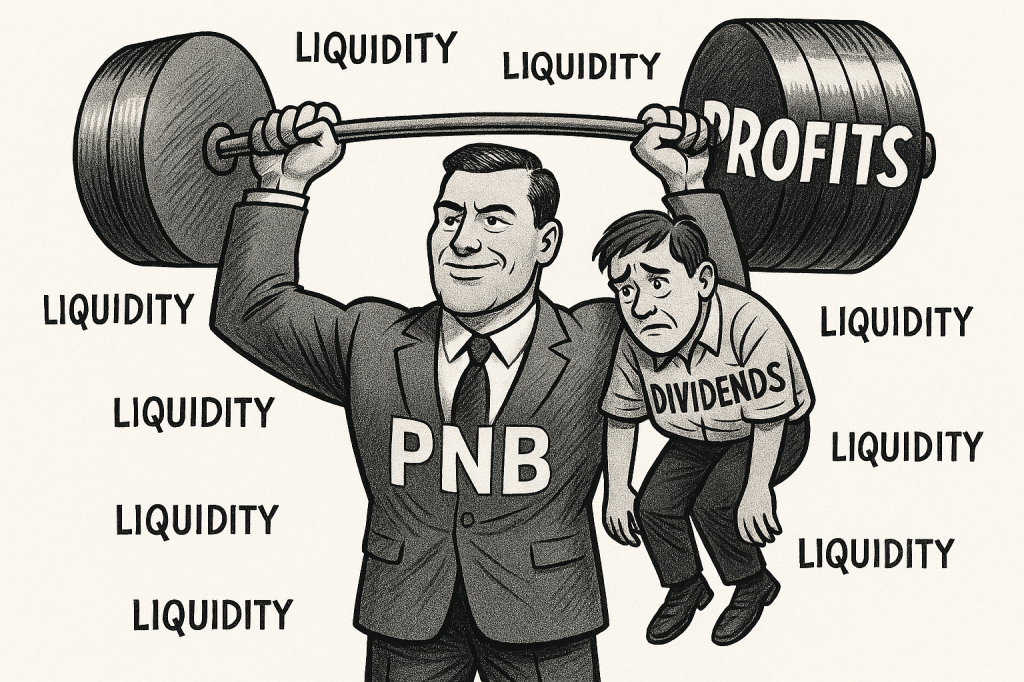
  • PNB’s Strong Quarter Masks Emerging Fragilities

    PNB’s Strong Quarter Masks Emerging Fragilities

    Philippine National Bank (PNB) has delivered a headline that investors love: ₱18.5 billion in net income for the first nine months of 2025, up 22.9% year-on-year. Capital ratios remain fortress-like, with CET1 at 19.95% and CAR at 20.79%, well above regulatory floors. On the surface, this looks like a bank in peak health.

    But beneath the glossy earnings lies a story of structural vulnerabilities—issues that could weigh on liquidity, credit resilience, and ultimately, shareholder returns.


    Liquidity Compression: The Silent Stress

    PNB’s liquid assets plunged 26% year-to-date, from ₱222.2 billion to ₱164.4 billion. Liquidity ratios deteriorated sharply: liquid assets-to-total assets fell to 19% from 29%, and liquid assets-to-liquid liabilities slid to 24.4%. Deposit liabilities contracted by ₱22.2 billion, with time deposits down 5.5%.

    In a high-rate environment, shrinking liquidity buffers limit flexibility. Boards typically prioritize cash preservation over payouts when liquidity tightens—making aggressive dividend hikes unlikely.


    Allowance Releases Inflate Earnings

    Loan-loss provisions collapsed to ₱473 million from ₱3.7 billion a year ago, while charge-offs surged to ₱6.6 billion. Allowance for credit losses fell by ₱5.4 billion, reducing NPL coverage to 81.8% from 87.3%.

    This accounting tailwind flatters profitability but is not sustainable. If macro conditions worsen, PNB may need to rebuild reserves—pressuring future earnings and payout ratios.


    Earnings Quality Risks

    PNB booked ₱1.9 billion in gains from asset sales, including foreclosed properties, which also grew by 8.2% to ₱17.3 billion. These gains are opportunistic, not structural. Heavy reliance on one-off disposals inflates ROE and masks underlying credit costs. If disposal markets soften, earnings volatility could spike.


    Related-Party Concentration

    Receivables from related parties total ₱50.8 billion, with another ₱44.9 billion in credit facilities and ₱45.3 billion in related deposits. Unquoted FVOCI equity includes a ₱25.5 billion stake in PNB Holdings, valued using NAV with a discount for lack of marketability.

    High intra-group exposures raise governance and concentration risk. Any stress within the LT Group ecosystem could cascade into PNB’s balance sheet.


    Why It Matters

    Strong capital ratios are reassuring, but these weaknesses signal that headline profits may not fully translate into sustainable shareholder returns. Expect a conservative dividend stance and a valuation discount if liquidity and governance concerns persist.

    For investors chasing yield, the message is clear: not all high profits guarantee high payouts—especially when risk metrics are flashing amber.

    Subscribe to Support Free & Independent Research