Tag: economy

  • Financing Costs Take Center Stage at Villar’s Vista Land

    Financing Costs Take Center Stage at Villar’s Vista Land

    We’ve been blogging for free. If you enjoy our content, consider supporting us!

    Vista Land & Lifescapes (VLL) has always been a story of two engines: the cyclical churn of homebuilding and condo turnovers on one side, and the steadier cadence of rental income from commercial assets on the other. In the first nine months of 2025, both engines did their job—barely. Consolidated revenues rose a modest 2.2% to ₱28.399 billion, supported by real estate sales (+~3%) and rental income (+~3%).

    But the quarter’s real headline isn’t the topline. It’s the bill that arrives after the sales and rent checks clear: financing cost.

    A decent earnings print—until you look at the interest line

    VLL reported net income of ₱9.462 billion, up ~4.3% year-on-year (9M 2024: ₱9.076 billion), with EPS rising to ₱0.668 (from ₱0.627).

    On paper, that’s a clean, incremental improvement—especially in a market that’s still juggling buyer affordability, selective demand, and uneven project completion cycles. 

    Yet under the surface, the company’s progress is being increasingly “taxed” by the cost of money. Interest and other financing charges jumped ~17% to ₱5.925 billion (from ₱5.043 billion), with management attributing the increase primarily to lower capitalization of interest during the period—meaning more borrowing costs flowed directly to the income statement rather than being parked in asset costs.

    The financial soundness table tells the same story in a single ratio: EBITDA-to-total interest fell to 1.34x (from 1.89x a year earlier). That is not a crisis number, but it is a clear signal that interest burden is rising faster than operating cushion.

    Operating discipline helped—but it can’t fully outrun higher carry

    To VLL’s credit, the company did what businesses do when the interest meter runs fast: tighten the controllables. Operating expenses fell to ₱7.057 billion from ₱7.742 billion, supported by lower advertising and promotion, professional fees, and repairs and maintenance, per management’s discussion.

    Costs of real estate sales also edged down to ₱4.552 billion from ₱4.625 billion.

    This discipline is exactly why net income still grew. But it also highlights the key constraint: there is a limit to how far expense efficiency can go when financing costs are moving in the opposite direction. Eventually, the financing line starts dictating what kind of growth is “allowed”—how fast you can launch, how aggressively you can build investment properties, and how quickly you can recycle capital into new inventory.

    The balance sheet says “stable,” but leverage keeps the interest sensitivity high

    As of September 30, 2025, VLL’s total assets rose to ₱387.581 billion (from ₱377.939 billion at end-2024), while total liabilities stayed broadly flat at ₱242.599 billion (vs ₱241.852 billion). Equity improved to ₱144.982 billion (from ₱136.087 billion), reflecting the period’s earnings.

    Liquidity remained adequate but slightly softer: current ratio of 1.74x, down from 1.81x at end-2024.

    Meanwhile, VLL disclosed leverage measures such as debt-to-equity at ~1.10x and net debt-to-equity at ~0.84x as of period-end.

    The debt stack remains meaningful: notes payable at ₱104.240 billionbank loans at ₱54.653 billion, and loans payable at ₱11.442 billion, plus lease liabilities.

    VLL also described refinancing actions—most notably, loans payable fell ~41% as borrowings were refinanced into bank loans.

    This matters because when financing costs are the pressure point, debt mix changes—what’s fixed, what reprices, what can be prepaid—become as important as unit sales and mall occupancy.


    The Macro Catalyst: BSP rate cuts and the refinancing window

    BSP has already moved—rates are down, and the cycle may be near its end

    The Bangko Sentral ng Pilipinas (BSP) has delivered a meaningful easing cycle. In its December 11, 2025 decision, the BSP cut the policy (overnight RRP) rate by 25 bps to 4.50%, with the deposit and lending facility rates correspondingly adjusted. Reports also noted that the BSP has reduced rates by a cumulative ~200 bps since the easing cycle began (August 2024) and signaled that the easing cycle is “nearing its end” and future moves would be data-dependent. 

    Earlier in 2025, the BSP also cut rates to 5.25% in June (another 25 bps), reinforcing the broader downtrend in domestic benchmark rates. 

    How does this help VLL? It depends on what portion of debt can actually reprice

    A BSP rate cut is not a magic eraser for interest expense—especially for issuers with large chunks of fixed-rate bonds and notes. VLL itself discloses that much of its interest-bearing liabilities carry fixed rates, including notes payable with coupons across a wide band and peso bank loans with fixed rates in a mid-to-high single-digit range.

    Still, rate cuts matter in three practical ways:

    1. Cheaper refinancing of maturing peso obligations
      As policy rates fall, banks typically reprice new loans and rollovers lower (though not one-for-one). For a developer with ongoing maturities and refinancing activity, the real benefit arrives when old tranches are replaced with new ones at lower coupons. VLL’s own disclosures show continued funding activity and covenant monitoring, and it even noted a new ₱5 billion, three-year loan facility signed for refinancing purposes after the reporting period—suggesting refinancing remains an active playbook, not a theoretical one.
    2. Improved negotiating leverage with lenders
      In a lower-rate environment, issuers with scale and bank relationships can re-open conversations on pricing, tenor, and covenant headroom. VLL highlights compliance with key covenants (current ratio, leverage, DSCR-type measures) across its debt programs, which supports lender confidence and can translate into better refinancing terms.
    3. A slower growth penalty from interest carry
      The most immediate “earnings” impact is not always a dramatic reduction in interest expense; it can be a reduction in the incremental cost of funding new launches and capex. This matters for VLL because investment properties and project launches expanded during the period—investment properties rose to ₱145.524 billion and inventories to ₱61.692 billion—both of which typically have funding footprints. Lower benchmark rates can soften the future carrying-cost curve.

    The fine print: what BSP cuts won’t fix

    Two realities temper the optimism:

    • Fixed-rate debt doesn’t reprice unless it is refinanced early, called, or replaced at maturity—sometimes with redemption premiums and transaction costs. VLL’s disclosure includes multiple note and bond programs with specified terms and redemption features, implying refinancing benefits arrive unevenly across maturities.
    • USD debt costs are influenced more by global dollar rates and FX than by BSP alone. VLL has significant USD-denominated notes payable exposure and also holds USD investments, which means refinancing economics must consider both rate differentials and currency movements.

    Bottom line: VLL’s operating story is intact—its financing story is the swing factor

    VLL’s 9M 2025 results read like a company doing the right operational things: steadying revenues through rentals, managing costs, and keeping earnings modestly higher.

    But the same report makes it clear where the market should keep its flashlight trained: ₱5.925 billion of financing charges and an interest-coverage indicator that has weakened year-on-year.

    If the BSP’s easing cycle has indeed brought policy rates down to 4.50% and created a window for cheaper refinancing, VLL has a clear incentive to use it—especially with refinancing activity already evident and a new ₱5 billion facility signed for that purpose.

    In short: VLL can still sell homes and collect rents, but the next chapter may be written by the treasurer as much as by the sales team. In an environment where the BSP has cut rates and signaled the easing cycle may be nearing its end, execution on refinancing—timing, pricing, and maturity management—could be the difference between steady profits and squeezed returns.

    We’ve been blogging for free. If you enjoy our content, consider supporting us!
  • PNB’s Bond Move Meets a BSP Rate Cut—The New Squeeze — When Rate Cuts Meet Fixed-Rate Bank Bonds

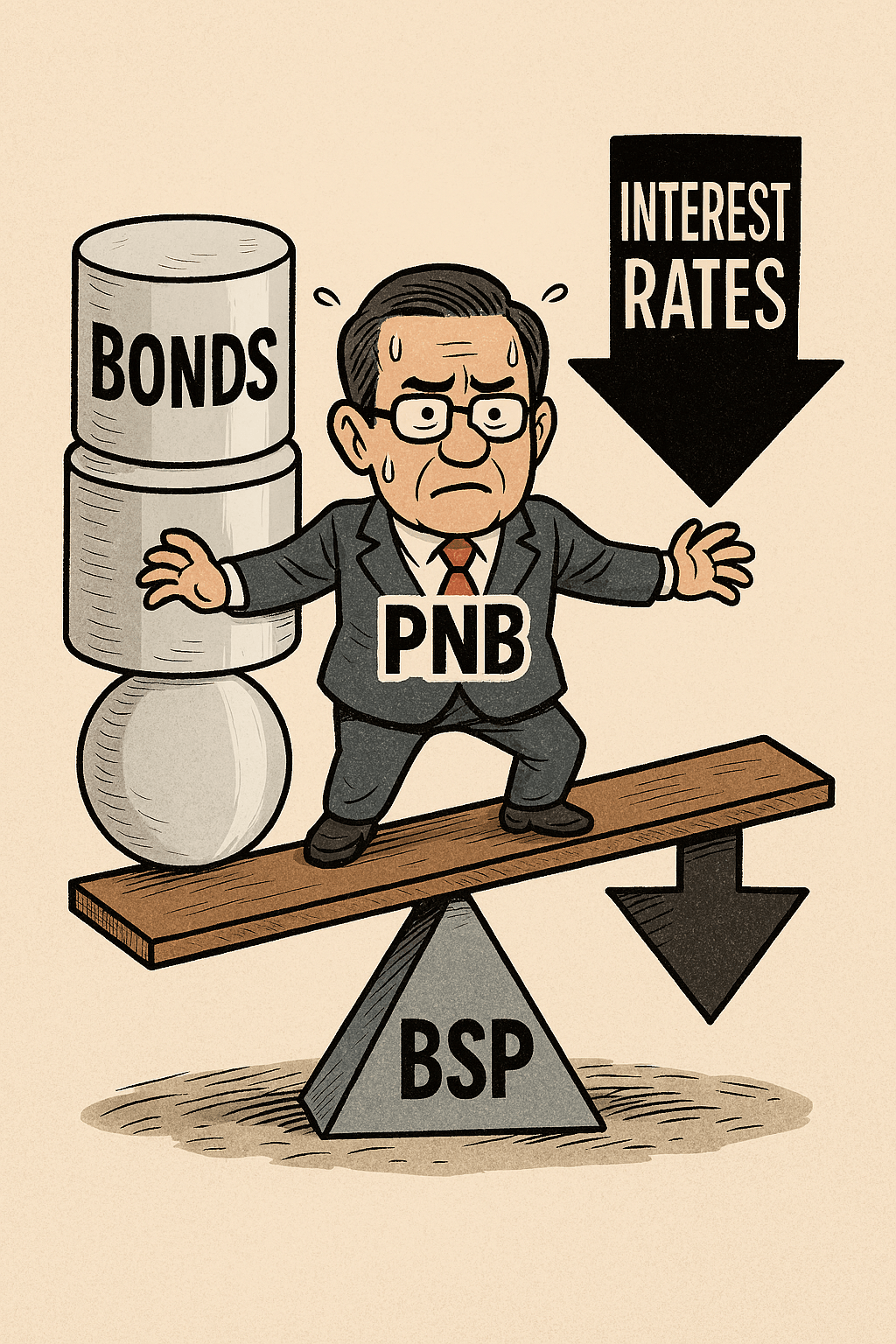
    PNB’s Bond Move Meets a BSP Rate Cut—The New Squeeze — When Rate Cuts Meet Fixed-Rate Bank Bonds

    We’ve been blogging for free. If you enjoy our content, consider supporting us!

    Philippine National Bank’s return to the peso bond market would normally be filed under “good news”: strong demand, a sizeable PHP 15.7 billion raise, and a clear promise to funnel proceeds into eligible projects under its Sustainable Financing Framework. But markets don’t grade banks on deal headlines—they grade them on spread, the narrow space between what a bank earns on assets and what it pays for money. And that spread is now facing a two-sided pincer: a fresh BSP rate cut that can pull loan yields down, and new fixed-rate bond funding that doesn’t reprice lower

    A bond deal priced for yesterday’s rate environment

    PNB’s issuance came in two tranches: Series A (3-year) at 5.4877% and Series B (5-year) at 5.7764%, for a combined PHP 15.7 billion. Those are clean, tradable coupons investors like because they are predictable. For the bank, however, predictability cuts both ways: these rates are locked in, creating a relatively firm “floor” for a portion of PNB’s funding costs over the next three to five years.

    That matters because PNB’s earnings machine is still overwhelmingly powered by net interest income. In its latest quarterly filing covering the period ended September 30, 2025, PNB reported net interest income of PHP 39.3 billion and a net interest margin (NIM) of 4.7% for the first nine months of the year. When a bank introduces more wholesale, fixed-rate funding into the mix, it increases the chance that overall funding costs drift upward—unless the proceeds are deployed into assets that earn meaningfully more than that fixed coupon. 

    Then came the BSP’s easing move—lower policy rates, lower pricing gravity

    On December 11, 2025, the Bangko Sentral ng Pilipinas cut the target reverse repurchase (RRP) rate by 25 bps to 4.50%, citing benign inflation and weaker growth, while signaling the easing cycle may be nearing its end. A policy rate cut is not just a macro headline; it’s a pricing signal that seeps into the banking system. Over time, it can soften interest rates across the curve—deposit pricing, wholesale funding benchmarks, and critically, loan pricing

    And that’s where the profitability tension sharpens. In easing cycles, banks often hope for a benign sequence: funding costs fall faster than asset yields, supporting NIM. But when a bank adds fresh fixed-rate bond funding, it risks changing that sequence. Bond coupons don’t follow the BSP downward. Meanwhile, loan yields—especially for new production or repriced credits—can trend lower as the overall cost of money declines and competition intensifies. 

    The core risk: loan yields may fall, but bond funding stays expensive

    Here is the cleanest way to see the risk: the BSP’s rate cut pulls down the “gravity” of borrowing costs. When benchmark rates move lower, banks typically face pressure to reprice or originate loans at lower rates—particularly in competitive segments and for high-quality borrowers. That means asset yields can fall over time. 

    But PNB’s new bond funding is priced in the mid‑5% range and is fixed. If loan yields soften due to easing—while bond coupons remain unchanged—then the spread between what PNB earns and what it pays can narrow. That is textbook margin compression: assets reprice down, liabilities don’t fully follow, and NIM drifts lower even when volumes are growing. 

    The risk is not theoretical. PNB’s 17‑Q already shows how meaningful interest expense is to the model: for the first nine months of 2025, total interest expense was PHP 13.07 billion, including PHP 630.3 million for “bonds payable.” Add more bond funding and—unless deployment is swift and high-yielding—interest expense becomes stickier at precisely the moment the BSP is trying to make money cheaper. 

    Why the first few quarters after issuance matter most

    A second layer of risk is timing. Bond proceeds arrive quickly; loan deployment—especially into projects that meet sustainability criteria—can take longer. PNB itself states the net proceeds will be used to finance or refinance eligible projects under its framework. If deployment lags, banks often park funds temporarily in liquid assets. In a falling-rate environment, those liquid assets may earn less, while bond coupons keep running—turning the early months into a “negative carry” window that can pull on NIM. 

    This is why investors shouldn’t judge the bond deal by oversubscription alone. The real scoreboard is whether the bank can keep its margin stable while adding fixed-rate funding. PNB’s reported 4.7% NIM provides a useful baseline heading into the post-issuance period. 

    The counterpoint: rate cuts can boost loan demand—volume can cushion the squeeze

    To be fair, BSP easing can also be helpful for banks. Lower policy rates are designed to support activity; they can lift credit demand, encourage refinancing, and reduce debt service burdens. If loan volumes accelerate enough, banks can sometimes offset thinner spreads with higher earning-asset balances. PNB’s own 17‑Q shows that loans and receivables rose 6.5% versus year-end 2024, indicating momentum in asset growth even before the December cut. 

    But volume is not a free pass. When rates fall, banks must avoid the temptation to buy growth at the expense of pricing discipline—especially if they are carrying fixed-rate liabilities that won’t reprice lower. If PNB uses the bond proceeds to fund assets that are either low-yielding or aggressively priced, the “growth story” can still translate into weaker NIM.

    What to watch: three tells that reveal whether NIM holds or slips

    Because the bond was listed on December 11, 2025, the post-issuance effect will show up more clearly in subsequent periods rather than the September 30, 2025 filing. When PNB reports new numbers, three items will tell the story quickly: 

    1. Loan yield trend — do new bookings and repricings show softening rates consistent with BSP easing? 
    2. Funding cost mix — does the new bond carry make interest expense less responsive to falling rates? 
    3. NIM direction vs 4.7% baseline — does it hold, or does the combination of lower loan yields and fixed bond coupons compress the spread? 

    Bottom line

    PNB’s bond issuance strengthens funding diversification and signals confidence, but the macro backdrop has shifted: the BSP has lowered the policy rate to 4.50%, reinforcing a downtrend in borrowing costs that can pull loan yields lower. With PNB’s new bond financing locked at 5.49%–5.78%, a portion of the bank’s funding costs becomes fixed and comparatively expensive just as the system is easing. If loan rates fall faster than the bank’s blended funding costs, the natural result is net interest margin compression—a risk that will only be confirmed (or disproved) in the coming quarters’ NIM and net interest income prints.

    We’ve been blogging for free. If you enjoy our content, consider supporting us!

  • China Bank: A Core Engine Running Strong—But Can It Outpace Market Headwinds?

    China Bank: A Core Engine Running Strong—But Can It Outpace Market Headwinds?

    When China Banking Corporation filed its third-quarter report with the SEC this November, the headline number—₱20.23 billion in nine-month net income—looked reassuring. A 10% year-on-year increase in profit is no small feat in a year marked by global volatility and a domestic economy slowing to 4% GDP growth. But as always, the story behind the numbers is where the real insight lies.

    The Core Strengths
    China Bank’s core banking engine is humming. Net interest income surged 15.2% to ₱53.5 billion, powered by a 6.2% expansion in loans and an improved net interest margin of 4.58%. These are enviable metrics in a competitive market. Efficiency gains are evident too: the cost-to-income ratio improved to 45% from 48%, signaling disciplined expense management even as the bank invests in technology and talent.

    Asset quality remains a bright spot. Non-performing loans are steady at 1.6%, and coverage is a robust 123%. Capital ratios—CET1 at 14.97% and total CAR at 15.85%—comfortably clear regulatory minimums, giving the bank room to grow and reward shareholders. Speaking of rewards, the board declared a hefty ₱ 2.50-per-share dividend earlier this year, including a special ₱1.00 payout. For investors seeking stability, these are reassuring signals.

    The Cracks Beneath the Surface
    Yet, the picture isn’t all rosy. Treasury operations have been a thorn in China Bank’s side, with trading and securities losses ballooning to ₱10.54 billion year-to-date. In a rising-rate environment, a securities book that accounts for roughly a third of total assets is a double-edged sword—liquid, yes, but vulnerable to mark-to-market swings. Add to that a funding mix tilted toward time deposits (CASA ratio stuck at 44.7%), and you have a franchise more exposed to interest rate pressures than peers with stronger low-cost deposit bases.

    Credit provisioning is another watchpoint. The bank set aside ₱6.99 billion for impairment and credit losses—nearly five times last year’s level. While this speaks to prudence, it also eats into earnings momentum. And while non-interest income flipped positive, much of it came from one-off gains: ₱6.99 billion from asset foreclosures and a ₱1.4 billion boost from associates, thanks to the renewal of its bancassurance joint venture with Manulife. Strip these out, and the underlying run-rate looks less spectacular.

    The Bigger Picture
    China Bank’s franchise remains formidable. It boasts strong governance credentials, industry accolades, and a diversified footprint spanning retail, institutional, and wealth segments. Subsidiaries like China Bank Savings and China Bank Capital add breadth to its offering. But the challenge ahead is clear: sustain core growth while taming volatility in treasury and building a more resilient funding base.

    For investors, the takeaway is nuanced. If markets stabilize and credit costs normalize, China Bank’s fundamentals could shine brighter than its current headline numbers suggest. But if rate swings persist and one-off gains dry up, expect earnings to feel the strain.

    In short, China Bank is a study in contrasts—a high-quality engine navigating a bumpy road. The question for 2026 is whether management can keep the wheels turning smoothly when the terrain gets rough.

    Subscribe to Support Free & Independent Research

  • AUB’s Growth Story: Strong Numbers, Subtle Cracks

    AUB’s Growth Story: Strong Numbers, Subtle Cracks

    Asia United Bank (AUB) closed the third quarter of 2025 with a headline that would make any banker proud: ₱9.37 billion in nine-month net income, up 9% year-on-year, and a balance sheet that swelled to ₱417 billion. Loans surged 29%, deposits climbed 19%, and capital ratios remain comfortably above Basel III floors. On paper, it’s a picture of resilience and ambition.

    But beneath the glossy numbers, there are pressure points investors and industry watchers should not ignore.

    Margins under strain. AUB’s net interest margin slipped to 5.0% from 5.3% a year ago. Why? Deposit costs jumped 35%, while yields on securities fell 12%. With the Bangko Sentral ng Pilipinas cutting reserve requirements earlier this year, liquidity is abundant, competition is fierce, and repricing gaps are widening. For a bank that thrives on spread income, this is a structural headwind.

    Trading gains: friend or fickle? Non-interest income helped cushion the margin squeeze, rising 18% for the nine-month period. Yet the third quarter told a different story: other operating income fell 9%, dragged by weaker forex and miscellaneous gains. When markets turn, these buffers vanish quickly.

    Loan growth vs. credit risk. AUB’s loan book ballooned to ₱256.9 billion, but provisions—though up 141%—still look light against system averages. Non-performing loans are impressively low at 0.36%, far below the industry’s 3.3%, but rapid growth often tests underwriting discipline. A normalization in credit costs could dent future earnings.

    Funding mix: a double-edged sword. Demand deposits soared 26%, while savings and time deposits shrank. This tilt toward transactional balances keeps funding cheap, but it also makes liquidity more sensitive to corporate flows and competitive pull from e-wallet giants like GCash and Maya. AUB’s own HelloMoney wallet is scaling, yet the digital battlefield is crowded and unforgiving.

    Capital and liquidity cushions remain strong, with CAR at 19.5% and liquid assets at 36% of total assets. Still, the trend shows a shift toward longer-duration assets, exposing the bank to interest-rate volatility—a risk already visible in its ₱1 billion unrealized loss on FVOCI securities.

    The bigger picture? AUB is executing well: growing loans, defending CASA, and pushing digital partnerships. But the narrative for 2026 will hinge on three things: protecting margins in a low-rate, high-liquidity environment; converting HelloMoney into a daily-use ecosystem to fend off fintech giants; and keeping credit discipline tight as growth accelerates.

    For now, AUB remains a solid performer—but in banking, strength today can mask fragility tomorrow. Investors would do well to watch the cracks before they widen.

    Subscribe to Support Free & Independent Research

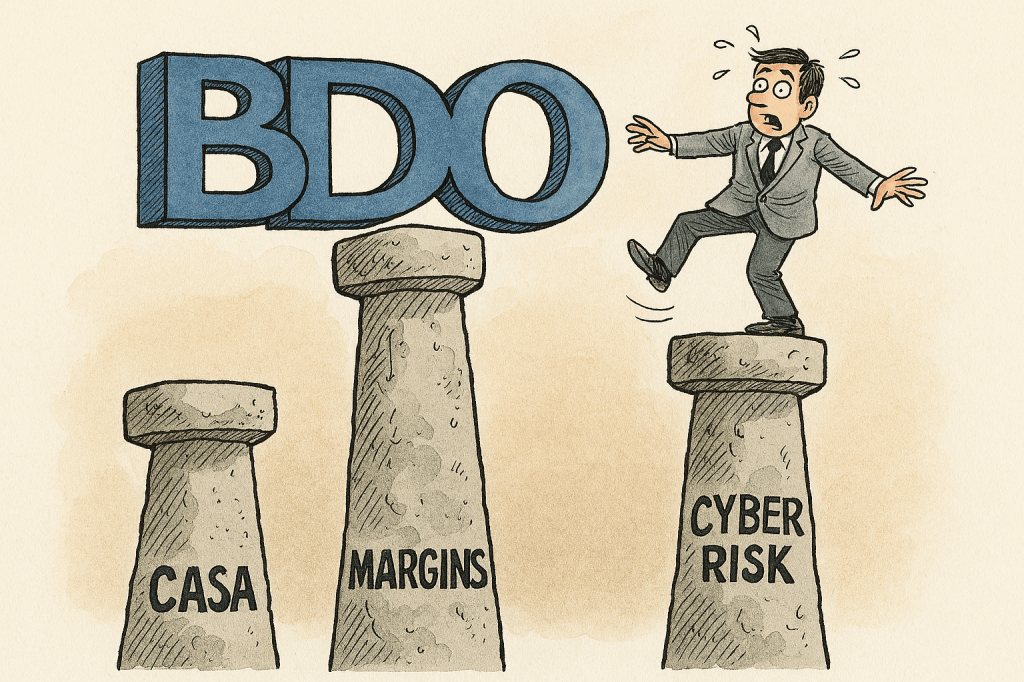
  • BDO’s Premium Under Pressure: Why Investors Should Watch CASA, Margins, and Cyber Risk

    BDO’s Premium Under Pressure: Why Investors Should Watch CASA, Margins, and Cyber Risk

    BDO Unibank has long been the crown jewel of Philippine banking—commanding scale, profitability, and a valuation premium that peers struggle to match. But its latest quarterly filing and sector trends suggest that the next chapter may be more challenging than the last.


    The Margin Squeeze Begins

    The first red flag is in the funding mix. Current and savings accounts (CASA)—the cheapest source of funds—slipped from about 71.5% at end-2024 to 66.6% by September 2025. Time deposits surged by nearly ₱300 billion. This isn’t just a footnote; it’s a structural shift that raises funding costs. Combine that with the Bangko Sentral ng Pilipinas’ rate-cut cycle—policy rate now at 4.75% and likely heading lower—and you have a classic margin squeeze: loan yields fall faster than deposit costs. For a bank with ₱5.27 trillion in assets, even a 10–20 basis point hit to net interest margin (NIM) can shave billions off earnings.


    Consumer Credit: A Quiet Risk

    BDO’s consumer book is growing, but so are its vulnerabilities. Credit card receivables past due beyond 90 days now hover around ₱20 billion—roughly 8% of the card portfolio. Restructured loans tell an even starker story: nearly 30% are overdue. These aren’t catastrophic numbers, but they hint at seasoning risk in unsecured lending, especially if economic growth cools. Sector analysts expect non-performing loans to inch up as banks chase retail growth. For BDO, that means higher provisions and a drag on profitability.


    Costs Are Climbing

    Operating expenses jumped 15% year-on-year, driven by branch expansion and technology upgrades. The bank plans to open 100–120 new branches, mostly in provincial areas—a strategic move to deepen reach. But until those branches deliver deposits and fee income, the cost-to-income ratio will feel the strain. Investors love growth stories, but they also watch operating leverage. Right now, that leverage is under pressure.


    Cybersecurity: The Intangible Risk

    A recent flap over unauthorized transactions reignited memories of past cyber incidents. BDO insists its systems are secure, blaming compromised client devices. Still, perception matters. In banking, trust is currency—and when trust wavers, valuation multiples can follow. The market doesn’t like uncertainty, especially in an era where digital channels dominate.


    Valuation: The Premium Isn’t Guaranteed

    BDO trades at a premium price-to-book ratio of around 1.3–1.4x, thanks to its scale and profitability. But if margins compress and costs bite, earnings growth could slow to single digits. That puts pressure on valuation multiples. A modest pullback—say 0.15x on P/B—could wipe out nearly ₱94 billion in market cap. Not a crash, but enough to make investors rethink lofty expectations.


    The Offsetting Strengths

    To be fair, BDO isn’t in trouble. Its capital buffers are strong (CET1 at 14.4%), provisioning is robust, and its franchise remains unmatched. Fee income is growing, and its bond market access gives it flexibility. But the message is clear: the premium isn’t automatic. CASA recovery, branch productivity, and credit discipline will decide whether BDO stays the market darling—or faces a valuation reset.


    What to Watch

    1. CASA ratio: Can BDO claw back to 70%?
    2. NIM trajectory: How deep will the margin squeeze go as BSP cuts rates?
    3. Consumer credit: Will card and restructured loan delinquencies stabilize?
    4. Cost-to-income: Can new branches pay for themselves quickly?
    5. Cyber risk: Will BDO restore confidence after recent headlines?

    Bottom line: BDO’s fundamentals remain strong, but the next 12 months will test its ability to defend its premium. For investors, this is no time for complacency. 

    Subscribe to Support Free & Independent Research

  • First Gen’s ₱50B Gas Asset Sale Signals Strategic Pivot Amid Earnings Decline and Execution Risk

    First Gen’s ₱50B Gas Asset Sale Signals Strategic Pivot Amid Earnings Decline and Execution Risk

    First Gen Corporation (FGEN) is moving forward with a landmark transaction to sell 60% of its gas-fired power generation and LNG infrastructure business to Prime Infrastructure Capital Inc. for ₱50 billion, following regulatory clearance from the Philippine Competition Commission (PCC). The deal includes the Santa Rita, San Lorenzo, San Gabriel, and Avion gas plants, as well as the Batangas LNG terminal, which began commercial operations in January 2025.

    The transaction marks a strategic pivot for the Lopez-led energy firm, which is increasingly focused on expanding its renewable energy portfolio and infrastructure assets. First Gen will retain a 40% stake in the gas platform, ensuring continuity and future upside participation.


    Revenue and Earnings Decline Underscore Strategic Urgency

    For the nine months ended September 30, 2025, consolidated revenues fell 3.3% year-on-year to US$1.786 billion, while net income declined 2.0% to US$265.8 million. The downturn was driven primarily by the gas generation segment, where San Gabriel’s transition to merchant trading following the expiry of its power supply agreement in February 2024 led to a 61% drop in revenue and a swing to net loss.

    Despite stronger performance from Santa Rita and San Lorenzo, the overall natural gas platform’s net income attributable to the parent fell 5.5%. The geothermal and wind segment (EDC) also faced pressure due to lower selling priceshigher depreciation, and increased interest expenses from recent borrowings. However, the Batangas LNG terminal emerged as a bright spot, contributing ₱1.92 billion in net income in its first nine months of operations.


    Execution Risk: Will the Deal Materialize?

    While the transaction has cleared regulatory hurdles, its ₱50 billion valuation—nearly equivalent to FGEN’s entire market capitalization—raises questions about execution risk.

    “This is a high-stakes transaction,” said an energy sector analyst. “Prime Infra is essentially valuing the gas platform at more than the whole company. If market conditions shift or LNG economics deteriorate, there’s a real possibility they could reassess.”

    The deal’s success hinges on final documentation, closing conditions, and Prime Infra’s continued appetite for gas infrastructure amid global energy transition pressures.


    Outlook: What Happens to FGEN Shares if the Deal Falls Through?

    Analysts warn that failure to close the transaction could weigh heavily on investor sentiment. The market has partially priced in expectations of a ₱50 billion cash infusion, which would strengthen FGEN’s balance sheet and accelerate its renewable energy expansion.

    If the deal collapses:

    • Share price downside risk: FGEN could trade back toward its pre-announcement levels, as the anticipated deleveraging and growth funding would evaporate.
    • Valuation pressure: Investors may re-focus on the merchant risk at San Gabriel, earnings volatility in the gas segment, and slower capital recycling.
    • Strategic overhang: Questions on FGEN’s ability to execute its pivot to clean energy without the transaction proceeds could dampen multiples.

    Conversely, if the deal closes as planned, analysts expect a potential re-rating driven by improved earnings quality, lower leverage, and clearer renewable growth visibility.


    Strategic Reset in Motion

    First Gen has already prepaid ₱20 billion in peso-denominated loans, signaling its intent to use the proceeds for deleveragingrenewable energy expansion, and potential shareholder returns. The company is advancing projects such as the Aya pumped-storage facilityTanawon geothermal plant, and multiple battery energy storage systems (BESS).

    “This is a strategic reset,” said a source familiar with the transaction. “First Gen is positioning itself for the next decade of clean energy growth, while monetizing assets that are becoming more volatile.”

    The transaction is expected to close in the coming months, subject to final documentation and remaining closing conditions.