Tag: business

  • Shakey’s Bold Expansion: Growth at a Cost

    Shakey’s Bold Expansion: Growth at a Cost

    Shakey’s Pizza Asia Ventures Inc. (PSE: PIZZA) has long been a household name in the Philippines, and its latest quarterly filing shows why: systemwide sales surged 14% to ₱17.7 billion, and net revenue climbed 12% to ₱11.24 billion for the first nine months of 2025. On the surface, this looks like a victory lap for a brand celebrating its 50th year in the country.

    But dig deeper into the numbers, and a more nuanced story emerges—one of growth bought at a price.


    The Expansion Gamble

    Shakey’s is in the middle of an aggressive rollout, adding new stores, renovating existing ones, and expanding its multi-brand portfolio, which includes Peri-Peri Charcoal Chicken and Potato Corner. This strategy is designed to cement its dominance in casual dining and kiosks, but it comes with short-term pain.

    The company’s gross margin slipped to 22.6% from 24.3%, and operating margin fell to 8.9%, despite double-digit revenue growth. Why? Pre-opening costs and renovation expenses—the unavoidable toll of rapid expansion. Management admits as much in its SEC filing: improving input costs were overshadowed by network investments.


    Debt and Interest: The Hidden Weight

    Expansion isn’t cheap. Shakey’s poured ₱693 million into capital expenditures this year, and while operating cash flow remains strong at ₱1.03 billion, the company leaned on debt to keep the engine running. Interest expense jumped 18% to ₱348 million, fueled by a loan repricing to 6.3% and short-term borrowings swelling to ₱1.32 billion.

    This financing burden shaved pretax margins and dragged EPS down to ₱0.34 from ₱0.40. Yet, in a move that will please shareholders but raise eyebrows among analysts, Shakey’s still declared a ₱ 0.20-per-share dividend—tightening internal funding at a time when liquidity is already under pressure.


    Liquidity: A Thinner Cushion

    Cash reserves fell to ₱821 million from ₱1.32 billion at year-end 2024. The current ratio eased to 1.3x, signaling a slimmer buffer against short-term obligations. While the company’s cash conversion cycle improved to 17 days—a testament to operational discipline—the reality is clear: expansion has narrowed financial flexibility.


    The Bigger Picture

    None of this means Shakey’s is in trouble. Its core EBITDA rose 14% to ₱1.8 billion, and its franchising model remains a powerful lever for long-term growth. But investors should recognize the trade-off: today’s margin squeeze and liquidity strain are the price of tomorrow’s market share.

    The question is whether the payoff will justify the cost. If new stores ramp up quickly and financing costs stabilize, Shakey’s could emerge stronger than ever. If not, the company may find itself juggling debt, leases, and shareholder expectations in a tougher consumer environment.


    Bottom line: Shakey’s is betting big—and for now, the bet is eating into margins and cash. For growth-focused investors, that may be acceptable. For those who prize near-term profitability, caution is warranted.


    Subscribe to Support Free & Independent Research

  • AUB’s Growth Story: Strong Numbers, Subtle Cracks

    AUB’s Growth Story: Strong Numbers, Subtle Cracks

    Asia United Bank (AUB) closed the third quarter of 2025 with a headline that would make any banker proud: ₱9.37 billion in nine-month net income, up 9% year-on-year, and a balance sheet that swelled to ₱417 billion. Loans surged 29%, deposits climbed 19%, and capital ratios remain comfortably above Basel III floors. On paper, it’s a picture of resilience and ambition.

    But beneath the glossy numbers, there are pressure points investors and industry watchers should not ignore.

    Margins under strain. AUB’s net interest margin slipped to 5.0% from 5.3% a year ago. Why? Deposit costs jumped 35%, while yields on securities fell 12%. With the Bangko Sentral ng Pilipinas cutting reserve requirements earlier this year, liquidity is abundant, competition is fierce, and repricing gaps are widening. For a bank that thrives on spread income, this is a structural headwind.

    Trading gains: friend or fickle? Non-interest income helped cushion the margin squeeze, rising 18% for the nine-month period. Yet the third quarter told a different story: other operating income fell 9%, dragged by weaker forex and miscellaneous gains. When markets turn, these buffers vanish quickly.

    Loan growth vs. credit risk. AUB’s loan book ballooned to ₱256.9 billion, but provisions—though up 141%—still look light against system averages. Non-performing loans are impressively low at 0.36%, far below the industry’s 3.3%, but rapid growth often tests underwriting discipline. A normalization in credit costs could dent future earnings.

    Funding mix: a double-edged sword. Demand deposits soared 26%, while savings and time deposits shrank. This tilt toward transactional balances keeps funding cheap, but it also makes liquidity more sensitive to corporate flows and competitive pull from e-wallet giants like GCash and Maya. AUB’s own HelloMoney wallet is scaling, yet the digital battlefield is crowded and unforgiving.

    Capital and liquidity cushions remain strong, with CAR at 19.5% and liquid assets at 36% of total assets. Still, the trend shows a shift toward longer-duration assets, exposing the bank to interest-rate volatility—a risk already visible in its ₱1 billion unrealized loss on FVOCI securities.

    The bigger picture? AUB is executing well: growing loans, defending CASA, and pushing digital partnerships. But the narrative for 2026 will hinge on three things: protecting margins in a low-rate, high-liquidity environment; converting HelloMoney into a daily-use ecosystem to fend off fintech giants; and keeping credit discipline tight as growth accelerates.

    For now, AUB remains a solid performer—but in banking, strength today can mask fragility tomorrow. Investors would do well to watch the cracks before they widen.

    Subscribe to Support Free & Independent Research

  • Retail Giant Puregold Posts Solid Growth, But Expansion Risks Loom

    Retail Giant Puregold Posts Solid Growth, But Expansion Risks Loom

    Puregold Price Club, Inc. (PGOLD) has once again demonstrated its resilience in the Philippine retail landscape, posting a net income of ₱7.3 billion for the first nine months of 2025, up 5.6% year-on-year. Sales surged 10.6% to ₱168.1 billion, powered by aggressive store expansion and steady same-store sales growth. Yet behind the headline numbers, a closer look at the company’s latest SEC filing reveals operational pressure points that could shape its trajectory into 2026.


    The Good News: Scale and Margins Hold

    Puregold’s top line benefited from the full-year impact of 2024 openings and 174 new stores launched in 2025, including one S&R warehouse. Same-store sales growth was healthy: Puregold +4.8%S&R +5.4%, signaling consumer stickiness despite inflationary headwinds.

    Gross margin improved to 18.7% from 18.2%, thanks to supplier rebates and scale efficiencies. Operating income rose 8.2% to ₱11.3 billion, though operating margin slipped slightly to 6.7%. Net margin eased to 4.3%, reflecting higher financing costs and foreign exchange losses.


    The Pressure Points

    While management asserts “no known material uncertainties,” the numbers tell a nuanced story:

    • Opex Surge: Operating expenses jumped 16.5%, outpacing sales growth. Expansion costs—manpower, utilities, depreciation—are biting into margins.
    • Lease-Heavy Model: Lease liabilities ballooned to ₱49.7 billion, underscoring Puregold’s reliance on rented space. Gains from lease terminations hint at active pruning but also raise questions about site-selection discipline.
    • S&R Basket Conundrum: Traffic soared 15.8%, yet average basket size fell 9%. More trips, smaller baskets—a trend that could pressure profitability if not reversed during the holiday peak.
    • Working Capital Strain: Inventory climbed 16.1% to ₱34.2 billion, while cash dropped 28.7%. Liquidity remains strong (current ratio 3.22x), but cash conversion will be critical in Q4.
    • Finance and FX Costs: Other charges rose 25%, driven by interest and a ₱288 million FX loss, partially offset by lease termination gains.

    Governance and Related-Party Exposure

    The report also flags significant related-party leases, totaling ₱5.7 billion. While common in Philippine retail, such arrangements warrant scrutiny for pricing fairness and renewal risk.


    Investor Takeaways

    Puregold’s fundamentals remain solid: strong brand equity, scale advantages, and liquidity buffers. But the cost discipline challenge is real. Expansion is a double-edged sword—fueling growth while amplifying execution risk. For investors, the Q4 holiday season will be the litmus test: can Puregold convert inventory into cash, normalize S&R baskets, and defend margins?

    If it succeeds, PGOLD stays a defensive play in consumer staples. If not, 2026 could bring margin compression and a rethink of its lease-heavy growth model.


    Bottom Line: Puregold is still a growth story—but one that demands sharper cost control and strategic agility. In retail, size matters, but efficiency matters more. 

    Subscribe to Support Free & Independent Research

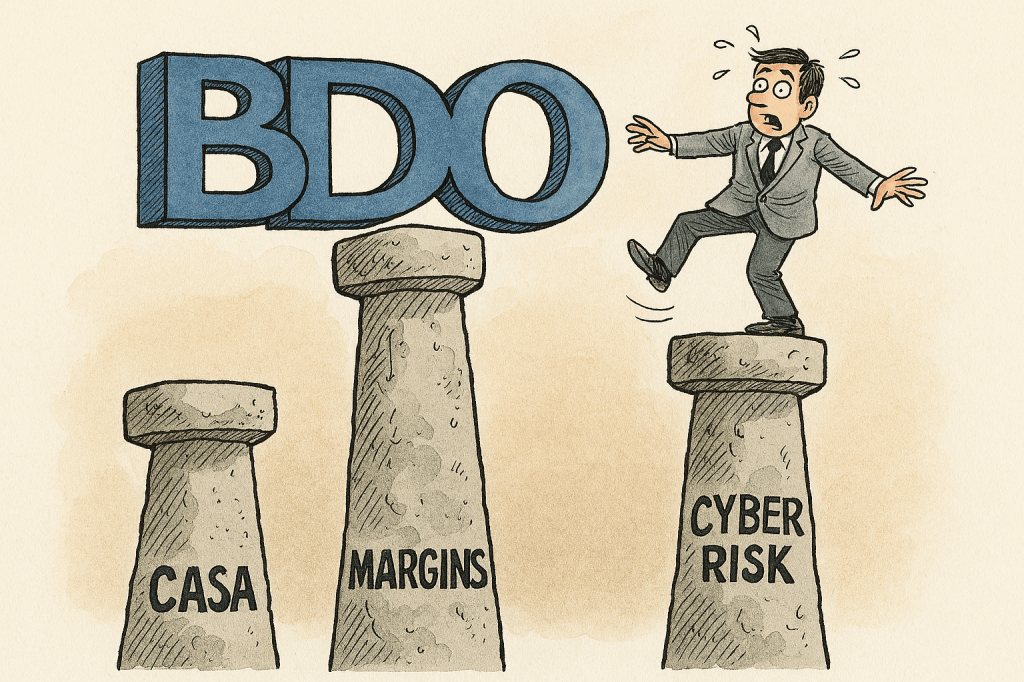
  • BDO’s Premium Under Pressure: Why Investors Should Watch CASA, Margins, and Cyber Risk

    BDO’s Premium Under Pressure: Why Investors Should Watch CASA, Margins, and Cyber Risk

    BDO Unibank has long been the crown jewel of Philippine banking—commanding scale, profitability, and a valuation premium that peers struggle to match. But its latest quarterly filing and sector trends suggest that the next chapter may be more challenging than the last.


    The Margin Squeeze Begins

    The first red flag is in the funding mix. Current and savings accounts (CASA)—the cheapest source of funds—slipped from about 71.5% at end-2024 to 66.6% by September 2025. Time deposits surged by nearly ₱300 billion. This isn’t just a footnote; it’s a structural shift that raises funding costs. Combine that with the Bangko Sentral ng Pilipinas’ rate-cut cycle—policy rate now at 4.75% and likely heading lower—and you have a classic margin squeeze: loan yields fall faster than deposit costs. For a bank with ₱5.27 trillion in assets, even a 10–20 basis point hit to net interest margin (NIM) can shave billions off earnings.


    Consumer Credit: A Quiet Risk

    BDO’s consumer book is growing, but so are its vulnerabilities. Credit card receivables past due beyond 90 days now hover around ₱20 billion—roughly 8% of the card portfolio. Restructured loans tell an even starker story: nearly 30% are overdue. These aren’t catastrophic numbers, but they hint at seasoning risk in unsecured lending, especially if economic growth cools. Sector analysts expect non-performing loans to inch up as banks chase retail growth. For BDO, that means higher provisions and a drag on profitability.


    Costs Are Climbing

    Operating expenses jumped 15% year-on-year, driven by branch expansion and technology upgrades. The bank plans to open 100–120 new branches, mostly in provincial areas—a strategic move to deepen reach. But until those branches deliver deposits and fee income, the cost-to-income ratio will feel the strain. Investors love growth stories, but they also watch operating leverage. Right now, that leverage is under pressure.


    Cybersecurity: The Intangible Risk

    A recent flap over unauthorized transactions reignited memories of past cyber incidents. BDO insists its systems are secure, blaming compromised client devices. Still, perception matters. In banking, trust is currency—and when trust wavers, valuation multiples can follow. The market doesn’t like uncertainty, especially in an era where digital channels dominate.


    Valuation: The Premium Isn’t Guaranteed

    BDO trades at a premium price-to-book ratio of around 1.3–1.4x, thanks to its scale and profitability. But if margins compress and costs bite, earnings growth could slow to single digits. That puts pressure on valuation multiples. A modest pullback—say 0.15x on P/B—could wipe out nearly ₱94 billion in market cap. Not a crash, but enough to make investors rethink lofty expectations.


    The Offsetting Strengths

    To be fair, BDO isn’t in trouble. Its capital buffers are strong (CET1 at 14.4%), provisioning is robust, and its franchise remains unmatched. Fee income is growing, and its bond market access gives it flexibility. But the message is clear: the premium isn’t automatic. CASA recovery, branch productivity, and credit discipline will decide whether BDO stays the market darling—or faces a valuation reset.


    What to Watch

    1. CASA ratio: Can BDO claw back to 70%?
    2. NIM trajectory: How deep will the margin squeeze go as BSP cuts rates?
    3. Consumer credit: Will card and restructured loan delinquencies stabilize?
    4. Cost-to-income: Can new branches pay for themselves quickly?
    5. Cyber risk: Will BDO restore confidence after recent headlines?

    Bottom line: BDO’s fundamentals remain strong, but the next 12 months will test its ability to defend its premium. For investors, this is no time for complacency. 

    Subscribe to Support Free & Independent Research

  • Manila Water Posts Strong 9-Month Earnings Growth; Defensive Like Maynilad but Dividend Yield Trails Rival

    Manila Water Posts Strong 9-Month Earnings Growth; Defensive Like Maynilad but Dividend Yield Trails Rival

    Manila Water Company, Inc. (MWC) reported a robust financial performance for the nine months ended September 30, 2025, driven by tariff adjustments and operational efficiencies across its concessions.

    Revenues climbed 9.1% year-on-year to ₱30.05 billion, supported by the third tranche of the approved Rate Rebasing tariff implemented in January. Despite a slight dip in billed volume in the East Zone, cost discipline helped sustain profitability.

    Net income attributable to the parent surged 25.4% to ₱12.67 billion, while EBITDA rose 14% to over ₱21 billion, improving the EBITDA margin to approximately 73%. Core net income, excluding one-off gains, grew 15% to ₱11.6 billion.

    The company also booked a ₱1.1 billion gain from the sale of its East Water investment in Thailand, boosting international contributions. Domestic operations outside Metro Manila delivered steady growth, with Visayas and Mindanao businesses benefiting from tariff adjustments and higher billed volumes.

    As of September 30, total assets stood at ₱241.67 billion, while stockholders’ equity increased to ₱85.94 billion. Manila Water invested nearly ₱18 billion in capital expenditures, with 85% allocated to East Zone infrastructure projects.

    Defensive Utility Play
    Analysts note that Manila Water shares characteristics with Maynilad, its West Zone counterpart, as both operate under regulated concessions with predictable cash flows and tariff-based revenue structures. This makes them attractive defensive plays for investors seeking stability in uncertain economic conditions.

    Dividend Yield Comparison
    Despite its strong fundamentals, Manila Water’s trailing dividend yield of about 4.8% (based on a 2025 dividend of ₱1.841 per share and a recent price of ₱38.70) lags Maynilad’s, which typically offers a higher payout ratio and yield in the 6–7% range. The gap reflects Manila Water’s more conservative dividend policy and its heavy capital expenditure commitments, with nearly ₱18 billion invested year-to-date, primarily in East Zone infrastructure.

    Outlook
    Management expects continued margin resilience into the fourth quarter, supported by regulated tariff structures and efficiency programs. Strategic expansion plans, including a potential acquisition in Mexico, could further diversify earnings.

    Subscribe to Support Free and Independent Research

  • Max’s Group Nine-Month Profit Down; Dividend Sustainability Under Scrutiny

    Max’s Group Nine-Month Profit Down; Dividend Sustainability Under Scrutiny

    Max’s Group, Inc. (PSE: MAXS), operator of iconic restaurant brands including Max’s Restaurant, Pancake House, and Yellow Cab, reported a 14% drop in net income to ₱160 million for the nine months ended September 30, 2025, compared to ₱186 million in the same period last year. The decline came as inflationary headwinds and higher financing costs weighed on profitability despite seasonal resilience and operational streamlining.

    Revenues slipped 2.8% year-on-year to ₱8.58 billion, while system-wide sales fell 3.8% to ₱13.2 billion. The group cited softer consumer sentiment and a smaller store footprint—566 outlets versus 626 a year ago—following its ongoing network rationalization strategy. Still, same-store sales growth reached 1.4%, supported by targeted value offerings and improved average daily sales, which rose 9.9%.

    Margins compressed as gross profit dropped 8.4% to ₱2.47 billion, with gross margin narrowing to 28.8% from 30.6% last year. EBITDA declined 9.1% to ₱983 million, while EBIT fell nearly 20% to ₱411 million. Finance costs edged up to ₱210 million, reflecting higher interest and lease expenses, further pressuring bottom-line results.

    On the expense side, general and administrative costs eased 1.4% to ₱2.0 billion, while selling and marketing expenses plunged 40% to ₱184 million due to tighter promotional spending. Other income also softened to ₱128 million from ₱150 million.

    The balance sheet showed total assets at ₱12.78 billion, down 5.2% from year-end 2024, with cash declining to ₱692 million from ₱1.06 billion. Debt-to-equity improved to 1.22x from 1.53x, signaling progress in deleveraging.

    Management reaffirmed its focus on margin resilience, cost discipline, and footprint optimization, while noting that Q4—traditionally a peak season—will be critical for recovery. “We continue to prioritize operational efficiency and brand relevance to navigate macro volatility,” the company said in its filing.

    Dividend Sustainability: Covered but Tight in Downside Scenarios

    Max’s paid ₱145.95 million in cash dividends in May 2025 (₱0.141/share), representing roughly 67% of nine-month earnings. While operating cash flow of ₱489 million covered the payout comfortably, free cash flow after capex was thin at ₱34 million, highlighting limited buffer for reinvestment.

    Forecast models suggest the current dividend is sustainable under base and bull recovery scenarios, with FY 2025 payout ratios ranging 54–68% and interest coverage near . However, in a bear case—where wage hikes and power costs persist—the payout could exceed 85% of earnings and push interest coverage toward 1.7×, leaving little room for shocks.

    For FY 2026, sustainability improves if inflation stays within BSP’s target and financing costs ease: payout ratios could fall to 30–51% in base/bull cases, with interest coverage rising above 2.3×. Conversely, under prolonged cost pressure, dividends may need to be cut or deferred to preserve liquidity and covenant compliance.

  • Figaro Culinary Group Faces Operational Strains Amid Expansion Drive

    Figaro Culinary Group Faces Operational Strains Amid Expansion Drive

    Figaro Culinary Group, Inc. (FCG), the operator behind Angel’s Pizza and Figaro Coffee, reported steady revenues for fiscal year ending June 30, 2025, but its latest audited financial statements reveal mounting operational challenges that could weigh on future performance.

    Margins Under Pressure
    Despite a 4.1% revenue increase to ₱5.67 billion, gross margins slipped to 44.7% from 45.9% a year earlier. Rising delivery commissions—up 28% to ₱375.2 million—and higher store overhead costs contributed to the squeeze. Advertising spend was cut by nearly 29%, helping operating margins, but analysts warn that prolonged marketing pullbacks could hurt brand momentum.

    Debt-Fueled Expansion Raises Financing Costs
    The company’s aggressive store rollout drove property and equipment assets up 54% to ₱3.89 billion. However, this expansion came at a cost: loans surged to ₱1.52 billion, pushing finance expenses to ₱105.2 million, more than double last year’s figure. Net income remained flat at ₱629.6 million, signaling that interest costs are eroding profitability gains.

    Cash Flow and Liquidity Concerns
    Operating cash flow fell 19% to ₱1.14 billion, while capital expenditures ballooned to ₱1.73 billion, resulting in negative free cash flow of roughly ₱743 million. The company relied on fresh borrowings to bridge the gap, raising questions about sustainability if expansion continues at the current pace.

    Franchise and Receivables Risks
    Royalty income plunged to ₱83.3 million from ₱162.6 million, and franchise deposits fell to zero, suggesting possible weakness in the franchising model. Trade receivables climbed 22% to ₱199.9 million, with ₱48.8 million overdue for more than 60 days, yet no impairment provision was recorded.

    Concentration and Lease Exposure
    Angel’s Pizza now accounts for over 70% of total sales, underscoring brand concentration risk. Meanwhile, prepaid rent soared to ₱47.7 million, and lease extensions remain non-binding, exposing the group to potential occupancy uncertainties.

    What’s Next?
    Industry observers suggest FCG must recalibrate its growth strategy, tighten credit controls, and renegotiate lease terms to safeguard liquidity. While its flagship pizza brand continues to dominate, diversification and operational discipline will be critical to sustaining long-term shareholder value.

    Subscribe to Support Independent Research

  • MERALCO’s Debt Surge Powers Strategic Growth, Not a Red Flag

    MERALCO’s Debt Surge Powers Strategic Growth, Not a Red Flag


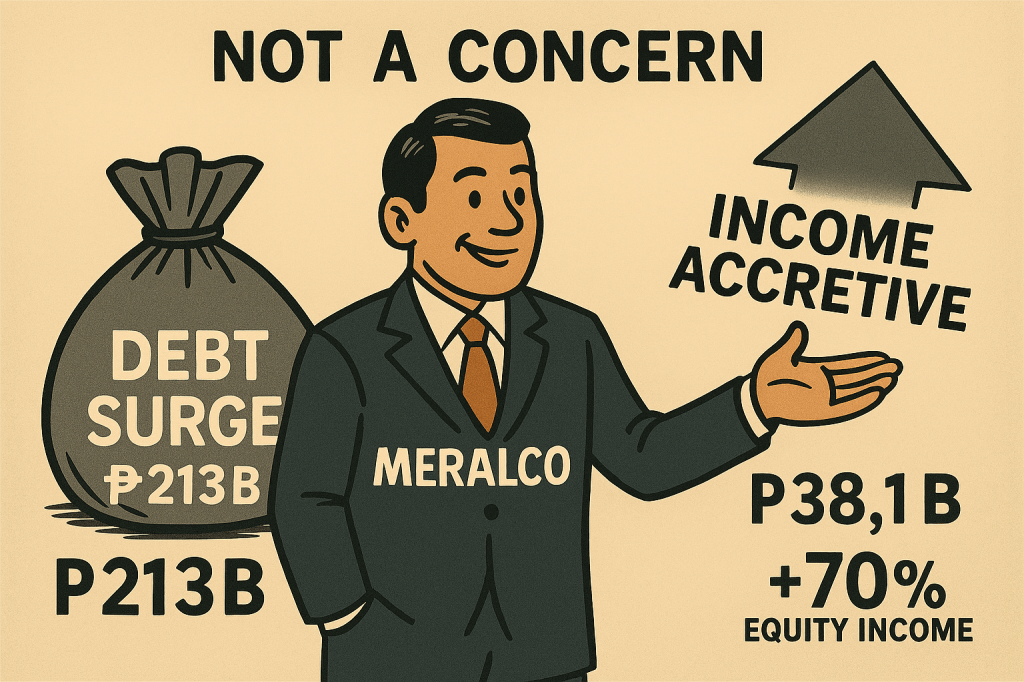
    Manila Electric Company (MERALCO) reported a sharp increase in its consolidated debt to ₱213.4 billion as of September 30, 2025, more than double its year-end 2024 level of ₱94.8 billion. While the spike raised eyebrows among market watchers, the company emphasized that the borrowing spree is part of a deliberate strategy to fund income-generating assets and future-proof its energy portfolio.

    The surge stems primarily from a ₱75-billion term loan drawn in January 2025 and additional project financing at subsidiaries, including ₱25.2 billion for MTerra Solar’s 3.5-GWp solar and battery storage project. MERALCO also deployed significant capital for its ₱85.4-billion investment in Chromite Holdings, a joint venture that acquired stakes in the Ilijan and EERI gas-fired plants and the Linseed LNG terminal.

    “These are not idle investments,” the company noted. “They are already contributing to earnings and strengthening our generation footprint.” Indeed, equity income from associates surged 70% to ₱13.1 billion, driven by the newly acquired gas assets, while consolidated net income rose 10% to ₱38.1 billion despite flat electricity volumes and regulatory refunds.

    MERALCO’s core EBITDA climbed 14% to ₱67.2 billion, underscoring the accretive nature of these projects. The LNG terminal and EERI units achieved commercial operation earlier this year, providing stable returns and enhancing supply security. Meanwhile, renewable projects under MTerra Solar are expected to start contributing from 2026 onward, aligning with the country’s clean energy transition.

    Although leverage ratios have increased — debt-to-equity now stands at 1.29x — management assured investors that the balance sheet remains healthy, with strong operating cash flows and compliance with all loan covenants. “This is strategic debt, not distress,” the company stressed. “We are investing in assets that deliver long-term value.”

    Analysts agree that the debt build-up is not a concern given MERALCO’s regulated distribution business, predictable cash flows, and growing generation portfolio. The company’s dividend policy remains intact, with ₱25.1 billion in cash dividends declared in 2025, signaling confidence in sustained earnings.

    Subscribe to Support Independent Research

  • Metro Retail Stores Group Posts Modest Gains Amid Margin Pressure and Cash Strain

    Metro Retail Stores Group Posts Modest Gains Amid Margin Pressure and Cash Strain


    Cebu City, Philippines — Metro Retail Stores Group Inc. (MRSGI) reported a slight improvement in profitability for the nine months ended September 30, 2025, as revenue growth was tempered by rising operating costs and a sharp drop in cash reserves.


    Sales and Revenue Performance

    Net sales climbed 4.1% year-on-year to ₱28.70 billion, driven by a 4.6% increase in food retail and 2.8% growth in general merchandise. Rental income surged 10.8% to ₱307.2 million, boosting total revenue to ₱29.0 billion, despite a 0.9% decline in same-store sales

    Margins and Expenses

    Gross margin held steady at 21.7%, but operating margin slipped to 1.63% from 1.81% last year as operating expenses jumped 8.7% to ₱6.06 billion. Higher utilities, personnel costs, and depreciation from new store openings weighed on profitability. Net income edged up 4.2% to ₱213.3 million, while finance costs rose slightly to ₱381.0 million.


    Liquidity and Cash Flow

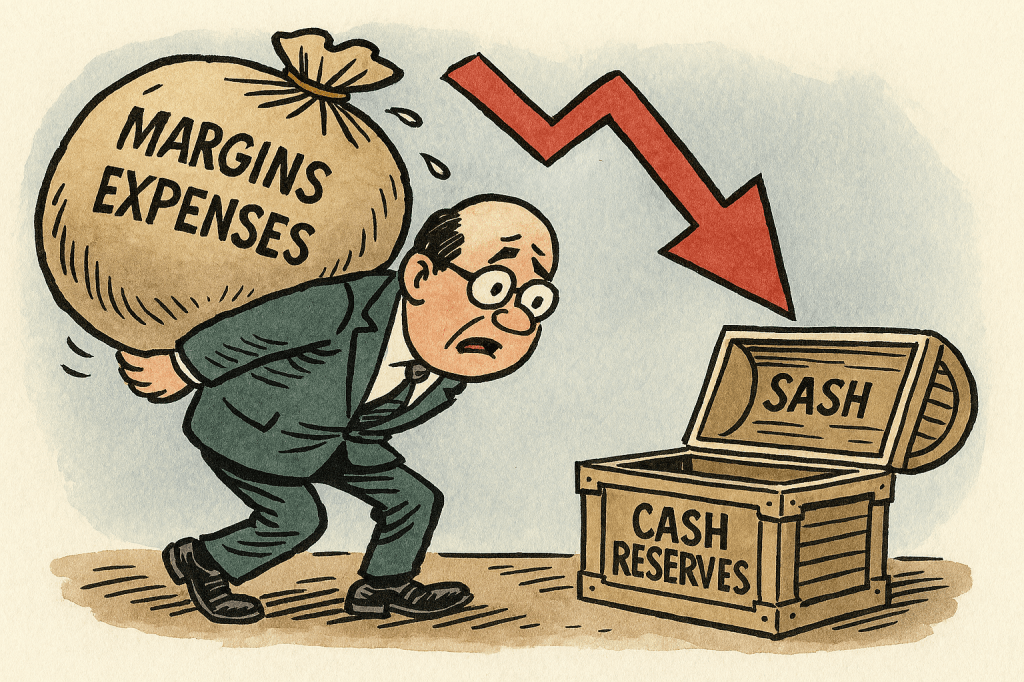
    Cash reserves fell 69% to ₱711.5 million, reflecting heavy capital spending of ₱1.21 billion, dividend payouts, and debt servicing. Although operating cash flow improved to ₱962.6 million, free cash flow remained negative. The current ratio stood at 1.47x, with the quick ratio at 0.35x, signaling tight liquidity. 


    Operational Metrics

    Inventory levels increased by ₱713.8 million, pushing days-in-inventory to 81 days, while payables averaged 66 days. The cash conversion cycle was approximately 25 days, underscoring working capital pressure ahead of the holiday season. 


    Debt and Lease Obligations

    Outstanding loans totaled ₱2.31 billion, down from ₱2.66 billion at year-end, while lease liabilities remained significant at ₱5.25 billion, despite recent space reductions that generated a ₱119.9 million gain.


    Valuation and Dividend Yield

    Metro Retail Stores Group trades at ₱1.14 per share on the Philippine Stock Exchange, giving it a market capitalization of about ₱3.7 billion. The stock’s price-to-earnings ratio (P/E) stands at 5.7x, well below sector averages, suggesting the market is pricing in modest growth and operational risks. The price-to-book ratio is approximately 0.39x, reinforcing its undervalued status relative to its assets. 

    For income investors, MRSGI offers an annual cash dividend of ₱0.06 per share, translating to a dividend yield of roughly 5.2% at current prices. The payout ratio is about 31%, leaving room for reinvestment while maintaining shareholder returns. The last ex-dividend date was April 23, 2025, with payment made in May. 


    Outlook

    Management faces the dual challenge of sustaining growth while curbing cost inflation and preserving liquidity. Analysts point to the need for tighter inventory control, cost optimization, and selective expansion to protect margins and cash flow. 

    Subscribe to Support Independent Research

  • SSI Group’s Nine-Month Profit Plunges 49% Amid Rising Operating Costs

    SSI Group’s Nine-Month Profit Plunges 49% Amid Rising Operating Costs

    SSI Group, Inc. reported a sharp decline in profitability for the nine months ended September 30, 2025, as operating expenses surged despite flat revenue growth.

    The specialty retailer posted ₱639.8 million in net income, down 49.3% from ₱1.26 billion in the same period last year. Third-quarter earnings fell even steeper, dropping 65% to ₱188.1 million.

    Sales remained largely unchanged, inching up 0.7% to ₱20.32 billion, while gross profit improved slightly to ₱9.08 billion, with margins rising to 44.7% from 44.2%. However, operating income plunged 44.9% to ₱914 million as expenses ballooned.

    “The increase in costs was driven by store network expansion and technology investments,” SSI said in its quarterly filing.

    Operating expenses climbed 12.4% to ₱8.18 billion, fueled by higher rent, depreciation, and personnel costs linked to a 13.6% increase in selling space and the rollout of SAP and ETP enterprise systems. Selling and distribution costs rose to ₱6.58 billion, while general and administrative expenses jumped 17.4% to ₁.60 billion.

    The company opened 17 new stores during the quarter, bringing its total to 613 outlets nationwide, and expanded its brand portfolio to 103 names. E-commerce contributed ₱1.57 billion, or 7.7% of total sales.

    SSI ended the period with ₱2.78 billion in cash, down from ₱5.14 billion at year-end 2024, after spending ₱1.20 billion on capital expenditures, paying ₱503.6 million in dividends, and repurchasing shares worth ₱50.4 million.

    Despite the earnings slump, SSI maintained a net cash position of ₱1.39 billion and a current ratio of 2.11, signaling adequate liquidity ahead of the holiday season, traditionally its strongest quarter.


    Outlook / Investor Takeaway

    • Holiday Quarter Critical: SSI’s inventory build to ₱13.15 billion positions it for peak season sales, but execution risk is high. Strong sell-through and markdown discipline will be key to converting stock into cash.
    • Margin Recovery Hinges on Cost Control: ERP transition costs and store expansion drove operating margin down to 4.5%. Normalization of G&A and leveraging new stores will determine if margins rebound in Q4.
    • Liquidity Cushion Intact: Net cash and low leverage (Debt/Equity at 0.08) provide breathing room, but free cash flow needs improvement after negative operating cash flow in 9M25.
    • Watch Luxury Segment: Luxury and Bridge sales fell 3.8%, signaling discretionary weakness. Performance in this category during the holidays will be a bellwether for 2026.
    • Valuation Implication: With EPS at ₱0.19 (vs ₱0.38 last year), investors may reassess growth expectations. Near-term upside depends on holiday performance and cost discipline.